@font-face {
font-family: ‘Guardian Headline Full’;
src: url(‘https://assets.guim.co.uk/static/frontend/fonts/guardian-headline/full-not-hinted/GHGuardianHeadline-Light.woff2’) format(‘woff2’),
url(‘https://assets.guim.co.uk/static/frontend/fonts/guardian-headline/full-not-hinted/GHGuardianHeadline-Light.woff’) format(‘woff’),
url(‘https://assets.guim.co.uk/static/frontend/fonts/guardian-headline/full-not-hinted/GHGuardianHeadline-Light.ttf’) format(‘truetype’);
font-weight: 300;
font-style: normal;
}
@font-face {
font-family: ‘Guardian Headline Full’;
src: url(‘https://assets.guim.co.uk/static/frontend/fonts/guardian-headline/full-not-hinted/GHGuardianHeadline-LightItalic.woff2’) format(‘woff2’),
url(‘https://assets.guim.co.uk/static/frontend/fonts/guardian-headline/full-not-hinted/GHGuardianHeadline-LightItalic.woff’) format(‘woff’),
url(‘https://assets.guim.co.uk/static/frontend/fonts/guardian-headline/full-not-hinted/GHGuardianHeadline-LightItalic.ttf’) format(‘truetype’);
font-weight: 300;
font-style: italic;
}
@font-face {
font-family: ‘Guardian Headline Full’;
src: url(‘https://assets.guim.co.uk/static/frontend/fonts/guardian-headline/full-not-hinted/GHGuardianHeadline-Regular.woff2’) format(‘woff2’),
url(‘https://assets.guim.co.uk/static/frontend/fonts/guardian-headline/full-not-hinted/GHGuardianHeadline-Regular.woff’) format(‘woff’),
url(‘https://assets.guim.co.uk/static/frontend/fonts/guardian-headline/full-not-hinted/GHGuardianHeadline-Regular.ttf’) format(‘truetype’);
font-weight: 400;
font-style: normal;
}
@font-face {
font-family: ‘Guardian Headline Full’;
src: url(‘https://assets.guim.co.uk/static/frontend/fonts/guardian-headline/full-not-hinted/GHGuardianHeadline-RegularItalic.woff2’) format(‘woff2’),
url(‘https://assets.guim.co.uk/static/frontend/fonts/guardian-headline/full-not-hinted/GHGuardianHeadline-RegularItalic.woff’) format(‘woff’),
url(‘https://assets.guim.co.uk/static/frontend/fonts/guardian-headline/full-not-hinted/GHGuardianHeadline-RegularItalic.ttf’) format(‘truetype’);
font-weight: 400;
font-style: italic;
}
@font-face {
font-family: ‘Guardian Headline Full’;
src: url(‘https://assets.guim.co.uk/static/frontend/fonts/guardian-headline/full-not-hinted/GHGuardianHeadline-Medium.woff2’) format(‘woff2’),
url(‘https://assets.guim.co.uk/static/frontend/fonts/guardian-headline/full-not-hinted/GHGuardianHeadline-Medium.woff’) format(‘woff’),
url(‘https://assets.guim.co.uk/static/frontend/fonts/guardian-headline/full-not-hinted/GHGuardianHeadline-Medium.ttf’) format(‘truetype’);
font-weight: 500;
font-style: normal;
}
@font-face {
font-family: ‘Guardian Headline Full’;
src: url(‘https://assets.guim.co.uk/static/frontend/fonts/guardian-headline/full-not-hinted/GHGuardianHeadline-MediumItalic.woff2’) format(‘woff2’),
url(‘https://assets.guim.co.uk/static/frontend/fonts/guardian-headline/full-not-hinted/GHGuardianHeadline-MediumItalic.woff’) format(‘woff’),
url(‘https://assets.guim.co.uk/static/frontend/fonts/guardian-headline/full-not-hinted/GHGuardianHeadline-MediumItalic.ttf’) format(‘truetype’);
font-weight: 500;
font-style: italic;
}
@font-face {
font-family: ‘Guardian Headline Full’;
src: url(‘https://assets.guim.co.uk/static/frontend/fonts/guardian-headline/full-not-hinted/GHGuardianHeadline-Semibold.woff2’) format(‘woff2’),
url(‘https://assets.guim.co.uk/static/frontend/fonts/guardian-headline/full-not-hinted/GHGuardianHeadline-Semibold.woff’) format(‘woff’),
url(‘https://assets.guim.co.uk/static/frontend/fonts/guardian-headline/full-not-hinted/GHGuardianHeadline-Semibold.ttf’) format(‘truetype’);
font-weight: 600;
font-style: normal;
}
@font-face {
font-family: ‘Guardian Headline Full’;
src: url(‘https://assets.guim.co.uk/static/frontend/fonts/guardian-headline/full-not-hinted/GHGuardianHeadline-SemiboldItalic.woff2’) format(‘woff2’),
url(‘https://assets.guim.co.uk/static/frontend/fonts/guardian-headline/full-not-hinted/GHGuardianHeadline-SemiboldItalic.woff’) format(‘woff’),
url(‘https://assets.guim.co.uk/static/frontend/fonts/guardian-headline/full-not-hinted/GHGuardianHeadline-SemiboldItalic.ttf’) format(‘truetype’);
font-weight: 600;
font-style: italic;
}Here’s the rewritten text in fluent, natural English:
“`css
@font-face {
font-family: ‘Guardian Headline Full’;
src: url(‘https://assets.guim.co.uk/static/frontend/fonts/guardian-headline/full-not-hinted/GHGuardianHeadline-Bold.woff2’) format(‘woff2’),
url(‘https://assets.guim.co.uk/static/frontend/fonts/guardian-headline/full-not-hinted/GHGuardianHeadline-Bold.woff’) format(‘woff’),
url(‘https://assets.guim.co.uk/static/frontend/fonts/guardian-headline/full-not-hinted/GHGuardianHeadline-Bold.ttf’) format(‘truetype’);
font-weight: 700;
font-style: normal;
}
@font-face {
font-family: ‘Guardian Headline Full’;
src: url(‘https://assets.guim.co.uk/static/frontend/fonts/guardian-headline/full-not-hinted/GHGuardianHeadline-BoldItalic.woff2’) format(‘woff2’),
url(‘https://assets.guim.co.uk/static/frontend/fonts/guardian-headline/full-not-hinted/GHGuardianHeadline-BoldItalic.woff’) format(‘woff’),
url(‘https://assets.guim.co.uk/static/frontend/fonts/guardian-headline/full-not-hinted/GHGuardianHeadline-BoldItalic.ttf’) format(‘truetype’);
font-weight: 700;
font-style: italic;
}
@font-face {
font-family: ‘Guardian Headline Full’;
src: url(‘https://assets.guim.co.uk/static/frontend/fonts/guardian-headline/full-not-hinted/GHGuardianHeadline-Black.woff2’) format(‘woff2’),
url(‘https://assets.guim.co.uk/static/frontend/fonts/guardian-headline/full-not-hinted/GHGuardianHeadline-Black.woff’) format(‘woff’),
url(‘https://assets.guim.co.uk/static/frontend/fonts/guardian-headline/full-not-hinted/GHGuardianHeadline-Black.ttf’) format(‘truetype’);
font-weight: 900;
font-style: normal;
}
@font-face {
font-family: ‘Guardian Headline Full’;
src: url(‘https://assets.guim.co.uk/static/frontend/fonts/guardian-headline/full-not-hinted/GHGuardianHeadline-BlackItalic.woff2’) format(‘woff2’),
url(‘https://assets.guim.co.uk/static/frontend/fonts/guardian-headline/full-not-hinted/GHGuardianHeadline-BlackItalic.woff’) format(‘woff’),
url(‘https://assets.guim.co.uk/static/frontend/fonts/guardian-headline/full-not-hinted/GHGuardianHeadline-BlackItalic.ttf’) format(‘truetype’);
font-weight: 900;
font-style: italic;
}
@font-face {
font-family: ‘Guardian Titlepiece’;
src: url(‘https://interactive.guim.co.uk/fonts/garnett/GTGuardianTitlepiece-Bold.woff2’) format(‘woff2’),
url(‘https://interactive.guim.co.uk/fonts/garnett/GTGuardianTitlepiece-Bold.woff’) format(‘woff’),
url(‘https://interactive.guim.co.uk/fonts/garnett/GTGuardianTitlepiece-Bold.ttf’) format(‘truetype’);
font-weight: 700;
font-style: normal;
}
@media (min-width: 71.25em) {
.content__main-column–interactive {
margin-left: 160px;
}
}
@media (min-width: 81.25em) {
.content__main-column–interactive {
margin-left: 240px;
}
}
.content__main-column–interactive .element-atom {
max-width: 620px;
}
@media (max-width: 46.24em) {
.content__main-column–interactive .element-atom {
max-width: 100%;
}
}
.content__main-column–interactive .element-showcase {
margin-left: 0;
}
@media (min-width: 46.25em) {
.content__main-column–interactive .element-showcase {
max-width: 620px;
}
}
@media (min-width: 71.25em) {
.content__main-column–interactive .element-showcase {
max-width: 860px;
}
}
.content__main-column–interactive .element-immersive {
max-width: 1100px;
}
@media (max-width: 46.24em) {
.content__main-column–interactive .element-immersive {
width: calc(100vw – var(–scrollbar-width, 0px));
position: relative;
left: 50%;
right: 50%;
margin-left: calc(-50vw + var(–half-scrollbar-width, 0px)) !important;
margin-right: calc(-50vw + var(–half-scrollbar-width, 0px)) !important;
}
}
@media (min-width: 46.25em) {
.content__main-column–interactive .element-immersive {
transform: translate(-20px);
width: calc(100% + 60px);
}
}
@media (max-width: 71.24em) {
.content__main-column–interactive .element-immersive {
margin-left: 0;
margin-right: 0;
}
}
@media (min-width: 71.25em) {
.content__main-column–interactive .element-immersive {
transform: translate(0);
width: auto;
}
}
@media (min-width: 81.25em) {
.content__main-column–interactive .element-immersive {
max-width: 1260px;
}
}
.content__main-column–interactive p,
.content__main-column–interactive ul {
max-width: 620px;
}
.content__main-column–interactive::before {
position: absolute;
top: 0;
height: calc(100% + 15px);
min-height: 100px;
content: ”;
}
@media (min-width: 71.25em) {
.content__main-column–interactive::before {
border-left: 1px solid #dcdcdc;
z-index: -1;
left: -10px;
}
}
@media (min-width: 81.25em) {
.content__main-column–interactive::before {
border-left: 1px solid #dcdcdc;
left: -10px;
}
}
“`The CSS code provided appears to be a set of styling rules for a web page, likely from a news or media site like The Guardian. It defines how different elements, such as videos, images, and text blocks, should be displayed on the page. The rules adjust spacing, alignment, and colors based on screen size and user preferences (like dark mode). For example, it sets maximum widths for inline elements, controls how video loops appear, and changes text colors in dark mode. The code also includes special handling for immersive video elements and block quotes. Overall, it ensures the page looks good and works well on different devices and settings.Here is the rewritten text in fluent, natural English:
For the first paragraph after certain elements like `.sign-in-gate`, `.element-atom`, or `hr` (excluding the last horizontal rule), the first letter is styled with the font `Guardian Headline`, `Guardian Egyptian Web`, `Guardian Headline Full`, or `Georgia, serif`. It is bold, 111px in size, with a line height of 92px. It floats to the left, is uppercase, and has a right margin of 8px. It is vertically aligned to the top, and its color comes from the `–drop-cap` variable, or falls back to `–new-pillar-colour`.
Paragraphs that follow an `hr` element inside `#article-body > div`, `.content–interactive > div`, `#comment-body`, `[data-gu-name=body]`, or `#feature-body` have no top padding.
Pullquotes inside `#article-body > div`, `.content–interactive > div`, `#comment-body`, `[data-gu-name=body]`, or `#feature-body` have a maximum width of 620px.
For showcase figures inside `#maincontent`, `#feature-article-container`, `#standard-article-container`, or `#comment-article-container`, the caption is positioned statically by default, with a width of 100% and a max width of 620px. On screens wider than 71.25em, the caption is positioned absolutely, with a max width of 140px. On screens wider than 81.25em, the max width increases to 220px.
Immersive elements take up the full viewport width, minus the scrollbar width. On screens narrower than 71.24em, their max width is 978px, and the caption has 10px of padding on each side. On screens between 30em and 71.24em, the caption padding increases to 20px. On screens between 46.25em and 61.24em, the max width is 738px. On screens narrower than 46.24em, the immersive element has a left margin of -10px (or -20px on screens wider than 30em), no right margin, and is positioned at left: 0.Here’s the rewritten version in fluent, natural English:
For immersive elements with captions, add 20px of padding on each side. On screens wider than 71.25em, showcase images in the main content column should have a left margin of -160px. On screens wider than 81.25em, that margin increases to -240px.
The furniture wrapper is positioned relatively. On screens wider than 61.25em, it becomes a grid with 20px column gaps and no row gaps. The grid has 10 columns: the first five for title, headline, meta, and standfirst, and the last five for portrait. The rows are set up so the title takes up 0.25fr, the headline 1fr, the standfirst 0.75fr, and the meta auto-fills, all aligned with the portrait.
In this layout, the first child of the headline section gets a 1px top border using the header border color. The meta section has 2px top padding and no right margin. The standfirst content has a 4px bottom margin, and its list items are 20px font size. Links in the standfirst have no bottom border or background image, but are underlined with a 6px offset and a light gray color. On hover, the underline color changes to the pillar color. The first paragraph in the standfirst has a top border and no bottom padding.
On screens wider than 71.25em, the first paragraph in the standfirst loses its top border. The furniture wrapper figure elements have a left margin of -10px and no bottom margin. Inline figures are limited to 630px max width.
At 71.25em and above, the grid changes to 14 columns: two for title, headline, and meta start, then five for standfirst, and seven for portrait. The rows adjust so the title is 80px tall, the headline auto-fits, and the standfirst and meta share the remaining space. The meta section gets a 540px wide, 1px high top border using the header border color. The standfirst paragraphs have no top border, but a 1px wide vertical line appears on the left side, spanning the full height.
At 81.25em and above, the grid uses 15 columns: three for title, headline, and meta start, then five for standfirst, and the rest for portrait.The layout uses a grid with columns defined as: `eadline-end standfirst-end portrait-start] repeat(8,1fr) [portrait-end]`. The rows are set as: `[title-start portrait-start] .25fr [title-end headline-start] 1fr [headline-end standfirst-start meta-start] .75fr [standfirst-end meta-end portrait-end]`.
In the `.furniture-wrapper`, the `#meta` element and `[data-gu-name=meta]` have a `::before` pseudo-element that is 620px wide. The `.standfirst`, `#standfirst`, and `[data-gu-name=standfirst]` have a `::before` pseudo-element positioned at `left: -0.5px`.
For the article header, the `.content__labels > div` inside `.furniture-wrapper .article-header` and `[data-gu-name=title]` has `padding-top: 2px`.
The headline (`#headline h1`, `[data-gu-name=headline] h1`, `.headline h1`) has a font weight of 600, a max width of 620px, and a font size of 32px. On screens wider than 71.25em, the max width becomes 540px and the font size increases to 50px.
On screens wider than 46.25em, the `.keyline-4` and `[data-gu-name=lines]` have no right margin. On screens wider than 61.25em, they are hidden. The SVG inside these elements uses `stroke: var(–headerBorder)`.
On screens wider than 46.25em, `#meta` and `[data-gu-name=meta]` have no right margin. The social and comment elements inside `#meta` and `[data-gu-name=meta]` use `border-color: var(–headerBorder)`. The `gu-island` inside `.content__meta-container_dcr > div` is hidden.
The `.standfirst`, `#standfirst`, and `[data-gu-name=standfirst]` have a left margin of -10px, left padding of 10px, and are positioned relatively. On screens wider than 46.25em, they have `padding-top: 2px`. Paragraphs inside them have a font weight of 400, font size of 20px, and bottom padding of 14px.
The main media (`#main-media`, `[data-gu-name=media]`) is positioned relatively, has no top margin, a bottom margin of 2px, and is placed in the `portrait` grid area. Its child divs are full width with no inline margin. On screens wider than 61.25em, the bottom margin is removed. On screens narrower than 46.24em, the width is `calc(100vw – var(–scrollbar-width, 0px))` with a left margin of -10px. On screens between 30em and 46.24em, the left margin becomes -20px.
The `figcaption` is positioned at the bottom, with padding of 4px 10px 12px, a background color of `var(–captionBackground)`, text color of `var(–captionText)`, full width, no max width, no bottom margin, and a minimum height of 46px. The `span` inside uses `color: var(–headerBorder)`, and its SVG uses `fill: var(–headerBorder)`. The first `span` is hidden, and the second is displayed with a max width of 90%. On screens wider than 30em, the padding becomes 4px 20px 12px. When the `figcaption` has the class `hidden`, its opacity is 0.
The `#caption-button` is displayed as a block, positioned at the bottom 10px and right 8px, with a z-index of 30, a background color of `var(–captionBackground)`, no border, a border radius of 50%, and padding of 6px 5px 5px. Its SVG is scaled to 0.85. On screens wider than 30em, the right position becomes 10px.
On screens wider than 71.25em, the `::before` pseudo-element of `.content__main-column–interactive` has a top of -12px and a height of `calc(100% + 24px)`. The class `.content__main-column–i` is also referenced.Here’s the rewritten version in fluent, natural English:
Interactive h2 { max-width: 620px; }
:root {
–new-pillar-colour: var(–darkmode-pillar, var(–darkModeFeature)) !important;
–headerBorderColor: #606060;
–darkModeFeature: #ff5943;
}
nav + section,
nav + aside,
aside + section {
display: none;
}
.furniture-wrapper {
background-color: var(–darkBackground);
margin: 0 -10px;
padding: 0 10px 4px;
}
@media (min-width: 30em) {
.furniture-wrapper {
margin: 0 -20px;
padding: 0 20px 8px;
}
}
@media (min-width: 61.25em) {
.furniture-wrapper {
padding: 0 20px;
}
}
@media (min-width: 81.25em) {
.furniture-wrapper::before {
content: “”;
width: calc((100vw – 1298px) / 2);
height: 100%;
position: absolute;
left: calc((100vw – 1298px) / -2);
background-color: var(–darkBackground);
border-right: 1px solid var(–headerBorderColor);
}
.furniture-wrapper::after {
content: “”;
width: calc((100vw – 1298px) / 2);
height: 100%;
position: absolute;
right: calc((100vw – 1298px) / -2);
background-color: var(–darkBackground);
}
}
.furniture-wrapper .article-header,
.furniture-wrapper [data-gu-name=”title”] a,
.furniture-wrapper [data-gu-name=”title”] span {
color: var(–new-pillar-colour, var(–darkModeFeature));
}
@media (min-width: 61.25em) {
.furniture-wrapper #headline > div:first-child,
.furniture-wrapper [data-gu-name=”headline”] > div:first-child,
.furniture-wrapper .headline > div:first-child {
border-top: 1px solid var(–headerBorderColor);
}
}
.furniture-wrapper #headline h1,
.furniture-wrapper [data-gu-name=”headline”] h1,
.furniture-wrapper .headline h1 {
font-weight: 700;
color: #dcdcdc;
}
.furniture-wrapper #headline figure,
.furniture-wrapper [data-gu-name=”headline”] figure,
.furniture-wrapper .headline figure {
margin-top: 0;
margin-bottom: 2px;
}
@media (min-width: 71.25em) {
.furniture-wrapper #meta::before,
.furniture-wrapper [data-gu-name=”meta”]::before {
background-color: var(–headerBorderColor);
}
}
.furniture-wrapper #meta details,
.furniture-wrapper #meta summary,
.furniture-wrapper #meta summary span,
.furniture-wrapper [data-gu-name=”meta”] details,
.furniture-wrapper [data-gu-name=”meta”] summary,
.furniture-wrapper [data-gu-name=”meta”] summary span {
color: #dcdcdc;
}
.furniture-wrapper #meta .meta__social a,
.furniture-wrapper #meta .meta__social button,
.furniture-wrapper [data-gu-name=”meta”] .meta__social a,
.furniture-wrapper [data-gu-name=”meta”] .meta__social button {
border-color: var(–headerBorderColor);
color: var(–new-pillar-colour, var(–darkModeFeature));
}
.furniture-wrapper #meta .meta__social a svg,
.furniture-wrapper #meta .meta__social button svg,
.furniture-wrapper [data-gu-name=”meta”] .meta__social a svg,
.furniture-wrapper [data-gu-name=”meta”] .meta__social button svg {
fill: var(–new-pillar-colour, var(–darkModeFeature));
}
.furniture-wrapper #meta .meta__social a:hover,
.furniture-wrapper #meta .meta__social button:hover,
.furniture-wrapper [data-gu-name=”meta”] .meta__social a:hover,
.furniture-wrapper [data-gu-name=”meta”] .meta__social button:hover {
color: var(–darkBackground);
background-color: var(–new-pillar-colour, var(–darkModeFeature));
}
.furniture-wrapper #meta .meta__social a:hover svg,
.furniture-wrapper #meta .meta__social button:hover svg,
.furniture-wrapper [data-gu-name=”meta”] .meta__social a:hover svg,
.furniture-wrapper [data-gu-name=”meta”] .meta__social button:hover svg {
fill: var(–darkBackground);
}
.furniture-wrapper #meta div,
.furniture-wrapper [data-gu-name=”meta”] div {
color: #dcdcdc;
}
.furniture-wrapper #meta a,
.furniture-wrapper [data-gu-name=”meta”] a {
color: var(–new-pillar-colour, var(–darkModeFeature));
}
.furniture-wrapper #meta a:hover,
.furniture-wrapper [data-gu-name=”meta”] a:hover {
color: var(–new-pillar-colour, var(–darkModeFeature));
text-decoration-color: var(–new-pillar-colour, var(–darkModeFeature));
}
.furniture-wrapper .standfirst a,
.furniture-wrapper .standfirst li a,
.furniture-wrapper #standfirst a,
.furniture-wrapper #standfirst li a,
.furniture-wrapper [data-gu-name=”standfirst”] a,
.furniture-wrapper [data-gu-name=”standfirst”] li a {
border-bottom: none;
color: var(–new-pillar-colour, var(–darkModeFeature));
background-image: none !important;
text-decoration: underline;
text-underline-offset: 6px;
text-decoration-color: var(–headerBorder, #dcdcdc);
}
.furniture-wrapper .standfirst a:hover,
.furniture-wrapper .standfirst li a:hover,
.furniture-wrapper #standfirst a:hover {
/ hover styles go here if needed /
}Here’s the rewritten text in fluent, natural English:
When you hover over links in the standfirst section of the furniture wrapper, the bottom border disappears and the underline color changes to match the pillar color. The standfirst paragraphs are light gray (#dcdcdc).
On screens wider than 61.25em, the first paragraph in the standfirst gets a top border using the header border color. On screens wider than 71.25em, that top border is removed.
List items in the standfirst are also light gray (#dcdcdc). On screens wider than 71.25em, a line appears before the standfirst, using the header border color.
On screens wider than 46.25em, the furniture wrapper adds two background strips on the left and right sides. These strips use the dark background color and are separated from the main content by a border. The width of these strips adjusts based on the screen size:
– At 46.25em, the total content width is 738px.
– At 61.25em, it increases to 978px.
– At 71.25em, it becomes 1138px.
– At 81.25em, it reaches 1298px.
The keyline-4 and lines elements use the header border color for their strokes. In the meta section, social media icons, comment areas, and their borders also use the header border color.
In article body text, h2 headings have a font weight of 200. If an h2 contains strong text, the weight changes to 700.
For elements with `data-print-layout=”hide”`, unordered lists have no background image.
Finally, a custom font called “Guardian Headline Full” is loaded in three formats (woff2, woff, and ttf) with a light weight (300) and normal style.@font-face {
font-family: ‘Guardian Headline Full’;
src: url(‘https://assets.guim.co.uk/static/frontend/fonts/guardian-headline/full-not-hinted/GHGuardianHeadline-LightItalic.woff2’) format(‘woff2’),
url(‘https://assets.guim.co.uk/static/frontend/fonts/guardian-headline/full-not-hinted/GHGuardianHeadline-LightItalic.woff’) format(‘woff’),
url(‘https://assets.guim.co.uk/static/frontend/fonts/guardian-headline/full-not-hinted/GHGuardianHeadline-LightItalic.ttf’) format(‘truetype’);
font-weight: 300;
font-style: italic;
}
@font-face {
font-family: ‘Guardian Headline Full’;
src: url(‘https://assets.guim.co.uk/static/frontend/fonts/guardian-headline/full-not-hinted/GHGuardianHeadline-Regular.woff2’) format(‘woff2’),
url(‘https://assets.guim.co.uk/static/frontend/fonts/guardian-headline/full-not-hinted/GHGuardianHeadline-Regular.woff’) format(‘woff’),
url(‘https://assets.guim.co.uk/static/frontend/fonts/guardian-headline/full-not-hinted/GHGuardianHeadline-Regular.ttf’) format(‘truetype’);
font-weight: 400;
font-style: normal;
}
@font-face {
font-family: ‘Guardian Headline Full’;
src: url(‘https://assets.guim.co.uk/static/frontend/fonts/guardian-headline/full-not-hinted/GHGuardianHeadline-RegularItalic.woff2’) format(‘woff2’),
url(‘https://assets.guim.co.uk/static/frontend/fonts/guardian-headline/full-not-hinted/GHGuardianHeadline-RegularItalic.woff’) format(‘woff’),
url(‘https://assets.guim.co.uk/static/frontend/fonts/guardian-headline/full-not-hinted/GHGuardianHeadline-RegularItalic.ttf’) format(‘truetype’);
font-weight: 400;
font-style: italic;
}
@font-face {
font-family: ‘Guardian Headline Full’;
src: url(‘https://assets.guim.co.uk/static/frontend/fonts/guardian-headline/full-not-hinted/GHGuardianHeadline-Medium.woff2’) format(‘woff2’),
url(‘https://assets.guim.co.uk/static/frontend/fonts/guardian-headline/full-not-hinted/GHGuardianHeadline-Medium.woff’) format(‘woff’),
url(‘https://assets.guim.co.uk/static/frontend/fonts/guardian-headline/full-not-hinted/GHGuardianHeadline-Medium.ttf’) format(‘truetype’);
font-weight: 500;
font-style: normal;
}
@font-face {
font-family: ‘Guardian Headline Full’;
src: url(‘https://assets.guim.co.uk/static/frontend/fonts/guardian-headline/full-not-hinted/GHGuardianHeadline-MediumItalic.woff2’) format(‘woff2’),
url(‘https://assets.guim.co.uk/static/frontend/fonts/guardian-headline/full-not-hinted/GHGuardianHeadline-MediumItalic.woff’) format(‘woff’),
url(‘https://assets.guim.co.uk/static/frontend/fonts/guardian-headline/full-not-hinted/GHGuardianHeadline-MediumItalic.ttf’) format(‘truetype’);
font-weight: 500;
font-style: italic;
}
@font-face {
font-family: ‘Guardian Headline Full’;
src: url(‘https://assets.guim.co.uk/static/frontend/fonts/guardian-headline/full-not-hinted/GHGuardianHeadline-Semibold.woff2’) format(‘woff2’),
url(‘https://assets.guim.co.uk/static/frontend/fonts/guardian-headline/full-not-hinted/GHGuardianHeadline-Semibold.woff’) format(‘woff’),
url(‘https://assets.guim.co.uk/static/frontend/fonts/guardian-headline/full-not-hinted/GHGuardianHeadline-Semibold.ttf’) format(‘truetype’);
font-weight: 600;
font-style: normal;
}
@font-face {
font-family: ‘Guardian Headline Full’;
src: url(‘https://assets.guim.co.uk/static/frontend/fonts/guardian-headline/full-not-hinted/GHGuardianHeadline-SemiboldItalic.woff2’) format(‘woff2’),
url(‘https://assets.guim.co.uk/static/frontend/fonts/guardian-headline/full-not-hinted/GHGuardianHeadline-SemiboldItalic.woff’) format(‘woff’),
url(‘https://assets.guim.co.uk/static/frontend/fonts/guardian-headline/full-not-hinted/GHGuardianHeadline-SemiboldItalic.ttf’) format(‘truetype’);
font-weight: 600;
font-style: italic;
}
@font-face {
font-family: ‘Guardian Headline Full’;
src: url(‘https://assets.guim.co.uk/static/frontend/fonts/guardian-headline/full-not-hinted/GHGuardianHeadline-Bold.woff2’) format(‘woff2’),
url(‘https://assets.guim.co.uk/static/frontend/fonts/guardian-headline/full-not-hinted/GHGuardianHeadline-Bold.woff’) format(‘woff’),
url(‘https://assets.guim.co.uk/static/frontend/fonts/guardian-headline/full-not-hinted/GHGuardianHeadline-Bold.ttf’) format(‘truetype’);
font-weight: 700;
font-style: normal;
}
@font-face {
font-family: ‘Guardian Headline Full’;
src: url(‘https://assets.guim.co.uk/static/frontend/fonts/guardian-headline/full-not-hinted/GHGuardianHeadline-BoldItalic.woff2’) format(‘woff2’),
url(‘https://assets.guim.co.uk/static/frontend/fonts/guardian-headline/full-not-hinted/GHGuardianHeadline-BoldItalic.woff’) format(‘woff’),
url(‘https://assets.guim.co.uk/static/frontend/fonts/guardian-headline/full-not-hinted/GHGuardianHeadline-BoldItalic.ttf’) format(‘truetype’);
font-weight: 700;
font-style: italic;
}Here is the rewritten text in fluent, natural English:
“`
@font-face {
font-family: ‘Guardian Headline Full’;
src: url(‘https://assets.guim.co.uk/static/frontend/fonts/guardian-headline/full-not-hinted/GHGuardianHeadline-BoldItalic.woff’) format(‘woff’),
url(‘https://assets.guim.co.uk/static/frontend/fonts/guardian-headline/full-not-hinted/GHGuardianHeadline-BoldItalic.ttf’) format(‘truetype’);
font-weight: 700;
font-style: italic;
}
@font-face {
font-family: ‘Guardian Headline Full’;
src: url(‘https://assets.guim.co.uk/static/frontend/fonts/guardian-headline/full-not-hinted/GHGuardianHeadline-Black.woff2’) format(‘woff2’),
url(‘https://assets.guim.co.uk/static/frontend/fonts/guardian-headline/full-not-hinted/GHGuardianHeadline-Black.woff’) format(‘woff’),
url(‘https://assets.guim.co.uk/static/frontend/fonts/guardian-headline/full-not-hinted/GHGuardianHeadline-Black.ttf’) format(‘truetype’);
font-weight: 900;
font-style: normal;
}
@font-face {
font-family: ‘Guardian Headline Full’;
src: url(‘https://assets.guim.co.uk/static/frontend/fonts/guardian-headline/full-not-hinted/GHGuardianHeadline-BlackItalic.woff2’) format(‘woff2’),
url(‘https://assets.guim.co.uk/static/frontend/fonts/guardian-headline/full-not-hinted/GHGuardianHeadline-BlackItalic.woff’) format(‘woff’),
url(‘https://assets.guim.co.uk/static/frontend/fonts/guardian-headline/full-not-hinted/GHGuardianHeadline-BlackItalic.ttf’) format(‘truetype’);
font-weight: 900;
font-style: italic;
}
@font-face {
font-family: ‘Guardian Titlepiece’;
src: url(‘https://interactive.guim.co.uk/fonts/garnett/GTGuardianTitlepiece-Bold.woff2’) format(‘woff2’),
url(‘https://interactive.guim.co.uk/fonts/garnett/GTGuardianTitlepiece-Bold.woff’) format(‘woff’),
url(‘https://interactive.guim.co.uk/fonts/garnett/GTGuardianTitlepiece-Bold.ttf’) format(‘truetype’);
font-weight: 700;
font-style: normal;
}
:root:has(.ios, .android) {
–darkBackground: #1a1a1a;
–feature: #c70000;
–darkmodeFeature: #ff5943;
–new-pillar-colour: var(–primary-pillar, var(–feature));
}
@media (prefers-color-scheme: dark) {
:root:has(.ios, .android) {
–new-pillar-colour: var(–darkmode-pillar, var(–darkmodeFeature));
}
}
body.ios #feature-article-container .element-atom:first-of-type + p:first-of-type:first-letter,
body.ios #feature-article-container .element-atom:first-of-type + .sign-in-gate + p:first-of-type:first-letter,
body.ios #feature-article-container .element-atom:first-of-type + #sign-in-gate + p:first-of-type:first-letter,
body.ios #standard-article-container .element-atom:first-of-type + p:first-of-type:first-letter,
body.ios #standard-article-container .element-atom:first-of-type + .sign-in-gate + p:first-of-type:first-letter,
body.ios #standard-article-container .element-atom:first-of-type + #sign-in-gate + p:first-of-type:first-letter,
body.ios #comment-article-container .element-atom:first-of-type + p:first-of-type:first-letter,
body.ios #comment-article-container .element-atom:first-of-type + .sign-in-gate + p:first-of-type:first-letter,
body.ios #comment-article-container .element-atom:first-of-type + #sign-in-gate + p:first-of-type:first-letter,
body.android #feature-article-container .element-atom:first-of-type + p:first-of-type:first-letter,
body.android #feature-article-container .element-atom:first-of-type + .sign-in-gate + p:first-of-type:first-letter,
body.android #feature-article-container .element-atom:first-of-type + #sign-in-gate + p:first-of-type:first-letter,
body.android #standard-article-container .element-atom:first-of-type + p:first-of-type:first-letter,
body.android #standard-article-container .element-atom:first-of-type + .sign-in-gate + p:first-of-type:first-letter,
body.android #standard-article-container .element-atom:first-of-type + #sign-in-gate + p:first-of-type:first-letter,
body.android #comment-article-container .element-atom:first-of-type + p:first-of-type:first-letter,
body.android #comment-article-container .element-atom:first-of-type + .sign-in-gate + p:first-of-type:first-letter,
body.android #comment-article-container .element-atom:first-of-type + #sign-in-gate + p:first-of-type:first-letter {
color: var(–secondary-pillar, #000);
}
body.ios #feature-article-container .article__header,
body.ios #standard-article-container .article__header,
body.ios #comment-article-container .article__header,
body.android #feature-article-container .article__header,
body.android #standard-a
“`The article header in the container is hidden by setting its height to 0.
On iOS and Android, the furniture wrapper inside the article containers (for feature, standard, and comment articles) has padding of 4px on top and 0 on the sides, with 10px on the right and left.
In these wrappers, the content labels use bold text, the font “Guardian Headline” (or similar fallbacks like Georgia or serif), and the color is set by a variable for the pillar. The text is capitalized.
The headline (h1) inside these wrappers is 32px, bold, with 12px padding at the bottom, and colored #121212.
For images inside figure elements with the class “element-image” in these wrappers, they are positioned relatively, with a top margin of 14px and a left margin of -10px. Their width is set to the full viewport width minus any scrollbar width, and height is automatic.
The inner parts of these figures (like the figure__inner, img, and a elements) have a transparent background, the same full viewport width, and their height is forced to auto.
The standfirst text in these wrappers is also styled similarly.For `.standfirst`, `body.android #comment-article-container .furniture-wrapper .standfirst`, add:
– `padding-top: 4px`
– `padding-bottom: 24px`
– `margin-right: -10px`
For `body.ios` and `body.android` on `#feature-article-container`, `#standard-article-container`, and `#comment-article-container`, inside `.furniture-wrapper .standfirst__inner p`, set:
– `font-family: Guardian Headline, Guardian Egyptian Web, Guardian Headline Full, Georgia, serif`
For links (`a`) and list links (`li a`) inside the same containers on both `body.ios` and `body.android`, apply:
– `color: var(–new-pillar-colour) !important`
– `background-image: none !important`
– `text-decoration: underline`
– `text-underline-offset: 6px`
– `text-decoration-color: var(–headerBorder, #dcdcdc)`
– `border-bottom: none`
On hover for those links, change:
– `text-decoration-color: var(–new-pillar-colour)`
For `.meta` inside the same containers on both platforms, set:
– `margin: 0`
For `.meta .byline`, `.meta .byline__author`, `.meta span.byline__author a`, and `.meta .meta__byline span` inside those containers, no additional styles are specified here.Here’s the rewritten version in fluent, natural English:
The byline author links and byline spans inside the comment, feature, and standard article containers on both iOS and Android now use the new pillar colour.
On both iOS and Android, the meta misc sections in all three article containers have no padding.
The SVG icons inside those meta misc sections also use the new pillar colour for their stroke.
On both platforms, the caption button inside showcase elements in all article containers is displayed as a flex item, centered, with 5px padding, and is 28px wide and tall, positioned 14px from the right.
The article body in all three containers on both iOS and Android has 12px padding on the left and right.
For images inside the article body that are not thumbnails or immersive, they have no margin and their width is set to the full viewport width minus 24px and the scrollbar width. Their height is automatic. The figcaption for these images is also adjusted accordingly.Here’s the rewritten version in fluent, natural English:
For images that are not thumbnails or immersive elements, the caption padding is removed on both iOS and Android devices across feature, standard, and comment article layouts.
Immersive images in these layouts take up the full width of the screen, accounting for any scrollbar width.
Blockquote styling: On both iOS and Android, the quotation mark before a quoted blockquote uses the new pillar color.
Links in article text: On both platforms, links are underlined with a 6px offset and use the primary pillar color. When you hover over a link, the underline changes to the new pillar color.
In dark mode (prefers-color-scheme: dark), the furniture wrapper background becomes dark gray (#1a1a1a). The content labels inside it use the new pillar color, and the headline (h1) has no background and uses the header border color.For iOS and Android devices, the text color in the standfirst paragraph of article containers (including feature, standard, and comment articles) is set to the header border color. Links in the standfirst, as well as byline author names and their links in the meta section, use the new pillar color. SVG icons in the meta section of these articles also have a stroke color matching the new pillar color. For showcase image figures, the caption color is set to the dateline color. In the article body, quoted blockquotes use the new pillar color. Additionally, for iOS and Android, the main content areas of feature, standard, and comment articles—such as article body divs, interactive content, feature body, and comment body—follow the same styling rules.For iOS and Android devices, the background color of article and comment sections is set to a dark theme using a custom CSS variable. This applies to various containers like article bodies, interactive content areas, feature bodies, and comment sections.
On iOS, in feature, standard, and comment article containers, the first letter of a paragraph that follows an element atom (or a sign-in gate) is styled in a specific way. This styling also applies when the paragraph comes after an element atom combined with a sign-in gate or a sign-in gate ID. The same rule applies to Android devices across all relevant containers.Here is the rewritten text in fluent, natural English:
On iOS, in the comment article container, the first letter of a paragraph that comes right after an element atom—whether or not there’s a sign-in gate before it—should be styled in a specific way. This applies to paragraphs inside the article body, feature body, comment body, and any section marked with `data-gu-name=”body”`. The same styling also applies to interactive content sections.
On Android, the same rule applies in the feature article container and the standard article container. In both cases, the first letter of a paragraph following an element atom—with or without a sign-in gate—should be styled the same way. This includes paragraphs in the article body, feature body, comment body, and any section with `data-gu-name=”body”`, as well as interactive content sections.Here’s the rewritten version in fluent, natural English:
For Android devices, the first letter of certain paragraphs should use the new pillar color (white by default). This applies to paragraphs that come right after an element atom, whether or not there’s a sign-in gate before them, in various sections like the comment body, article body, feature body, and interactive content areas.
On iOS and Android comment articles, the standfirst section inside the furniture wrapper should have 24 pixels of padding at the top and no margin above it.
The `h2` headings in prose text should be 24 pixels in font size.
On iOS, the caption button in feature, standard, and comment article containers should have 6 pixels of top padding and 5 pixels of left/right padding, with no bottom padding. On Android, it should have 4 pixels of top padding and 4 pixels of left/right padding.
When the user’s system is set to dark mode and the page doesn’t have a light color scheme, the following styles apply: follow text and standfirst text should be a light gray (#dcdcdc), and the follow icon fill, standfirst link text, and standfirst link border should use the dark mode pillar color. The byline should also use the dark mode pillar color.
The dark background color is set to a very dark gray (#1a1a1a).
On both iOS and Android, the article header in feature, standard, and comment article containers should be completely transparent (opacity set to 0).
The furniture wrapper in all article containers should have no margin.
In the furniture wrapper, the content labels should use the new pillar color (or the dark mode feature color as a fallback).
The headline (`h1`) in the furniture wrapper should also follow the appropriate styling.Here is the rewritten CSS in fluent, natural English:
– For the `.furniture-wrapper h1.headline`, set the text color to `#dcdcdc` and make it important.
– On iOS and Android devices, within the `#feature-article-container`, `#standard-article-container`, and `#comment-article-container`, style the `.furniture-wrapper` so that:
– Links inside `.article-header` or `[data-gu-name=”title”]` use the color defined by `–new-pillar-colour` (or fall back to `–darkModeFeature`).
– Before the `#meta` or `[data-gu-name=”meta”]` element, add a repeating linear gradient background using `–headerBorderColor` for 1 pixel, then transparent for 3 pixels.
– The `.byline` text inside `#meta` or `[data-gu-name=”meta”]` should be colored `#dcdcdc`.
– Links inside `#meta` or `[data-gu-name=”meta”]` should also use the color from `–new-pillar-colour` (or fall back to `–darkModeFeature`).
– For the `#meta .meta__misc svg` inside the feature article container, no additional styling is specified beyond what’s already there.Here’s the rewritten version in fluent, natural English:
For iOS and Android devices, the SVG icons in the meta section of feature, standard, and comment article containers use a stroke color defined by the pillar color variable (or the dark mode feature color as a fallback).
On iOS and Android, the alert labels in the meta section of all article types (feature, standard, and comment) are set to a light gray color (#dcdcdc).
Also on both platforms, any span elements with a data-icon attribute in the meta section of these article containers use the pillar color variable (or the dark mode feature color as a fallback) for their text color, including the content added before the span via the :before pseudo-element.Here’s the rewritten version in fluent, natural English:
Icons before elements with `[data-icon]`, and on Android, icons before `span[data-icon]` inside the furniture wrapper of comment articles, use the new pillar color (or the dark mode feature color as a fallback).
On screens wider than 71.25em, on both iOS and Android, the meta section and elements with the class `meta.keyline-4` inside the furniture wrapper of feature, standard, and comment articles are displayed as block elements. They also have a top border using the new pillar color (or the header border color as a fallback). In these cases, the `meta__misc` part has no margin except for a left margin of 20px.
On both iOS and Android, paragraphs and unordered lists inside the article body of feature, standard, and comment articles have a maximum width of 620px.
For quoted blockquotes inside the prose of the article body on both iOS and Android, the color before the quote uses the secondary pillar color.
Links inside the prose of the article body on both iOS and Android use the primary pillar color, have no background image, are underlined with a 6px offset, and the underline color is `#dcdcdc`. When you hover over these links, they…When you hover over a link, and on Android devices when you hover over links in article text, the background image disappears and the underline color changes to the secondary pillar color.
In dark mode, on both iOS and Android, quoted blockquotes in articles use the dark mode pillar color for their quotation marks. Also in dark mode, links in article text on both platforms are colored with the dark mode pillar color, and when hovered over, their underline changes to that same color.
For pages rendered in apps, the following styles apply:
– Follow text is light gray.
– Follow icons use the new pillar color.
– Standfirst text is light gray.
– Standfirst links use the new pillar color for both text and borders.
– Byline text uses the new pillar color.
– Article meta lines use the header border color.
– The byline also uses the dark mode pillar color.
In app rendering, the byline’s span text is colored with the new pillar color. If a byline span contains a div followed by a “FollowWrapper” element, its background uses the header border color.
In light mode, for app-rendered pages, if a link in the meta section is sponsored by “theguardian.org” and contains a picture with an image, that image is inverted.
—
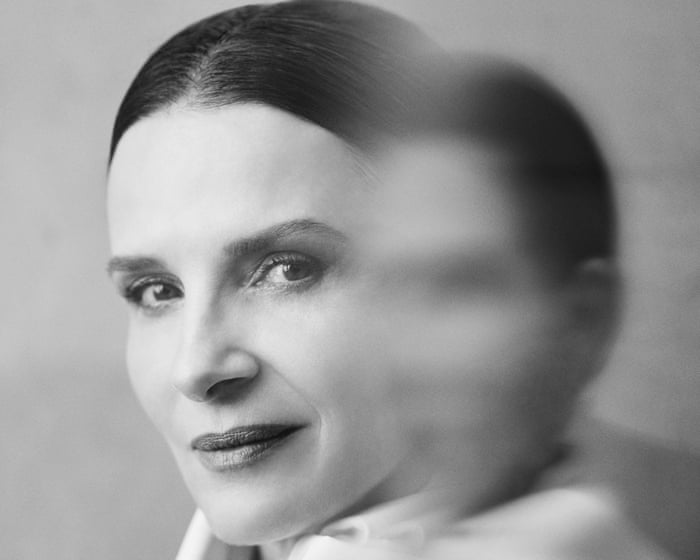
Starring in more than 70 movies is all well and good, but Juliette Binoche can still get nervous. Right now, the Oscar-winning actor is biting her lip on the third floor of a Manhattan high-rise. In 20 minutes, she will walk into a sold-out movie theater to introduce her directorial debut at New York’s Museum of Modern Art. The film is called In-I In Motion, a vérité-style documentary that follows Binoche’s late-2000s dive into contemporary dance, where she performed a series of daring and strangely beautiful shows with British dancer Akram Khan. “So,” she asks me, “how do you think I should present it?”
That’s how I ended up giving public speaking advice to arguably the most celebrated French actor working today. I tell her she did a great job last night introducing the film at the trendy Metrograph cinema downtown. But it’s hard to know how to prepare an audience for the film’s poetic—and sometimes confusing—nonlinear story. Maybe you just have to let them figure it out. She gives a sly smile. “Should I say, ‘This film isn’t going to hold your hand’?”
That would be a very Juliette Binoche thing to do. Over a four-decade career, she has rarely coddled audiences, moving between cerebral experimental theater and virtuosic performances directed by international auteurs, along with the occasional Hollywood popcorn movie. After her breakthrough role in Jean-Luc Godard’s Hail Mary, she became the toast of European arthouse cinema in the late 80s and broke through as an international star with roles in The Unbearable Lightness of Being, The English Patient, and Chocolat. As well as lead.In some of the most celebrated films of the 21st century so far—like Michael Haneke’s Caché and Abbas Kiarostami’s Certified Copy—the past decade has brought some of Binoche’s best work. This includes the historical romance The Taste of Things, the social realism drama Between Two Worlds, and Let the Sunshine In, where she plays a woman in her fifties desperately searching for love, raw as an exposed nerve.
In-I In Motion is unlike anything she’s done before. Binoche is laid bare as she takes her first steps into completely unfamiliar creative territory. There’s emotional vulnerability and plenty of sweat as she goes through six grueling months of dance rehearsals with Khan; at one point, she’s thrown repeatedly against a wall. She’s no stranger to pushing herself to extremes, but I was blown away by her complete lack of self-consciousness while dancing. It was as if every cell in her body vibrated with the same intensity she brings to her most unforgettable roles. As I left the screening last night, I overheard two people marveling at her commitment. “That was like Leo in The Revenant, but with dance.”
Binoche smiles politely when I tell her this story. I don’t think she loves the comparison to DiCaprio’s over-the-top performance. Sipping from an eco-friendly water bottle in a meeting room, she says she was more interested in breaking down the world’s glamorous image of “La Binoche.” “I wanted the audience to experience what it feels like to be in the process of creation,” she says. “That’s not a red carpet. It’s searching, and it’s finding common ground between two very different people.”
She loved being in what she calls the “blurry place” of inexperience. The way she talks about it is almost Buddhist. “Being a beginner meant not knowing,” she says, her eyes widening for emphasis. “It’s about finding a truth within yourself. It’s not about being confident—it’s about allowing yourself to be nothing.”
Binoche and Khan shaped their characters’ journey through many therapy-like conversations with acting coach Susan Batson and improvisation guided by movement director Su-Man Hsu. “Why do we need the other so much?” Binoche asks at one point in the documentary. “What does it mean to love? And when do we give up because it’s so hard, and when do we keep going?” These big questions come to life in the full In-I performance that closes the documentary: Binoche’s limbs glide fluidly through the air; her hands rest to caress Khan’s face before being slapped away. They kiss, mouths tearing at each other like wild birds on raw meat.
When In-I premiered in London in 2007, it got mixed reviews. But Binoche sees the project—which ran for more than 100 international performances—as a personal milestone. Her sister, filmmaker Marion Stalens, had shot nearly 200 hours of raw rehearsal footage, which Binoche carefully cut down to make the finished two-hour documentary. She already had early encouragement from a Hollywood legend: after one performance at the Brooklyn Academy of Music in 2008, the late Robert Redford came into her dressing room and insisted she make a film of the show. “He repeated it several times, and I was like, ‘Yeah yeah, I know,'” says Binoche. “I thought, ‘One day I have to find a way.’ And I was lucky enough that two and a half years ago, a producer and a financier came to me and said, ‘Do you have a project you’d like to do?'”
If you’re attached to status… IYou might be missing out on opportunities for art.
Juliette Binoche
Following her inner voice led to a captivating film, and I tell Binoche I wish I had seen the original dance production on stage back in 2007. “But you would have been five years old then!” she jokes, her eyes sparkling. She’s off by 15 years, but I’m not too modest to take the compliment. Binoche is in New York for a few days to screen the film. In her 30s, she once thought about moving to the city “because you hear so much about the energy here.” She looks critically out at the gloomy March afternoon. “But when I see all the concrete, all the buildings, I think, no way.”
The actor lives in Paris in a small stone house with a garden, and also keeps a place in the countryside. She grew up in the French capital and has described her childhood self as “a little warrior.” The opening of In-I is inspired by one of Binoche’s most striking—and unusual—childhood memories. At just 12 years old, she became infatuated with an older man while watching Fellini’s Casanova in 1976 at the cinema. In the dance piece, that moment sparks the romance between Binoche and Khan, setting off a relationship that moves from the honeymoon phase and sexually charged duets to fights over pee on the toilet seat during a messy breakup.
At the intense climax of In-I, Binoche is suspended against Anish Kapoor’s blood-red set and mimes being choked. For that scene, the actor drew on the violent memory of being mugged as a young girl. “It turned into a big fight, and I was strangled,” Binoche recalls. “I said to him: ‘Go ahead, do it.’ And then he stopped because I said that.”
It’s almost impossible to imagine the self-control Binoche must have had to look her attacker in the eye and call his bluff. I suggest it must have been painful to revisit such a traumatic experience, but she won’t accept that. “A lot of people go through it, hello?! In France, the percentage of women who experience violence like this is huge.”
Binoche had previously thought about directing (“of course,” she notes), but says she never felt a strong urge to make her own film because she always made sure to have a say in her projects. “As an actor, you’re so involved in the directing because you’re right in the middle of it,” she says. “I never really felt the desire, because I felt I was already part of it.”
She says she didn’t take tips from any of the directors she has worked with in the past, but absorbed something of their approach over her decades on set. “What I learned from most directors is that they follow their intuition,” she tells me. “So you go with your intuition, but mainly your need. I think any art form starts from sensation. Because that’s what your body and gut feeling are telling you.”
I can imagine Binoche starting from a place of spiritual truth for her intense character studies and experimental auteur work, but less so for her supporting roles in simple blockbusters. Is it the same for Ghost in the Shell as it was for Mauvais Sang? “Yeah, yeah, yeah,” she says, before pulling back a little. “Well, with Mauvais Sang I wasn’t as aware of it,” Binoche adds about the surreal 1986 Leos Carax thriller, which earned her a second César nomination. “That was more about my relationship with Leos, being in love and wanting him to love me.” That role had her jumping out of an airplane. Could she do it again? “It depends on what and for who!”
Last year, Binoche was president of the Cannes jury that awarded the Palme d’Or to Jafar Panahi’s It Was Just An Accident, a dark comedy partly based on true events.The Iranian director’s experience as a political prisoner. For Binoche, it was a full-circle moment of sorts. She had drawn attention to Panahi’s imprisonment while accepting the best actress award at Cannes in 2010 for Certified Copy. But this wasn’t Binoche’s smoothest Cannes. During a press conference, she was criticized for dodging a journalist’s questions about why she didn’t sign a letter condemning the film industry’s silence on Gaza. “I can’t answer you,” Binoche said at the time. “You’ll maybe understand a little later.” That evening, at the official opening ceremony, she read a tribute to a Palestinian photojournalist named Fatima Hassouna, who was the subject of a documentary in competition. When I bring it up today, she’s still frustrated by the whole thing. “Because they didn’t know what I was going to do that evening,” she says. “I had a plan! The journalist kept repeating, and I kept repeating – it was ridiculous!”
In general, Binoche prefers to let her work speak for itself. “What I like in choosing a story, a script, or a play is when there’s transformation,” she says. “Because I think we can transform. And we have to transform and let go of stuff from our education and where we come from.”
Juliette Binoche at the 1997 Academy Awards after winning best supporting actress for The English Patient. Photograph: Steven D Starr/Corbis/Getty Images
She says the film that changed her the most was The Lovers on the Bridge, the wildly chaotic 1991 masterpiece directed by Carax, her former boyfriend. Binoche is stunning as Michèle, a homeless artist slowly going blind. At Carax’s request, she spent time living on the streets to prepare for the role. “It was such a difficult film to make,” she says. The production missed several deadlines and ended up taking over two years to complete. Binoche turned down many opportunities to dedicate herself to the role. “There was a lot of depression around me,” she says. “And also, it was: ‘How are we going to find the money?'”
At the time of filming, Carax’s movie was reported as the most expensive French film ever, with a large chunk of its estimated $28 million budget coming from grants through the CNC, a department of the French ministry of culture that supports film. “In France, some people are still angry because there was some money from the CNC,” Binoche says, shrugging. “But it’s also about jealousy: because they’re not part of it and it has great recognition in the world.”
It’s hard to imagine getting state funding on that scale for a project these days. Does she think it’s tougher to be a filmmaker today than in the 90s? “Well, in France we have a system that protects artists,” Binoche says. “So there’s some cinema that’s been helped, but recently they took away money from the CNC. [The funds are] probably for the army,” she says grimly. “All the money has to go towards making weapons or in case of war.”
Binoche truly crossed over to English-speaking audiences in the 90s after her roles in Krzysztof Kieślowski’s masterpiece Three Colours: Blue, for which she won the Volpi Cup at the Venice Film Festival, and an Oscar-winning turn in the 1996 period romance The English Patient. With a history of sensual roles in films like The Unbearable Lightness of Being and Damage, along with her growing presence in English-language films, the British press labeled Binoche a sex symbol. Even highbrow publications weren’t immune: a 2000 Sight and Sound cover called her “The Erotic Face,” despite the fact that she was promoting a literary biopic of 19th-century author George Sand.
“It never bothered me,” she says of her image at the time. “Each time you have to do nude scenes, it’s always difficult. You have to focus on why you’re doing them so you’re not worried about them in a heavy way. It helps when
Frequently Asked Questions
Here is a list of FAQs based on the article about Juliette Binoche and her directorial debut inspired by a traumatic teenage experience
BeginnerLevel Questions
1 What is this article about
Its about actress Juliette Binoche explaining how a traumatic event from her teenage yearsbeing strangledinspired her to write and direct her first film
2 Who is Juliette Binoche
She is a famous French actress who has won many awards including an Oscar She is now also a film director
3 What is the name of her first film as a director
The article mentions the film is called The Taste of Things
4 How did being strangled as a teenager inspire a movie
The experience made her want to explore themes of violence fear and survival She wanted to tell a story that deals with how people react in terrifying situations
5 Did the film actually show her being strangled
No The article says the film is not a direct autobiography Instead the feeling of powerlessness and the fight for survival from that event became the emotional core of the story
AdvancedLevel Questions
6 Why did Binoche choose to share this personal story now
She felt that making her first film required her to be completely honest about her own life She wanted the film to have real emotional weight and that meant drawing from her deepest fears
7 Does the film focus on the attacker or the victim
The focus is on the victims internal experiencethe panic the decision to fight or submit and the aftermath Its less about the attacker and more about the psychological impact
8 How does this experience connect to her acting career
She said that being an actress often requires her to simulate fear and vulnerability The real experience of being strangled gave her a deeper more authentic understanding of those emotions which she now uses to guide actors in her film
9 What did she mean by I told him Go ahead do it
In the moment of the attack she said those words as a way to stand up to her attacker It was a defiant act of control in a situation where she had none That phrase became the title of the