Iran’s Revolutionary Guards have threatened to target US sites in the Middle East if its tankers come under attack, Iranian media reported on Saturday, as Washington awaited Tehran’s response to its latest negotiating offer.
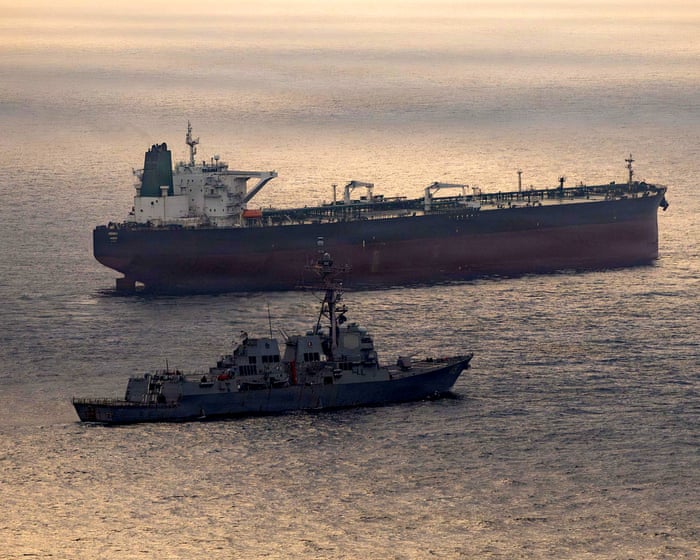
“Any attack on Iranian tankers and commercial vessels will result in a heavy attack on one of the American centres in the region and enemy ships,” the force said, a day after US strikes on two Iranian tankers in the Gulf of Oman.
On Sunday morning, the UK Maritime Trade Operations centre said a ship caught fire after being hit by an unknown projectile off the coast of Qatar. The attack caused a small fire on the bulk carrier, which was put out. It happened 23 nautical miles (43km) north-east of Qatar’s capital, Doha, UKMTO said.
Donald Trump had said on Friday that he expected Iran’s answer to Washington’s latest peace deal proposal “supposedly tonight”. But if Tehran sent a response through Pakistani mediators, there was no public sign of it. Iran’s foreign minister, Abbas Araghchi, reportedly questioned the reliability of US leadership.
“The recent escalation of tensions by American forces in the Persian Gulf and their numerous actions in violating the ceasefire have added to suspicions about the motivation and seriousness of the American side in the path of diplomacy,” he said in a call with his Turkish counterpart, according to Iran’s ISNA news agency.
On Friday, a US fighter jet fired on and disabled two Iranian-flagged tankers that Washington accused of challenging its blockade of Iran’s ports. An Iranian military official told local media the navy had responded with strikes. This followed a flare-up the night before in the Strait of Hormuz, a vital international sea lane that Iran is trying to control in order to collect tolls and gain economic leverage over the US and its allies. The US says it is unacceptable for Tehran to control this key oil route.
Washington has sent Iran, via Pakistani mediators, a proposal to extend the truce in the Gulf to allow for talks on a final settlement of the conflict that began 10 weeks ago with US-Israeli strikes on Iran. A reporter for French broadcaster LCI, Margot Haddad, said on Saturday that Trump told her in a brief interview he still expected to find out Iran’s answer “very soon”. Iran’s foreign ministry spokesperson said on Friday the proposal was still “under review”.
The US secretary of state, Marco Rubio, met with the leader of Qatar on Saturday. Qatar is a key intermediary for Washington in talks with Iran. The state department said they discussed “continued close coordination to deter threats and promote stability and security across the Middle East”. Qatar’s Sheikh Mohammed bin Abdulrahman Al Thani met the previous day with the US vice-president, JD Vance, to discuss the Pakistani-led efforts to broker a permanent peace. Iran has attacked sites in Qatar during the war, pointing to the wealthy emirate’s role as host of a major US airbase.
Meanwhile, satellite images have shown an apparent oil slick spreading off the coast of Iran’s Kharg Island, a key oil export terminal for Iran. It was not immediately clear what caused the spill, which was off the island’s west coast and appeared to cover more than 20 square miles (52 square kilometres), according to global monitor Orbital EOS. A UK-based non-governmental organisation, the Conflict and Environment Observatory, told AFP that by Saturday the slick was “much reduced”, and may have been caused by leaking oil infrastructure.
Kharg Island is at the heart of Iran’s oil export industry, a linchpin of its battered economy, and lies in the Gulf far north of the narrow Strait of Hormuz. After the start of the war on 28 February, Iran largely ceded control of the strait.The strait was closed, throwing global markets into chaos and pushing oil prices higher. In response, the U.S. imposed its own blockade of Iranian ports, and this week Trump ended a short-lived U.S. naval mission to reopen the strait for commercial shipping.
Fighting on the Lebanon front
A parallel ceasefire on the war’s Lebanon front is also under pressure, with daily exchanges of fire between Israel and the Iran-backed Hezbollah.
Authorities reported that at least nine people were killed in Israeli strikes in southern Lebanon on Saturday. State media said air raids targeted a highway south of Beirut, outside the militant group’s usual strongholds.
These recent attacks were among the most intense since a three-week-old ceasefire between Israel and Hezbollah began. Hezbollah said it targeted Israeli troops in northern Israel with drones on at least two occasions in response to the ongoing strikes.
Israel’s military reported that several explosive drones were launched into its territory, leaving one army reservist seriously wounded and two others moderately injured.
The new strikes come as Lebanon and Israel—officially at war since 1948—are set to hold direct negotiations in Washington next week, a move Hezbollah strongly opposes.
Frequently Asked Questions
Here is a list of FAQs about the warning from Irans Revolutionary Guards regarding targeting US sites if their oil tankers are attacked
BeginnerLevel Questions
Q What exactly did Irans Revolutionary Guards say
A They warned that if the US or its allies attack their oil tankers in the Middle East they will retaliate by targeting US military sites or interests in the region
Q Why are they threatening to target US sites
A They are trying to deter the US from stopping or attacking Iranian oil shipments Its a dont hit us or well hit you warning
Q What is an Iranian oil tanker in this context
A Any ship carrying crude oil or fuel that belongs to Iran or is shipping oil on Irans behalf
Q Does this mean a war is starting
A Not necessarily Its a threat designed to prevent conflict However it raises the risk of a direct military clash if either side acts on their threats
Q Where are these US sites located
A They likely refer to US military bases naval ships or assets in countries like Qatar Bahrain the UAE Saudi Arabia or Iraq
IntermediateLevel Questions
Q What is the IRGC and why are they making this statement
A The IRGC is a branch of Irans military separate from the regular army They control Irans missile and naval forces and often issue such threats to show strength and protect Irans economic interests
Q Is this threat related to US sanctions on Iran
A Yes The US has strict sanctions to stop Iran from selling oil The IRGC is warning that if the US uses military force to enforce those sanctions Iran will respond with military force
Q How would Iran actually target a US site
A They could use ballistic missiles drones or naval mines They might also use allied groups to attack US bases with rockets or drones
Q Has Iran made similar threats before