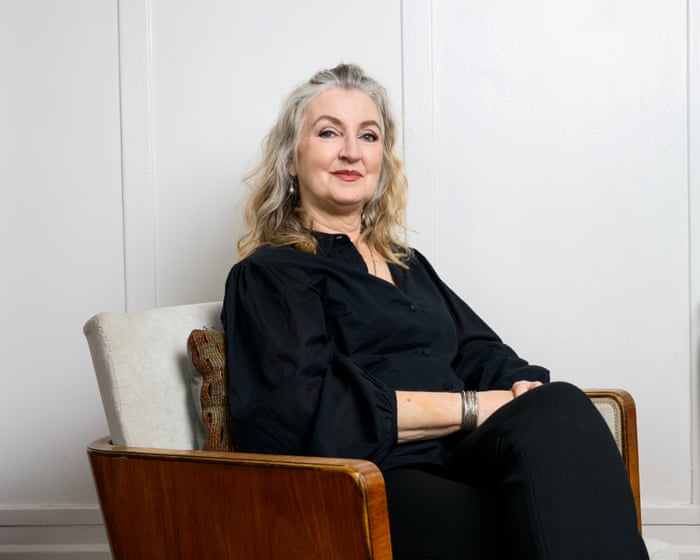
When I speak to Rebecca Solnit, she is beaming, and I can’t immediately figure out why. Her new book, The Beginning Comes After the End: Notes on a World of Change, arrives with a pragmatic optimism, it’s true. She writes with a “pull yourself together, don’t even think about despair” tone. But that’s not why she’s smiling—it’s because Andrew Mountbatten-Windsor just got arrested. “Why is the UK doing these things the US should be doing? Why now? Wow!”
This “feminist chortling” (as she calls it) about the disgraced royal is right in the wheelhouse of the writer who practically invented the term mansplaining. A genuinely hilarious story about a man explaining her own book to her at a party became the wildly viral essay “Men Explain Things to Me” in 2008, and later a fierce, controlled critique of the patriarchy in a book of the same name in 2014.
Mountbatten-Windsor’s arrest also, indirectly, underscores the point of her new book: yes, we’re living through a political revolution, but it’s not the one you think. It’s not the fast-paced hurtle toward fascist necropolitics we wake up to every day, with atrocities constantly exploding and demanding our attention. Instead, it’s the slow revolution that’s been happening since the ’50s—seismic shifts in our attitudes toward everything, from gender to race to sexuality to science to the climate. Every battle we fight builds on one that was won before. A government can take away your rights, but no one can take away your belief in those rights. The first points of challenge to fascism are memory and history.
“I often feel like a tortoise at a mayfly party,” she says, via video call from San Francisco. “People do not remember the past… [they] often seem to live in a perpetual present. Some find that reassuring, that nothing is ever going to change. Some find it despair-inducing, because nothing is ever going to change. I wanted, in this horrible moment, to remind people that what the far right is doing globally, I think, is largely backlash. A new world is being born, and they’re basically trying to abort it. Which is a little ironic, given their views on abortion.”
Solnit, 64, is referencing the Italian political philosopher Antonio Gramsci, who was living in his own interregnum between the death of the old and the birth of the new when he said in 1930: “The old world is dying, and the new world struggles to be born: now is the time of monsters.” (“Monsters” is sometimes translated as “morbid symptoms.”) On the brink of fascism and world war, Gramsci wasn’t wrong; I guess what perturbs me is that people have been quoting him nonstop since the financial crash in 2008. By 2013, Michael Gove was name-checking him as his education inspiration. Don’t we need a new theorist, along with some new theories, to cope with the fact that calling this a time of monsters doesn’t seem to defang them or stop their success?
She agrees that these times, in the U.S. certainly, have no precedent. “Even during the Civil War, when we were at risk of losing a bunch of states to their disgusting commitment to slavery, the federal government wasn’t corrupted and obscene. We currently have an autoimmune disorder, essentially. The first thing to say is that Donald Trump’s presidency is not really a reflection of what American people want.”
That’s actually not the first thing Solnit says in her book: rather, she starts with a ceremony in October 2024, in which 466 acres of ranch land north of San Francisco were handed back to the Federated Indians of Graton Rancheria, to be cared for in perpetuity. This restitution was the fruition of resistance campaigning, activism, poetry, and memory that had gone on ever since the land was taken over by white settlers in the 19th century.In the mid-20th century, Essie Parrish, a spiritual leader and dreamer from the Kashaya Pomo tribe, prophesied that “one day the white people would come to us to learn how to take care of the land.” Rebecca Solnit, an activist who grew up in the region during the 1970s and 80s, describes her background: “An Irish Catholic Russian Jew; as you can see, I am very pale, but I joke that we haven’t been white that long.” Her family was quite left-wing, but Solnit’s involvement with indigenous activism stemmed more from her geographical roots than from family influence. “I had a sense, growing up in that town, of something missing. There had been a huge indigenous presence; those people were still around, but they’d been almost completely erased.”
Environmental, conservation, anti-nuclear, civil rights, and anti-colonial movements all intersected and came together to create a change that would have seemed impossible not just ten years, but even one year, before it happened. “What was also striking about how I grew up,” Solnit says, “is the story of indigenous people was always told as a story that had ended. Bad things had happened, they were very regrettable, but it was all over. We could talk about Native people pretty much entirely in the past tense.” If the cliché is that history is made by the people who show up, Solnit complicates and extends that idea—change is made by people who refuse to forget.
“Something big I propose in the book,” she says, “is that the whole idea of the ascent of man, his separation from nature, his inevitable progress towards the supremacy of industrialized capitalism, towards this supreme version of himself, is a weird detour from how most people, throughout most of time, have thought about nature and our place in it.” The error of that detour might reveal itself in environmental destruction, or in an epidemic of loneliness, or in the scourge of corporate greed. But, once the imagination has awakened to it, says Solnit, “the change is deep and profound.”
Class consciousness and environmental awareness—some things, once awakened, cannot simply be extinguished. “Fossil fuel lobbyists cannot undo it. Putin and Trump and that idiot in Argentina [Javier Milei] cannot undo it. They’re trying to push rewind on the VCR, which feels like the right technological moment in history for them. They’re essentially saying, if you listen closely: ‘You all are very powerful. You’ve changed the world profoundly, with the environmental and climate work, feminism, queer rights, the general anti-authoritarian push for accountability and equality. All those things are connected.’ Your enemies appraise you accurately, even when you don’t believe it yourself.”
Solnit quotes the American theologian Walter Brueggemann, who said “hope arises from memory.” “You can turn that inside out to say that despair arises from forgetting. If you forget that every good thing we have came about as the result of a heroic struggle, of course you will despair. But the right for women to be treated as people and to have voices and to participate in public and civic life is the result of a heroic struggle. Racial equality, far from perfectly achieved, but to the extent which it has been, is the result of a heroic struggle. When it comes to the environment, often our victories look like nothing: the river that wasn’t dammed or is no longer polluted, the forest that wasn’t cut down, the species that didn’t go extinct. You cannot see them, but they were the result of heroic struggle, and to know that is to know we have tremendous power.”Power. These things depended on us actually showing up and doing the work. We have to keep showing up and keep doing the work.
“This book was written quickly and might not be my most polished,” Solnit says, sounding completely unbothered by that. I don’t think it reads as rushed, for what it’s worth, but what she is emphasizing, in a self-deprecating and gentle, steady tone, is that people—progressives, at least—need to start treating their own history with more respect. When destructive forces are setting the political agenda—when your government is detaining your neighbors, when regions across the Middle East are in turmoil—you can’t avoid discussing it. But if you don’t also remember the creativity in politics and the victories, you’ll succumb to the feeling that things can only get worse. “Nothing is inevitable,” Solnit says. “I use the word ‘evitable’ often.”
It’s a familiar idea that the far right creates chaos to distract and disrupt positive change, but Solnit focuses on the mechanics: “Authoritarianism always sees facts and truth, as delivered by journalism, history, and science, as rival sources of power. Those are radically democratic things. You can be a king or a commoner, and the rules of gravity are still the same. So they try to undermine those things.” The politics of chaotic spectacle, disinformation, and outright falsehood leaves you endlessly trying to prove gravity exists, your own priorities sidelined. The pattern is similar to that in an abusive relationship: it doesn’t matter what you say, and it doesn’t matter whether gravity exists. The purpose is to trap you in the engagement so that it becomes your reality.
“Something I’ve been saying since I wrote Hope in the Dark,” Solnit says—her influential 2004 work was a tribute to activism and hope—”is that optimism, pessimism—and we can add climate doomerism and cynicism—all assume we know the future, and therefore nothing is required from us. I think the future is radically uncertain, and therefore much is required of us.” It’s not new information, but it is immensely persuasive, especially when Solnit points to random developments that would have seemed “inconceivable, unfathomable” until they happened—from Epstein’s arrest and disgrace to the collapse of Soviet totalitarian regimes. “I remember chatting with a German photographer in 1989—we both thought the Berlin Wall would outlive us, that the Cold War was permanent,” she says. “Seeing the progress of feminism, being in San Francisco for the first great surge of marriage equality, when thousands of couples came to our city hall in joy and amazement to get married, seeing the Paris climate treaty pass. I was one of the campaigners to stop the Keystone XL pipeline that would have brought dirty crude oil from Alberta to refineries in the U.S. for export. We fought it for 12 years, while critics stood on the sidelines and told us we were doing it wrong and we would never win, and then we won. The world I was born into no longer exists.”
I often think about the widespread climate pessimism, which spans the political spectrum and crosses generations; how much deeper it feels than the nuclear-war anxiety and pessimism of the ’80s—whether that’s because the climate crisis is objectively worse, or because there’s been a hidden authoritarian interest in embedding that despair, making everyone more compliant. It’s unanswerable—the climate crisis is objectively worse, there’s more data for it, more irreversible damage has occurred, more forces drive it forward. But we didn’t know that in the ’80s; the comparative energy and ambition of that time…We could not have logically believed that annihilation would be hideous but at least we weren’t headed for 4°C of warming. So perhaps the spread of pessimism has been a deliberate project—but if it has, you can’t endure it alone.
“One of the beautiful, profound things I’ve seen again and again,” says Solnit, “is how moments of uprising—anti-war protests, demonstrations against monarchy, Occupy Wall Street—bring a transformative sense of power and belonging. The solidarity, the purpose, the interconnectedness are deeply meaningful.” In her book A Paradise Built in Hell (2009), Solnit describes the intense communities formed in disasters: the 1906 San Francisco earthquake, the 1917 Halifax explosion, the 1985 Mexico City earthquake, 9/11, Hurricane Katrina. She sees the same unbreakable bonds being built through activism—the friendships, energy, self-awareness, and ambition born from political action stay with you, often defining your life.
“I often quote my friend, environmentalist Bill McKibben. We were sitting on a concrete floor at an activist space during the Paris climate treaty process. Someone walked up and asked him a question he hears all the time: ‘What’s the best thing I can do as an individual?’ He replied, ‘Stop being an individual.’ You may have your own quirky playlist and makeup style, but you also have this solidarity. When you act, you act with others.”
The Beginning Comes After the End by Rebecca Solnit (Granta Books, £14.99). To support the Guardian, order your copy at guardianbookshop.com. Delivery charges may apply.
Frequently Asked Questions
Of course Here is a list of FAQs about Rebecca Solnits perspective on the slow revolution as discussed in her work framed in a natural conversational tone
Beginner Definition Questions
1 What does Rebecca Solnit mean by a new world is being born
She means that beneath the headlines of crisis and backlash profound positive changes in how we think about justice community and power are steadily taking root and growing
2 What is the slow revolution she talks about
Its the idea that real lasting social change doesnt happen overnight Its a gradual process of shifting cultural values building new institutions and changing hearts and minds over generations
3 Who is the far right in this context and why cant they accept this change
The far right refers to political movements deeply invested in preserving traditional hierarchies of power They cannot accept this new world because it directly challenges their vision of society and their own status within it
4 Can you give a simple example of this slow revolution in action
Yes The rapid widespread acceptance of samesex marriage over the past 25 years It moved from a fringe idea to a legal right and a mainstream value through decades of activism storytelling and cultural changea classic slow revolution
Intermediate BenefitsProblems Questions
5 If the revolution is happening why does everything feel so chaotic and bad right now
Solnit argues that the chaos and backlash are often a reaction to the success of these movements The far rights intense opposition is a sign that the old world is losing its grip not that the new one is failing
6 What are the main benefits of viewing change as a slow revolution
It helps combat despair and burnout It allows us to see todays losses as part of a longer struggle where progress is nonlinear but real It shifts focus from shortterm political wins to deeper cultural transformation
7 Whats a common mistake people make when thinking about social change
We expect clear permanent victories and get discouraged by setbacks The slow revolution framework reminds us that progress is more like a spiralwe revisit issues at higher levels of understandingnot a straight line