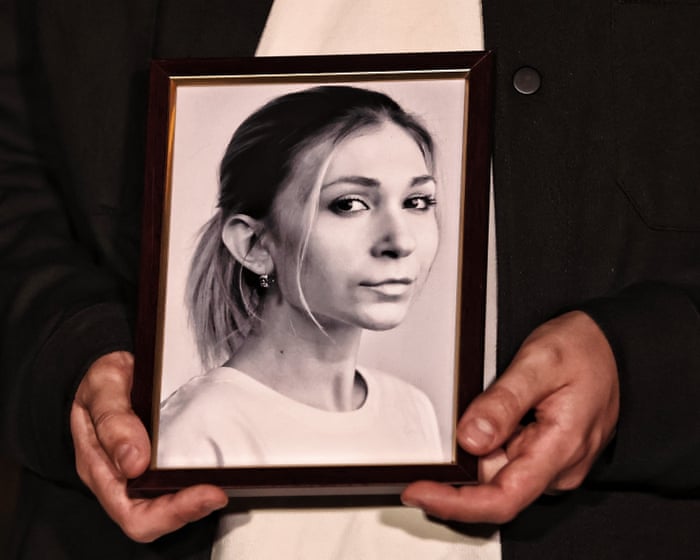
New details have emerged about the final days of Ukrainian journalist Viktoriia Roshchyna, who died last year, from a soldier who was with her when she was taken to a prison deep inside Russia.
Roshchyna was captured while reporting from occupied Ukraine in the summer of 2022. She is among an estimated 16,000 civilians detained by Russia since the full-scale invasion began.
A recently released Ukrainian soldier from the Azov regiment has shared an account that supports recent reports of Roshchyna’s death. He says she died after being transported to Sizo-3, a prison in the town of Kizel near the Ural mountains.
Speaking to reporters from the Viktoriia Project—an investigation by the Guardian and international media partners led by Forbidden Stories—Mykyta Semenov said Roshchyna’s final journey began by train and ended on trucks. He was in the same train wagon and first saw her as she walked down the corridor to use the toilet.
“I saw her. She walked past our compartment,” Semenov said. “She was wearing a light blue summer dress with flowers. She also had summer sneakers with white soles, sporty ones. And she carried a small makeup mirror with her.”
The journalist walked with her hands behind her back, a stress position. Having been on hunger strike at a previous facility, Roshchyna was visibly in poor health.
“It looked like everything was difficult for her: walking was difficult, eating was difficult, speaking was difficult. It seemed like that dress of hers… that the dress was carrying her. Holding her up.”
The Russian Ministry of Defense informed her family that she died on September 19, 2024, at age 27. The cause and place of her death have never been officially confirmed. According to the investigating prosecutor, her remains, which were returned to Ukraine, showed multiple signs of torture.
Roshchyna had previously spent nearly nine months in the Sizo-2 pre-trial detention facility in Taganrog. Conditions at the prison, located on the shores of the Sea of Azov, were so terrible it has been called the “Russian Guantánamo.”
Roshchyna had been told she would be released in a prisoner exchange that month, but instead, she was sent hundreds of miles east.
Semenov said the prisoners in his group, including Roshchyna, left Taganrog on September 9 and arrived in Kizel a few days later, on September 11.
“She was very, very thin. Barely able to stand. I could see she had once been a beautiful girl, but they had turned her into a mummy: yellow skin, hair that looked… not alive.”
Held in the adjacent cell, Semenov said he could identify her by listening to her conversations with guards from the Russian FSIN prison service.
He said Roshchyna did manage to exchange food with others, with the guards’ help.
“I remember that she didn’t eat meat. I don’t know why. She said she had something going on with her body and couldn’t digest it anymore. So she would give us the meat from her rations, and we gave her vegetables, zucchini spread, things like that.”
A fellow soldier told Semenov that Roshchyna had “pushed hard for her rights at Taganrog” and was given more freedom than other detainees. She went on hunger strike, he said, to protest the conditions.
Semenov described the journey as violent, with guards drinking alcohol throughout. The unit chief ordered his officers to find fighters from the Azov regiment and bring them to him for beatings. The regiment originated as a volunteer battalion founded in 2014, which initially included many with far-right views, and has since been labeled “neo-Nazi” by Russian propaganda.He was taken and returned after 15 to 20 minutes. “I let him catch his breath and asked what happened. He told me that the chief had a deputy—a paratrooper. The two of them beat him in the face and in the liver area. Both were drunk.” At one point, the beating was filmed on a video call.
When the prisoners arrived at Kizel, they were beaten again in what is known as the “reception” ritual, a practice inflicted on civilians and soldiers throughout the Russian prison system. “When I jumped out of the truck, they threw a black bag over me. They put us on our knees. There wasn’t enough air. They started shouting, asking for our unit, our age. Screams and groans were coming from all sides.”
Conditions in Kizel were harsh. Prisoners had to wait for permission to drink water, use the toilet, or even sit. They were forced to stand most of the time. Speaking, gestures, and putting hands in pockets were all forbidden. Compliance was monitored through surveillance cameras, Semenov said.
Officers from the FSIN concealed their identities with balaclavas and nicknames.
Public data indicates that the acting director of Sizo-3 in Kizel at the time Roshchyna was held there was Vitaly Spirin, age 39. When contacted by phone, Spirin hung up without responding to questions. The FSIN did not respond to a request for comment.
Last month, prison bosses at Taganrog were added to the EU sanctions list after being identified by the Viktoriia Project.
Semenov was eventually returned home this summer. The last he heard of Roshchyna was that she was still refusing food. “I heard that she was somewhere in another building, held with another woman. I heard she had health problems and that they were even allowed to sit in the cell. And that Vika continued her hunger strike there.”
It appears Roshchyna survived for only eight days at Kizel. Russia has never provided a death certificate to her family, but an autopsy found she suffered violence at the very end: bruises on her neck and a fracture of her hyoid bone, injuries typically caused by strangulation.
Some weeks ago, the Ukrainian news site Slidstvo.Info reported obtaining information from closed Russian databases about her death certificate. It was reportedly issued by the Leninsky department of civil status records of the Perm city administration. The date of death recorded in the document is 19 September 2024.
Ukrainian prosecutors have confirmed they believe Roshchyna died while in detention at Kizel.
Frequently Asked Questions
Of course Here is a list of FAQs based on the provided statement
FAQs About the Statement She was extremely thin a witness recounted describing the Ukrainian journalists final days in a Russian prison
BeginnerLevel Questions
1 Who is this statement about
This statement refers to a Ukrainian journalist who was imprisoned in Russia While the quote does not name her it is describing Victoria Roshchyna a freelance journalist who was detained by Russian forces in 2023 and whose condition deteriorated severely in custody
2 What does the statement mean
It is a firsthand account from someone who saw the journalist near the end of her imprisonment The phrase extremely thin strongly suggests she was suffering from severe malnutrition neglect or illness due to the conditions of her detention
3 Why was a Ukrainian journalist in a Russian prison
Since Russias fullscale invasion of Ukraine in 2022 numerous Ukrainian journalists activists and civilians have been detained by Russian authorities often on accusations of espionage or violating Russian laws Many are held as political prisoners
4 Is this a common problem
Yes International human rights organizations and watchdogs have extensively documented systemic abuse torture starvation and lack of medical care in Russian detention facilities particularly for Ukrainian prisoners
Advanced Contextual Questions
5 What are the legal and humanitarian implications of this statement
The description of an extremely thin prisoner points to potential violations of international humanitarian law and human rights law It suggests a failure to provide adequate food and healthcare which can constitute inhumane treatment or even torture
6 What is the purpose of releasing such witness accounts
These accounts serve several purposes to document potential war crimes to pressure Russian authorities and the international community to act to raise public awareness and to counter Russian disinformation about detention conditions
7 How does this fit into broader patterns of Russian imprisonment of Ukrainians
This is not an isolated case It is part of a documented pattern of forced disappearances filtration camps and abusive detention used to intimidate punish and extract false confessions from Ukrainians including journalists to suppress the truth about the war