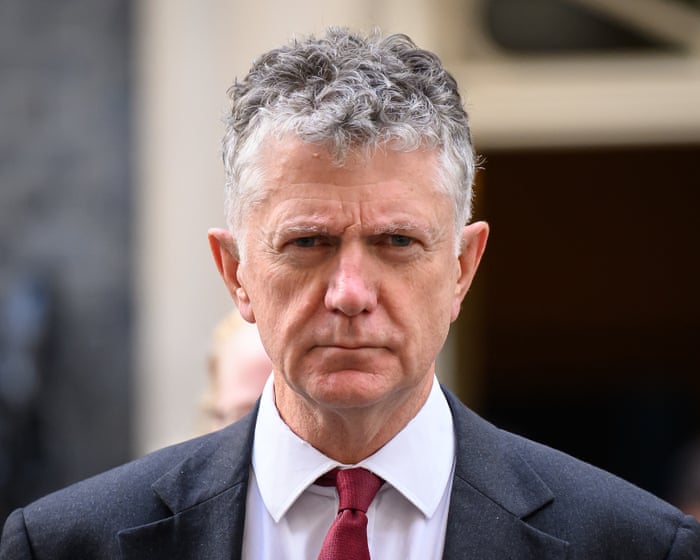
Britain’s national security adviser, Jonathan Powell, was present at the final U.S.-Iran talks and believed Tehran’s offer on its nuclear program was significant enough to avoid a rush to war, the Guardian can reveal.
According to sources, Powell viewed the progress in Geneva as substantial and described Iran’s proposal as “surprising.”
Just two days after the talks concluded—and after a follow-up round of technical discussions had been scheduled for Vienna—the U.S. and Israel launched their attack on Iran.
Powell’s involvement in the talks and his detailed awareness of their progress were confirmed by three sources. One noted he was present at Oman’s ambassadorial residence in Cologny, acting as an adviser. His presence reflected broader concerns about the U.S. delegation’s expertise, which was represented by Donald Trump’s son-in-law Jared Kushner and special envoy Steve Witkoff.
Kushner and Witkoff had invited Rafael Grossi, director general of the International Atomic Energy Agency (IAEA), to provide technical input in Geneva—though Kushner later claimed he and Witkoff already had “a pretty deep understanding of the issues that matter.” Nuclear experts would later point out that Witkoff’s statements on Iran’s nuclear program contained basic errors.
Powell, an experienced mediator, brought an expert from the UK Cabinet Office with him. One Western diplomat said, “Jonathan thought there was a deal to be done, but Iran wasn’t quite there yet, especially on allowing UN inspections of its nuclear sites.”
A former official briefed by participants added, “Witkoff and Kushner didn’t bring a U.S. technical team. They used Grossi as their expert, but that’s not his role. So Jonathan Powell brought his own team.
“The UK team was surprised by what Iran put forward,” the former official continued. “It wasn’t a complete deal, but it was progress and unlikely to be Iran’s final offer. The British team expected the next round of talks to build on what was achieved in Geneva.”
That next round was scheduled for Vienna on Monday, March 2, but never took place. The U.S. and Israel had launched their full-scale attack two days earlier.
Powell’s participation in the Geneva talks, along with earlier meetings in the same city that month, helps explain the UK government’s reluctance to support the U.S. attack on Iran—a stance that has strained UK-U.S. relations.
Britain saw no compelling evidence of an imminent Iranian missile attack on Europe or that Iran was close to obtaining a nuclear weapon. This is the first time it has been revealed that the UK was so closely involved in the discussions, giving it clear grounds to assess whether diplomacy had been exhausted and military action was necessary.
Instead, the UK viewed the attack as unlawful and premature, since Powell believed there was still a path to a negotiated solution over Iran’s nuclear ambitions.
Downing Street declined to comment on Powell’s role in Geneva or his views.
Prime Minister Keir Starmer has been repeatedly criticized by Trump for not offering stronger support for the U.S. attack—including initially refusing the use of British military bases, and later only permitting defensive use after Iran targeted UK allies in the Gulf. Trump has warned that NATO could suffer if European members do not help open the Strait of Hormuz, a request that has been declined.
The indirect talks between Iran and the U.S. in Geneva were mediated by Oman’s foreign minister.Badr bin Hamad Al Busaidi.
Gulf diplomats did not clarify why Powell was allowed to join the discussions, though it likely stems from the ties he has cultivated with the U.S. over time, including during his earlier role as Tony Blair’s chief of staff.
UK officials later noted they were encouraged that Iran was willing to make the deal permanent—unlike the 2015 nuclear agreement, which included expiration dates, or “sunset clauses,” that would have lifted restrictions on Iran’s program.
Iran also agreed to dilute its 400kg stockpile of highly enriched uranium under IAEA supervision inside the country and committed not to accumulate any such stockpiles in the future.
During the final session, Iran accepted a three-to-five-year halt on domestic enrichment. However, after consulting with Trump, the U.S. delegation later demanded a 10-year pause. In reality, Iran lacked the capacity to enrich uranium domestically after its enrichment facilities were bombed in 2015.
Iran additionally proposed what mediators called an “economic bonanza,” offering the U.S. an opportunity to take part in a future civil nuclear program.
In exchange, nearly 80% of economic sanctions on Iran would have been lifted, including assets frozen in Qatar—a key demand Iran raised in the 2025 talks.
The Omani mediator viewed Iran’s offer to maintain zero stockpiles of highly enriched uranium as a breakthrough, bringing an agreement within reach.
Reports vary on whether Kushner left the talks suggesting Trump would support what had been negotiated, or whether U.S. negotiators understood it would require something extraordinary to convince Trump that war was not the best course. One diplomat familiar with the discussions remarked, “We saw Witkoff and Kushner as Israeli assets who pulled a president into a war he now wants to exit.”
Frequently Asked Questions
FAQs UK Security Advisers Role in USIran Negotiations
BeginnerLevel Questions
1 What is this news about
This refers to reports that the UKs National Security Adviser was involved in diplomatic talks between the US and Iran likely regarding Irans nuclear program or regional tensions and reportedly assessed that a new agreement was possible
2 Who is the UK security adviser mentioned
This is the UKs National Security Adviser a senior official who coordinates security and foreign policy advice for the Prime Minister At the time of these reports this was Sir Tim Barrow
3 What negotiations are being talked about
The negotiations primarily concern Irans nuclear program The goal is often to revive or replace the 2015 nuclear deal which collapsed in 2018 and to address broader regional security issues
4 Why is the UK involved in USIran talks
The UK along with France and Germany was an original negotiating partner in the 2015 Iran nuclear deal It retains a strong diplomatic interest in preventing nuclear proliferation and ensuring Middle East stability
5 What does an agreement was achievable mean
It means the UKs senior adviser believed based on the discussions that there was a credible path for the US and Iran to overcome their differences and formally agree on terms
Advanced Detailed Questions
6 What specific role did the UK adviser play
As a close ally of the US and a member of the E3 the adviser likely acted as a facilitator or intermediary conveying positions clarifying sticking points and offering a European perspective to help bridge gaps between Washington and Tehran
7 What are the main obstacles to an agreement
Key obstacles include the extent of sanctions relief for Iran the scale and verification of Irans nuclear rollbacks guarantees that future US administrations wont abandon the deal again and addressing Irans ballistic missile program and regional activities
8 How does the UKs assessment differ from public statements by the US or Iran
Public statements are often tough and pessimistic for domestic audiences A behindthescenes assessment from an ally like the UK that a deal is achievable can signal that despite public posturing genuine progress is being made in private channels