Angry protests that have shaken Spain and France in recent weeks have now spread to Italy and Portugal, with rioters clashing with police and setting property on fire in Milan, and a tent encampment appearing in Lisbon over the weekend.
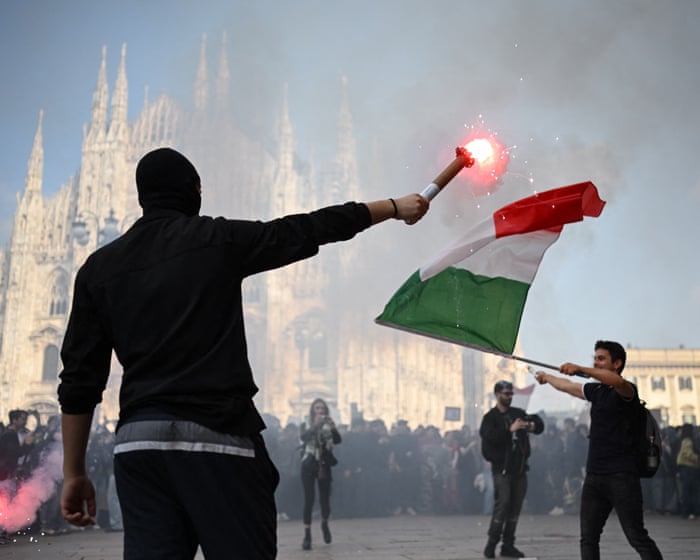
A march in central Milan on Saturday against rising living costs began peacefully but ended with masked rioters throwing stones, paving blocks and other objects at riot police and setting fire to barricades made from bar tables.
Police used water cannon and teargas to disperse the crowds, and images of the aftermath showed a severely damaged carabinieri car. At least two police officers were injured and about 50 demonstrators, including many minors, were detained, the LaPresse news agency reported.
Italy’s prime minister, Giorgia Meloni, said that while demonstrating was a right, “setting our cities ablaze is not”. In a social media post, she said “hooligans” had exploited the protests “to sow chaos, attack those responsible for ensuring security and to hold entire cities hostage”.
Milan’s centre-left mayor, Giuseppe Sala, said that while “the reasons for the protests were understandable, the violence against law enforcement and serious damage to the city are not justifiable”.
In Lisbon, a tent camp reminiscent of the one set up in Madrid three weeks ago was established by protesters demanding action on the housing crisis and living costs.
Hundreds of protesters rallied at night in Rossio Square – in the bustling, touristic heart of the Portuguese capital – after a march that had drawn thousands of people nationwide.
The participants vowed to stay overnight, with hundreds singing songs as they sat around the statue of King Pedro IV that dominates the square.
“The Portuguese social class that pays taxes, that keeps this country going, is under attack and is losing its rights, notably its right to housing,” said Elena Costa, a 46-year-old social assistant. “So we are all here together to try to explain that we are suffocating.”
Antonio Margado, a 52-year-old engineer, criticised the centre-right government for “a total liberalisation of rents; owners are protected more and more, while tenants who need a house are those who are protected less and less”.
Portuguese housing prices rose by 124% between 2015 and 2024, roughly twice as fast as the EU average, according to official data. The impact is especially harsh on younger people and those in Lisbon – around a quarter of Portugal’s more than 11 million inhabitants live in the capital’s greater metropolitan area.
Saturday’s camp in Lisbon amplified a housing protest that started in the northern city of Porto, where dozens of tents had already been set up.
At the earlier protest in Lisbon called by the main CGTP union, demonstrators called for better public services, pensions and wages as well as measures against soaring housing costs.
Portugal’s prime minister, Luís Montenegro, has said his government understood that people wanted to “express their outrage at what, in their view, may be omissions in public policies”. But he has warned political rivals against “importing into Portugal climates of instability and protest that, in fact, have no support in Portuguese society”, in a likely reference to violent protests in France.
There have also been violent demonstrations in Albania this week, where demonstrators angry over university conditionsProtests over high tuition fees and other grievances have led to calls for the resignation of Prime Minister Edi Rama. On Saturday, demonstrators threw rocks, Molotov cocktails, metal objects, and pyrotechnic devices at police, and set cars and trash bins on fire, using them as burning barricades to block police advances. In a sign of escalating violence, police fired rubber bullets at protesters for the first time since the demonstrations began. The protests continued into the night, with buildings—including a courthouse, banks, and a post office—set on fire or severely damaged. The unrest follows months of anti-government protests in the Balkan nation, initially triggered by a controversial resort development linked to the family of US President Donald Trump.
Growing anger over soaring rents and social inequality erupted in Spain last month after an 87-year-old woman was evicted from her home because she could not afford the 230% rent increase demanded by the investment firm that had bought her apartment. The case of the late María del Carmen Abascal—and the broader issue it represented—led to street demonstrations and a protest camp in central Madrid, and prompted the socialist-led government to propose emergency measures to facilitate and protect access to housing. When right-wing and far-right parties voted down those measures in congress, Prime Minister Pedro Sánchez responded by calling a snap general election for the end of November.
In France, outrage over teacher absences and poor school facilities in the impoverished northern suburbs of Paris has grown into a nationwide movement against inequality, weak public spending, and declining standards. More than 1,200 people were arrested in France on Saturday after protesters supporting high school students clashed with police, and some demonstrations later spiraled out of control, with buildings set on fire and shops looted.
The Associated Press and Agence France-Presse contributed to this report.
Frequently Asked Questions
Heres a set of FAQs about the protests
1 What are the We are suffocating protests
Theyre demonstrations that started over rising housing costs and the high cost of living People are protesting because they can no longer afford rent bills and everyday expenses
2 Where are the protests happening
They began in one city and have now spread to Lisbon and Milan with tensions growing over housing and living costs
3 Why are people protesting
Because housing and daily life have become too expensive Many people feel theyre being suffocated by rents mortgages and bills that their wages cant cover
4 What does suffocating mean here
Its a metaphor People feel financially squeezed like they cant breathe because their income doesnt stretch far enough to cover basic needs
5 Who is joining the protests
Mostly ordinary residents renters young people families and workers who are struggling with housing and living costs
6 What are the protesters demanding
Generally they want action on housing affordability and the cost of living such as rent controls more affordable housing and help with rising prices
7 Why is housing so expensive in these cities
Common reasons include limited housing supply tourism and shortterm rentals inflation and wages that havent kept up with prices
8 What is cost of living
Its the amount of money needed to cover basics like housing food energy and transport When it rises faster than wages people struggle
9 Are the protests peaceful
Reports describe growing tensions but the core message is about economic pressure on everyday people Check current news for the latest on specific events
10 How can I follow updates
Follow reliable news outlets covering Lisbon Milan and the wider housingcost movement and watch for official statements from local authorities
11 Whats a practical tip if Im struggling with housing costs
Look into local housing assistance programs tenant rights organizations and community groups many offer advice on rent subsidies and legal protections
12 Whats the bigger picture
These protests reflect a wider trend across Europe housing and living costs are rising faster than incomes pushing ordinary people to speak out