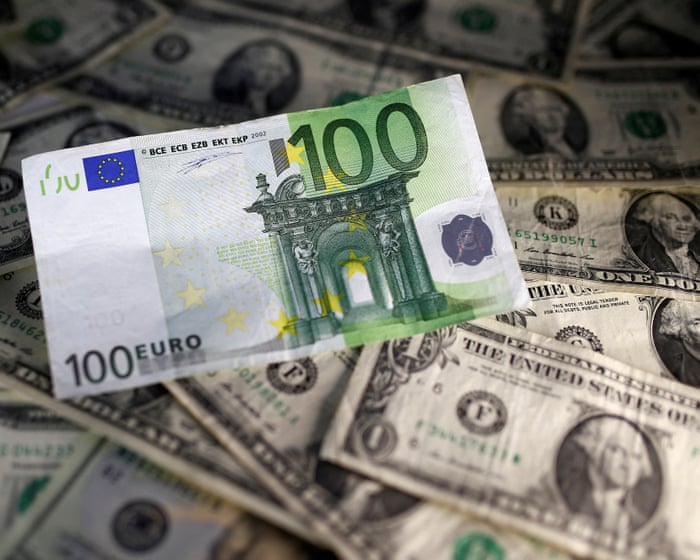
The euro has fallen to its lowest level against the dollar in 17 months, driven by growing fears that France’s debt problems could threaten the stability of the wider currency bloc.
The single currency dropped as much as 0.8% against the dollar in early trading on Monday, falling below $1.12 — its lowest since May 2025. It has lost about 1.2% this month, extending a decline of roughly eight cents from a peak of $1.20 in January.
Investors said the euro’s sell-off was driven by concerns over France’s rising borrowing costs, as the government struggles to control its strained public finances ahead of next year’s presidential election.
Global oil stockpiles ‘scarily thin,’ says Saudi Aramco chief; euro hits 17-month low on France debt fears – business live
Read more
France’s Cac 40 index of leading shares fell 1% on Monday, even as other European markets gained. The FTSE 100 rose 0.2%, while Germany’s Dax was roughly flat.
Monday’s announcement of a snap election in Spain by socialist prime minister Pedro Sánchez — after rightwing parties blocked emergency housing legislation last week — has added to uncertainty in the eurozone. Madrid’s benchmark Ibex 35 index rose 0.5%.
“Europe is taking the spotlight at the start of the week, as fiscal and political concerns hit the bloc,” said Kathleen Brooks, research director at XTB. “France is the epicentre of the concerns; however, Spain is also set to get ready for an early election, which is adding to investor worries.”
Amid a global sell-off in government debt as the Iran war unsettles markets, the yield — effectively the interest rate — on French 10-year government bonds hit its highest level since 2002 last week, before easing back on Friday.
This pushed the gap between French and German borrowing costs — a key measure of investor concern — to its widest level since 2012, at the height of the eurozone sovereign debt crisis.
Investors are focused on Paris’s fiscal position and worry that the presidential election and a hung parliament — with Marine Le Pen’s far-right National Rally party gaining ground — could make it harder for the government to reduce a large budget deficit.
The minority government of French prime minister Sébastien Lecornu announced plans last month for a €54bn (£45.8bn) savings drive to curb borrowing, setting up a fierce political battle.
With President Emmanuel Macron’s centrist administration under pressure amid strikes and protests across the country, the budget measures include cuts to pension spending and funding for government departments, excluding defence.
Lecornu said the savings would reduce this year’s budget deficit of 5.5% of GDP to 5% next year. He warned that without action, the gap between public spending and revenue could reach 6.5%.
skip past newsletter promotion
Free newsletter | Every weekday
Sign up to Business Today
Get set for the working day – we’ll point you to all the business news and analysis you need every morning
Enter your email
Sign up
after newsletter promotion
However, investors fear political pressures could derail fiscal consolidation, threatening to push up borrowing and adding to France’s debt pile at a time of soaring government borrowing costs.
Analysts warned the stresses in the French bond market could spread to other countries in the euro area, raising fears of a return to the dynamics of the 2010s sovereign debt crisis.
This comes amid concerns over the test facing the European Central Bank from rising inflationary pressures caused by the war in the Middle East, and the risk that France’s debt problem spreads throughout the euro area.
Roberto Mialich, a currency strategist at the Italian bank UniCredit, said: “Investors still do not rule out riding a further decline of the euro, making a retest of $1.10 possible in the near term.
“This is also because growing political tensions across the eurozone (primarily in France and Spain) and fears of contagion across the European soPressure in the sovereign debt market is weighing on the euro.
Frequently Asked Questions
Here is a list of FAQs about the euro dropping to a 17month low against the dollar due to French debt concerns
Beginner Questions
1 What does it mean that the euro hit a 17month low against the dollar
It means the euro is cheaper to buy with dollars than it has been at any time in the last 17 months You need fewer dollars to buy one euro so the euro has lost value compared to the dollar
2 Why is the euro dropping right now
Mostly because of worries about French government debt Investors are concerned that France may struggle to pay back its loans or manage its budget so they are selling euros and buying dollars instead
3 What is French debt and why does it matter
French debt is the total money the French government has borrowed and needs to repay If investors think France might have trouble repaying they lose confidence in the euro which makes it weaker
4 How does a weaker euro affect me if I live in Europe
It makes imports from the US more expensive Things like American phones medicine or travel to the US will cost you more But it can help European companies that sell goods abroad because their products become cheaper for foreign buyers
5 How does it affect me if I live in the US
It makes travel to Europe cheaper for you Hotels food and shopping in France Germany or Italy will cost less But it can hurt American companies that sell to Europe because their products become more expensive there
6 Is a weak euro good or bad
It depends Its good for European exporters and for American tourists Its bad for European importers and for Europeans traveling to the US There is no single answer
7 What is an exchange rate
Its the price of one currency in terms of another For example if 1 euro equals 105 dollars thats the exchange rate
8 Why do investors care about French debt
Because France is one of the largest economies in Europe If France looks risky investors worry that the whole eurozone could be unstable so they move their money to safer places like the US dollar
Intermediate Questions
9 How does French debt specifically weaken the euro
When investors fear France might default or need a bailout they sell French