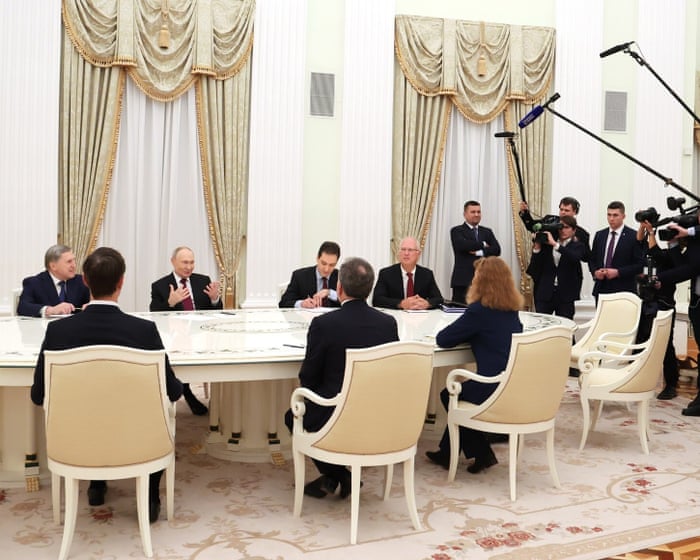
The failure of this week’s peace talks between Vladimir Putin and Donald Trump’s envoy Steve Witkoff follows a now familiar pattern of deadlocks over Ukraine during Trump’s second term. However, the underlying dynamic that led to these talks appears to be hardening. The core U.S. and Russian interests pushing the process remain unchanged, even as the actual conflict escalates. This week’s lack of progress means another attempt to end the war will likely happen soon, and another after that, until eventually some U.S.-backed deal emerges to stop the fighting—most likely on terms that broadly favor Russia.
The geopolitical logic behind this effort is too consistent to overlook. It has repeated since Trump returned to the White House in January. During his campaign, Trump claimed he could end the war in a day, which was never realistic. But since February 12, when Trump first spoke directly with Putin about Ukraine, the intention and method have not shifted—and there’s no reason to think they will now. In fact, Tuesday’s stalemate might even spur another attempt.
The pattern that has brought us here is now familiar: Trump refuses to provide arms to Ukraine, instead seeking a bilateral deal with Putin to stop the war at Ukraine’s territorial expense. Russia bombs Ukraine and makes gradual gains on the battlefield. Ukraine and its other allies mobilize to oppose any emerging deal favorable to Russia. The U.S. adjusts its plans in response to these objections. Talks are held. Putin rejects a deal. The war continues, and so does the diplomacy.
As this cycle repeats—as it will—one of two things will happen: either the process will be seen as futile and abandoned, or some part of it will be altered to make an outcome more likely. Abandoning the process is possible, but it would humiliate Trump and likely lead to a more intense, lethal, and destabilizing war. Pressure to stop it would return, prompting a renewed U.S. diplomatic effort from a weaker position than today.
The second option—altering or bypassing part of the process—therefore seems more probable. This inevitably puts NATO and Europe squarely in the crosshairs of Moscow, and to some extent Washington as well. It explains why the Kremlin hinted yesterday that agreements worth pursuing still exist—specifically between Russia and the U.S., excluding Europe. Putin has made it clear he sees Europe as Trump’s weak link. Before this week’s talks with Witkoff, he said, “Europe is preventing the U.S. administration from achieving peace on Ukraine.” He added, “They are on the side of war,” and warned, “Russia does not intend to fight Europe, but if Europe starts, we are ready right now.”
Some of this is rhetoric, but Putin’s key insight is correct: Europe—more precisely, NATO minus the U.S.—is indeed managing to block Trump from making the kind of deal with Putin he wants. NATO allies’ steady commitment to this task hasn’t been widely praised, for fear of provoking Trump, but it’s unmistakable. The effort has been intense since Trump and J.D. Vance publicly criticized Volodymyr Zelenskyy during his Oval Office visit on February 28, and it has been largely successful.
This so-called “coalition of the willing” has the power to disrupt U.S.-Russia plans but not to shape them. It includes most European nations plus Canada, all committed to materially supporting postwar Ukraine. Its efforts have been pursued on an ad hoc basis, partly within NATO—like yesterday’s foreign ministers’ meeting at NATO HQ in Brussels, which U.S. Secretary of State Marco Rubio notably skipped.Europe’s urgent efforts on behalf of Ukraine have repeatedly succeeded in holding the line against both Trump and Putin. This happened again this week when the Witkoff plan was adjusted ahead of the Putin meeting. Drawing Zelenskyy closer has been a central part of this strategy since the Oval Office debacle. It would be surprising if Zelenskyy were not being intensively advised and consulted by allies at nearly every step. I suspect that if we ever see a record of his communications, memos, meetings, and travels, we would find Keir Starmer’s national security adviser, Jonathan Powell, playing a major role in this effort.
Yet this cannot go on forever. The core problem for both Ukraine and Europe is that the 21st-century balance of power is tilted against them. In this new reality, Europe and NATO lack sufficient arms, power, or wealth to force an alternative peace settlement that Russia and the U.S. would feel compelled to take seriously or accept. The postwar idea of the West may not be dead, but it is in intensive care. European and some American leaders are using all their skill to keep it alive. The truth, however, is that Trump could easily pull the plug tomorrow.
If that happens, the danger of Russian troops eventually marching down Whitehall might still be remote. But the threat to Kyiv’s main street, Khreshchatyk, would certainly grow. Whether Trump understands this, or cares, is hard to say. It is not impossible that an effective Ukrainian government, whether led by Zelenskyy or not, could continue to function and secure the financial and military support of international backers to begin reconstruction. Much would depend on whether the West’s frozen Russian assets, worth £253 billion, end up in Kyiv or are returned to Moscow.
Either way, NATO could then turn out to be yesterday’s solution to tomorrow’s threat. NATO nations would still have their weapons and armed forces. They would remain committed to an independent Ukraine and to their shared values. They would also keep what the London-based historian Georgios Varouxakis, author of the acclaimed The West: The History of an Idea, calls their “capacity for self-criticism and self-correction.” But the strategic self-correction required of Europe without a fully committed U.S. partner would be difficult and could come with a price tag few European nations and voters would be willing to pay.
It may not yet be true that Trump’s America has reached a decisive fork in the road, where it must choose between Europe and Ukraine on one side and Russia on the other. But that moment is drawing closer than at any time since 1945. The looming tragedy is that history has given Europe a role in supporting Ukraine that it is ultimately unable to fulfill to the extent needed.
Frequently Asked Questions
FAQs European Resistance to US Russian Plans for Ukraine
BeginnerLevel Questions
1 What does it mean that Europe is resisting Trump and Putins plans
It means that European governments and institutions are actively opposing or pushing back against policies proposed by former US President Donald Trump and Russian President Vladimir Putin that would reshape the conflict in Ukraine often in ways Europe sees as threatening its security or principles
2 What are Trump and Putins supposed plans for Ukraine
While not official policy concerns center on ideas like pressuring Ukraine into a quick ceasefire or territorial concessions that would favor Russia and Russias goal of fully controlling Ukraine or making it a neutral demilitarized state under Moscows influence
3 Why is Europe resisting these plans
Primarily for security and stability Europe believes a Russian victory would embolden further aggression undermine international law and create a permanent threat on its eastern border They also support Ukraines sovereignty and democratic choice
4 Why cant this resistance last indefinitely
Because sustaining it requires immense and continuous resourcesfinancial aid military supplies and political unity War fatigue rising costs internal political shifts and potential US policy changes could strain European resolve over time
Advanced Strategic Questions
5 What are the main tools Europe is using to resist
Economic Military Aid Billions in funding weapons and training for Ukraine
Sanctions Severe economic restrictions on Russia to cripple its war machine
Diplomatic Isolation Working to keep Russia diplomatically isolated and maintaining global support for Ukraine
Energy Diversification Reducing dependence on Russian oil and gas to remove a key lever of Putins influence
6 What are the biggest internal challenges to Europes united front
Political Divergence Differing views between EasternWestern European nations and the rise of populist proRussia parties in some countries
Economic Strain High energy costs and inflation related to the war and sanctions
Capacity Limits European militaries and defense industries are stretched to supply Ukraine while replenishing their own stocks
7 What might happen if European resistance weakens or fractures
The most likely