A human rights activist in Hungary is under investigation and could face criminal charges for organizing a peaceful Pride march, in what campaigners call an “unprecedented and dangerous” case for the EU.
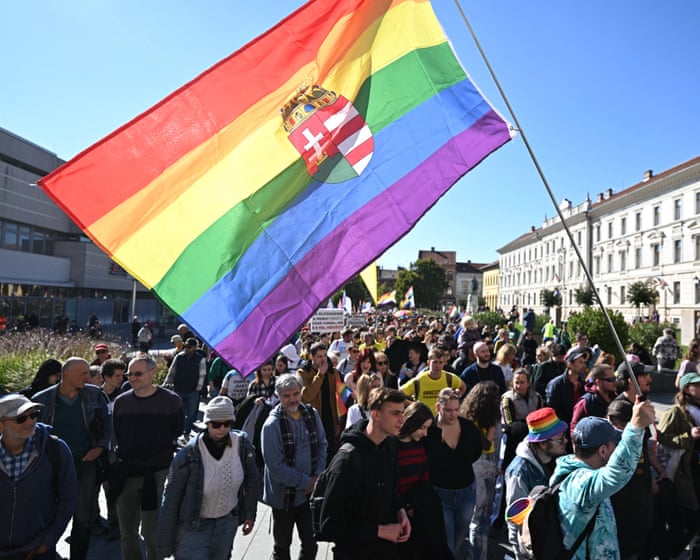
In early October, thousands gathered in the southern city of Pécs for the Pride march. This was its fifth year, and alongside Budapest’s, it was the country’s only annual Pride event, growing into a symbol of the city’s dedication to freedom, diversity, and minority inclusion.
This year, however, the political climate was tense. In March, Prime Minister Viktor Orbán and his right-wing populist party voted to ban Pride events and authorize the use of facial recognition technology to identify and potentially fine attendees—a move Amnesty International called a “full-frontal attack” on LGBTQ+ people.
Despite this, tens of thousands defied the ban in June to march in Budapest after Pride was reclassified as a municipal cultural event. Months later, Pécs Pride also drew record numbers, with up to 8,000 participants, including several European Parliament members, even after police and Hungary’s highest court confirmed the event was prohibited.
For organizer Géza Buzás-Hábel, the ordeal began shortly after. “We decided to hold Pécs Pride despite the ban because Hungary must remain a European country,” said the Romani LGBTQ+ activist. “Freedom of assembly is a fundamental human right, and we cannot allow political decisions to limit our community’s visibility or self-expression.”
Organized by the Diverse Youth Network, which Buzás-Hábel co-founded and leads, the march has taken on broader significance in recent years as Hungarian authorities targeted LGBTQ+ people with discriminatory measures. “If we don’t stand up for ourselves here, then where?” he said. “Pride is not just a march—it’s a message: queer people exist even when others try to silence or ban us.”
Days after the march, he was called in for police questioning. His case was then forwarded to the prosecutor’s office with a recommendation to charge him with organizing and calling for participation in a prohibited assembly. Prosecutors are now deciding on the next steps; Buzás-Hábel could face a suspended prison sentence of up to three years.
This adds to the persecution he says he has already faced as an LGBTQ+ activist. Last year, he was dismissed from his state teaching job after nearly a decade of teaching Romani language and culture. He also lost his position as a mentor at a music center where he had worked for five years. If formally charged, he would be permanently barred from returning to teaching.
Campaigners in Hungary and internationally have raised alarms about the case. “This is the first known case in the European Union where a human rights defender faces criminal prosecution for organizing a Pride march—a step until now only seen in Russia or Turkey,” four Hungarian human rights organizations stated in a joint October statement.
They called the case a “dangerous shift” in Hungary’s campaign against LGBTQ+ people and civil society, and a “test for Europe,” urging the European Commission to act. “If a teacher in an EU member state can face prison for organizing a Pride march, it is not only Hungarian democracy at stake, but the credibility of the European Union itself,” the statement noted. “A gay Roma teacher in southern Hungary should not have to risk prison to remind the EU of its values.”
The European Roma Rights Centre echoed this sentiment: “Hungary’s case is unprecedented and dangerous. No one should be criminalized for organizing a peaceful Pride march. Not in Hungary. Not anywhere in Europe.”
Others see the case as revealing the vulnerability of activists and theOrganizations in Hungary view the persecution of Géza Buzás-Hábel as an attempt to intimidate Hungarians from exercising their right to peaceful assembly and from defending the values important to them.
The European Pride Organisers Association urged Hungary to drop the case, stating, “Our message is simple: Pride is peaceful, legitimate, and protected. Criminalising organisers is unacceptable.”
Buzás-Hábel believes this is part of a broader pattern across Hungary. “This is not really about me. In the eyes of those in power, I am just a speck of dust,” he said. “This is directed at my broader community, and the goal is to intimidate the people around me. They are using me as an example for the entire country.”
He spoke to the Guardian before traveling to Brussels, where, as a board member of Europe’s largest Roma youth network, he was due to attend a ceremony honoring Roma youth-led projects. The trip would also allow him to meet with EU decision-makers and politicians concerned about his case and the situation in Hungary.
“The real question is whether the European Union is ready to stand up for the principles it claims to represent,” he said. “If someone in an EU member state can face criminal prosecution simply for organising a peaceful Pride march—and the EU does not respond firmly—it sends the message that European values only matter until defending them requires real political courage.”
Despite the uncertainty now affecting his life and career, he expressed no regrets. “I have already experienced the personal cost of this system: I lost all my jobs, I was placed under secret service surveillance, and I now face potential criminal charges,” he said.
“But none of this changes the fact that I would organise Pride again in exactly the same way—and I will do so next year as well,” he added. “For me, it is not just an event, but a stand for all those who need visibility and courage in such a hostile environment. Freedom sometimes comes at a high price, but the only thing I would truly regret is failing to stand up for my community.”
This article was amended on 10 December 2025 to clarify that Géza Buzás-Hábel was dismissed from his teaching job in 2024, prior to organising the Pécs Pride event.
Frequently Asked Questions
Of course Here is a list of FAQs about the case of a teacher in Hungary facing criminal charges for organizing a Pride event written in a natural tone
BeginnerLevel Questions
1 What exactly happened
A teacher in Hungary helped organize a school Pride event to promote LGBTQ inclusion Following a complaint the police investigated and the public prosecutor has now brought criminal charges against the teacher
2 What are the actual charges
The teacher is charged with violating the prohibition of the dissemination of information detrimental to the development of minors This is based on a controversial 2021 Hungarian law that restricts content about homosexuality and gender transition in schools and media accessible to minors
3 Why is this a criminal matter and not just a school issue
Because of the 2021 law which frames certain discussions about LGBTQ topics with minors as a potential crime moving it from an educational policy issue to a legal one
4 What could happen to the teacher if found guilty
The teacher could face a fine or even imprisonment though a fine is the more likely initial penalty
5 What has been the reaction in Hungary
It is deeply divided Supporters of the government and the law see it as protecting children LGBTQ advocates opposition parties and many teachers see it as an attack on fundamental freedoms academic freedom and a frightening escalation of the laws application
Advanced Contextual Questions
6 What is the 2021 Hungarian antiLGBTQ law people keep mentioning
Officially called the Child Protection Act it bans the portrayal and promotion of gender identity different from sex at birth sex change and homosexuality in school educational programs media and advertisements accessible to minors Critics including the EU say it conflates LGBTQ content with pornography and illegally discriminates
7 How does this case differ from the laws initial intent
The law was widely seen as targeting media and publishers Charging an individual teacher for organizing a school event is a significant and novel escalation setting a direct precedent for educators
8 What is the European Unions stance on this
The European Commission has launched infringement procedures against Hungary over this law arguing it violates EU internal market rules fundamental human rights and the values of the Union This case will likely intensify that legal battle