Bulgaria’s prime minister has announced that his government will resign, having served for less than a year amid ongoing anti-corruption protests.
Prime Minister Rosen Zhelyazkov made the announcement on Thursday, ahead of a parliamentary vote on a no-confidence motion brought by the opposition. The decision followed a meeting of the ruling coalition’s party leaders.
“The government resigns today,” Zhelyazkov told reporters. “People of all ages, ethnic backgrounds and religions have spoken out in favour of resignation. That is why this civic energy must be supported and encouraged.”
The latest wave of protests saw tens of thousands of people demonstrate across Bulgaria on Wednesday, criticizing the government for its perceived failure to tackle corruption. Anger was initially sparked by a draft 2026 budget, which protesters argued was designed to conceal widespread corruption. Although the government withdrew the budget last week, public frustration has continued.
As the European Union’s poorest member state, Bulgaria is still scheduled to join the eurozone on January 1, a move analysts expect to proceed despite the political turmoil. However, concerns about rising prices ahead of the euro adoption have further eroded public trust in the country’s institutions and leaders.
Last week, President Rumen Radev expressed support for the protesters and called on the government to step down to allow for early elections.
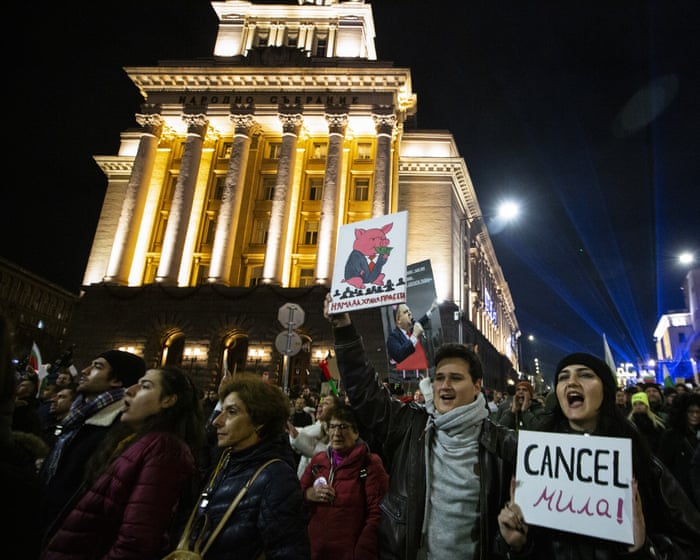
During Wednesday’s rally in Sofia, a large crowd gathered outside parliament, chanting “resign” and holding signs with messages like “I’m fed up!” alongside caricatures of politicians. Gergana Gelkova, a 24-year-old shop worker, told AFP she joined the protest because corruption had become “intolerable,” adding that most of her friends had left Bulgaria with no plans to return.
Bulgaria ranks among the lowest EU members on Transparency International’s Corruption Perception Index. The country has experienced significant political instability, holding seven snap elections since mass protests in 2020 targeted the government of former long-serving Prime Minister Boyko Borissov.
Borissov’s centre-right GERB party won the most votes in last year’s election and formed the current coalition government in January.
Frequently Asked Questions
Of course Here is a list of FAQs about the Bulgarian government stepping down following protests against corruption designed to answer questions from basic to more advanced
Basic Understanding Context
1 What just happened in Bulgaria
The Prime Minister and his cabinet resigned after months of large public protests The protests were fueled by widespread anger over corruption and the influence of powerful business interests in politics
2 Why did the government step down
They stepped down due to massive public pressure from ongoing nationwide protests While not legally forced to the political pressure and loss of public trust made governing effectively impossible
3 What were people protesting about
Protesters were primarily demanding the resignations of the Prime Minister and the chief prosecutor accusing them of protecting corrupt oligarchs and failing to prosecute highlevel corruption for years
4 What is an oligarch in this context
In Bulgaria it refers to a very wealthy businessperson who is believed to use their money and connections to secretly influence government decisions laws and prosecutors for their own benefit often at the expense of the public
Immediate Consequences Process
5 Who is in charge now
The resigned government remains in a caretaker or acting capacity managing daily affairs but not making major new policies They will stay until a new government is formed after elections
6 What happens next
The President will appoint a caretaker government Then the country must hold early parliamentary elections so voters can choose a new parliament which will then try to form a new ruling coalition
7 Will things change immediately
No The resignation is the first step Real change depends on the results of the upcoming elections and whether new politicians can form a stable government with a clear anticorruption mandate
8 Is this a coup or a revolution
No This is a constitutional democratic process The government resigned peacefully under public pressure and the next steps are all outlined in Bulgarias constitution
Deeper Analysis Implications
9 Why is corruption such a big issue in Bulgaria
Bulgaria is the poorest and perceived as the most corrupt country in the European Union Many citizens feel EU funds are stolen justice is for sale and this holds back their economy and quality of life