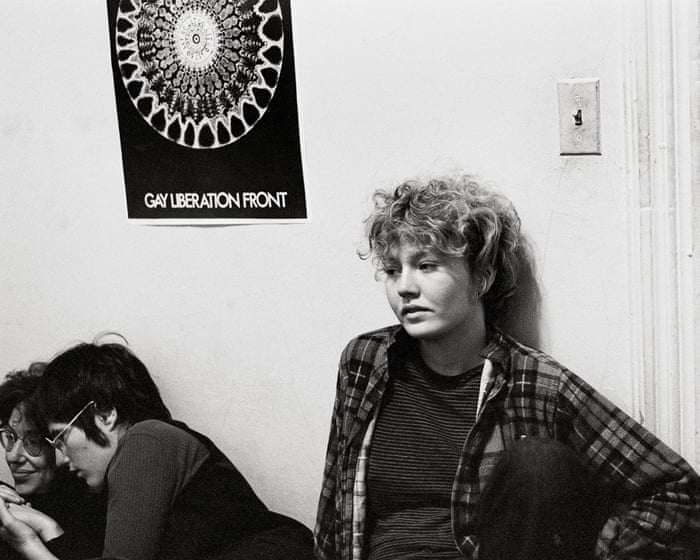
When Donna Gottschalk came out as gay to her mother, her mother responded, “You’ve chosen a rough path.” It was New York in the 1960s, a time when homosexuality was illegal. As the photographer reflects in a video piece for her new exhibition, We Others, “There were no happy gay people.” The show opens with a photograph of Gottschalk’s mother in the beauty salon she ran in the notoriously crime-ridden Alphabet City. The images are accompanied by texts from French writer Hélène Giannecchini, which record Gottschalk’s memories of the people and events depicted.
Gottschalk first picked up a camera at 17, so these pictures also trace her own awakening as she embraced her identity and joined the Gay Liberation Front. The story begins with family. One painfully poignant image shows her sister, Myla, at age 11—a picture of innocence and peace—asleep in bed in the family’s tenement apartment.
Myla’s own sexual blossoming over the years mirrors Gottschalk’s. At 16, Myla appears semi-nude, posing shyly in an apartment, aware of her beauty. This quiet, caring sequence is sharply interrupted by a 1979 close-up of Myla’s face after a violent “gay bashing” with a golf club, her eyelids swollen and purple. Taken at Myla’s request, the image pulses with shared indignation. Another photo, shot almost 20 years later, soon after Myla began her transition, shows her relaxed and happy in their mother’s apartment. Myla’s story—at least as the exhibition tells it—ends in 2013 with a picture of her, fully herself.
In these images, the personal and political are closely intertwined. One of Gottschalk’s best-known photos depicts a couple huddled under a rough blanket on a single bed in a dilapidated apartment. Above them hangs a poster from the Revolutionary Women’s Conference: “Lesbians Unite!” Gottschalk placed the poster there before taking the picture. It’s a simple yet scorchingly radical image, offering a glimpse of the happy gay life she had never seen before.
Gottschalk’s exhibition synergistically connects with this year’s Deutsche Börse Photography Foundation Prize. The shortlist exhibition—which, for the first time, features only women and non-binary artists—shows marginalized bodies still under threat, but here the camera becomes a tool for solidarity, kinship, and activism: a way to protect inner worlds and escape loneliness.
This year’s prize boldly embraces elegant, stripped-down forms of display, giving both images and viewers space. This approach begins with Rene Matić, whose work shares the themes and urgency of Gottschalk’s as they document their own young, queer community. The Turner Prize-nominated artist recreates their installation Feelings Wheel. Matić’s signature diaristic, smudgy, sensual snapshots of friends and family are printed in various sizes and mounted in glass-panel structures, allowing them to overlap, collide, and rub against each other like sweaty bodies in a smoky club.
The qualities of glass—an amorphous solid—serve as a metaphor for the experiences of Matić’s subjects: a community shaped by precarity, vulnerability, and fluidity, yet resilient. Born in 1997, Matić is the Wolfgang Tillmans of their generation, teasing out tensions and ideas through spatial installations that use varied constellations and structures to guide the viewer. Individually, their images may seem unexceptional, but together, bouncing off one another, they gain power.
In the next room, a series of documentary photographs by Jane Evelyn Atwood plunges you into a nightmarish world…Jane Evelyn Atwood was among the first female photojournalists to document women’s prisons in the 1990s, dedicating a decade to the project. She visited 40 prisons across nine countries, spending at least a week in each. Appalled by the hellish conditions—including physical and mental abuse, dehumanizing treatment, and women giving birth while handcuffed—her work became a powerful call for change.
Her photographs, though carefully composed, strike with a raw, urgent force. Most of the incarcerated women she encountered were mothers separated from their children, imprisoned for non-violent offenses, or trapped by abusive partners. One of the most haunting images shows the empty death row chapel at Riverbend Maximum Security Institution in Nashville: a barren space with rigid pews and two hand-stitched prisoner-made posters on the walls, each bearing a single, poignant word: “HELP” and “FREE.”
Upstairs, Weronika Gąsicka’s Encyclopaedia offers a more playful, yet unsettling, exploration of knowledge and its distortion. Using stock and AI-generated imagery, she creates entries for hundreds of invented facts, mimicking the style of historical reference works. With vivid colors and displays framed like artifacts or curiosity cases, Gąsicka immerses viewers in a slippery world of untrustworthy images, where truth drifts from reality. Her work presents a dystopian warning: we must quickly learn to distinguish fact from sophisticated fiction before we lose our way entirely.
The exhibition concludes with Iranian artist Amak Mahmoodian, now living in exile in the UK. Over several years, she collaborated with 16 other exiles to create One Hundred and Twenty Minutes, a lyrical, multimedia piece. Mahmoodian recorded each person’s recurring dreams, created visual representations of them, and wove these together through poetry, film, and photography. The resulting sequence flows like a wave of dreams along the wall, moving through the unconscious. Recurring symbols—windows, mirrors, spectral figures in white, snakes, and hands—evoke a sensation of drifting, floating far above the everyday.
It is a tender, original approach to social documentary, conveying the ache of displacement without exploiting identity or pain. Mahmoodian highlights a universal human capacity: to dream, to hope, to cling to memories of home even when torn from it. The room carries a melancholy tone, but there is solace in her reminder that some things—carried within us, often unnoticed—can never be taken away.
Donna Gottschalk and Hélène Giannecchini: We Others and the Deutsche Börse Photography Foundation Prize 2026 are at The Photographers’ Gallery, London, until 7 June.
Frequently Asked Questions
Of course Here is a list of FAQs about the exhibition Donna Gottschalk and Hélne Giannecchini A Deutsche Brse Prize review images that enrage baffle and profoundly move you
General Beginner Questions
1 What is this exhibition about
Its a dual exhibition showcasing the work of two photographers Donna Gottschalk and Hélne Giannecchini who were both nominated for the prestigious Deutsche Brse Photography Foundation Prize The title highlights the powerful emotional impact of their images
2 Who are Donna Gottschalk and Hélne Giannecchini
Donna Gottschalk is an American photographer known for her intimate activist portraits of the lesbian and queer community in 1970s San Francisco
Hélne Giannecchini is a contemporary French artist who creates enigmatic often staged photographs and installations that explore themes of the body memory and perception
3 Why are they shown together Whats the connection
They are linked by their nomination for the same major prize The exhibition likely explores how both artists from different eras use photography to challenge norms document marginalized experiences and evoke deep feelingeven if their styles are very different
4 What does images that enrage baffle and profoundly move you mean
Its a description of the intended effect Gottschalks work might enrage you at historical injustice or move you with its tenderness Giannecchinis abstract poetic work might baffle or puzzle you inviting deeper contemplation that can also be moving
5 Where and when is this exhibition happening
You would need to check the website of the Deutsche Brse Photography Foundation or the hosting gallery for current details
Content Themes
6 What kind of photos will I see by Donna Gottschalk
Expect powerful blackandwhite portraits and candid scenes from the lesbian feminist dyke culture of the 1970s Her work is direct personal and a vital historical document of love and resistance