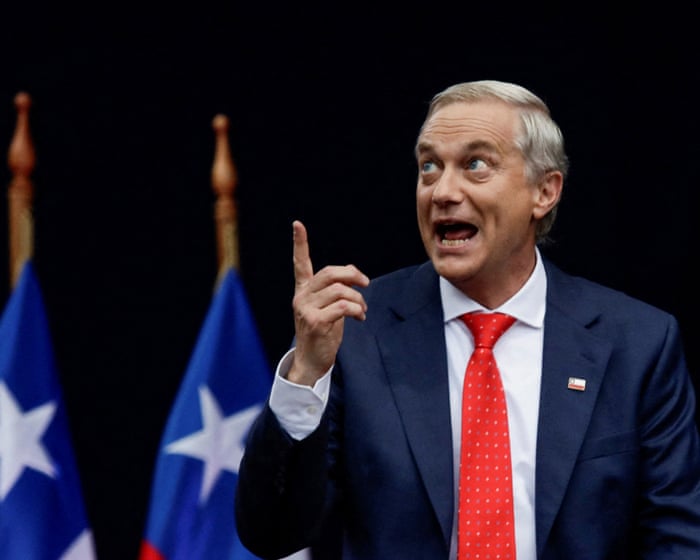
Chileans will vote in a presidential runoff on Sunday, with the frontrunner being a candidate inspired by Donald Trump who has promised to build a wall along the country’s borders to keep migrants out.
José Antonio Kast, a 59-year-old ultra-conservative former congressman, has centered his campaign on a pledge to expel tens of thousands of undocumented migrants. He is running against Jeannette Jara, a 51-year-old former labor minister under the current center-left president, Gabriel Boric, 39.
Jara led the first round with 26.9% of the vote compared to Kast’s 23.9%. However, while she was the unified candidate of a left-wing coalition, right-wing contenders, including Kast, collectively won more than half of the votes.
As a result, and based on recent polls, Kast is widely expected to become Chile’s next president for a four-year term. He is the son of a Nazi party member, an admirer of the dictator Augusto Pinochet, and a staunch Catholic known for opposing abortion and same-sex marriage.
However, analysts caution that his victory is not guaranteed due to a new factor in this election: for the first time in over a decade, voting is compulsory again. In past elections, about a third of Chile’s 15 million eligible voters typically abstained.
Claudia Heiss, a political scientist at the University of Chile, noted that these 5 million people are generally more distrustful of politics. In the first round in November, this “new” electorate was drawn to right-wing populist promises and voted against the ruling coalition.
But Heiss says the behavior of these voters in the runoff remains unpredictable. Another candidate, economist Franco Parisi, 58, appeared to benefit from their support. Running for the third time and presenting himself as an “outsider,” Parisi secured a surprising third place with 20% of the vote.
Rossana Castiglioni, a political science professor at Diego Portales University, explained that Parisi appealed to young men who were typically not politically engaged. Now, it is unclear where his votes will go, as he did not endorse Kast for the runoff, unlike other defeated right-wing candidates. Instead, he maintained his campaign slogan of “neither fascist nor communist,” and many of his supporters may spoil their ballots in protest.
Still, Castiglioni said, “if we trust the polls, everything indicates that Kast should be the winner.”
Heiss noted that Kast has benefited from public “paranoia” over security and migration. Chile’s immigrant population has doubled in the past decade, driven largely by about 700,000 Venezuelans fleeing their country’s economic collapse.
“There is a fear linked to the emergence of new forms of crime that weren’t common here—such as contract killings, kidnappings, and extortion—associated with the arrival of foreign organized crime groups, but they are not the majority of migrants coming to Chile,” Heiss said.
She added, “Heightened fear has created fertile ground for penal populism and iron-fist policies.”
During a presidential debate, Kast twice claimed that “1.2 million people are murdered each year in Chile,” a wildly inaccurate figure. Despite a recent increase, the country records about 1,200 homicides annually, remaining one of the safest in Latin America.
Like many right-wing leaders in the region, Kast admires El Salvador’s president, Nayib Bukele, who has imprisoned at least 2% of his country’s adult population in a controversial crackdown on gangs. “Every Chilean voting today, if Bukele were on the ballot, would choose Bukele,” Kast said in another debate.
Jara has also presented her own version of an “iron fist” policy, stating that security is her “top priority” and promising to build five new prisons and expel criminals.While Jara aims to register approximately 330,000 undocumented migrants using biometric identification, Kast has issued an ultimatum for them to leave before the next president takes office on March 11, or face expulsion “with only the clothes on their backs.”
Migrants are a key focus of his platform, which features a plan inspired by Donald Trump to construct detention centers, along with 5-meter-high walls, electric fences, and 3-meter-deep trenches. He also proposes increasing military presence along the border, especially in the north near Peru and Bolivia.
Despite Kast’s clear admiration and references to Trump, the former U.S. president has not expressed support for his Chilean counterpart. This contrasts with other Latin American elections this year, such as in Argentina and Honduras, where analysts and local politicians criticized Trump for outright interference.
Even without any sign of backing from his political idol, Kast continues to revere Trump and his actions. During a debate, when asked if he would support a U.S. ground intervention in Venezuela, the ultra-conservative candidate responded positively, invoking the motto from Chile’s national coat of arms: “By reason or by force.”
Frequently Asked Questions
Of course Here is a list of FAQs about José Antonio Kast and the Chilean presidential runoff designed to answer questions from basic to more advanced
Basic Information Context
1 Who is José Antonio Kast
José Antonio Kast is a Chilean lawyer and politician known for his strongly conservative and lawandorder platform He is the founder of the Republican Party and is often described as a farright candidate
2 What is a presidential runoff election
A runoff happens when no candidate wins more than 50 of the vote in the first round The top two candidates then face each other in a second vote to determine the winner In Chile this was between Kast and his leftwing rival Gabriel Boric
3 Why is Kast described as farright
He is labeled farright due to his hardline positions emphasizing strict immigration control a strong military and police presence conservative family values skepticism of climate change policies and a desire to roll back many recent social reforms
4 Did José Antonio Kast win the election
No While he was favored by some polls after the first round he lost the runoff election on December 19 2021 to Gabriel Boric Gabriel Boric is now the President of Chile
Platform Policies
5 What were Kasts main campaign promises
His key promises included building a ditch on the northern border to stop illegal immigration increasing police powers and funding cutting taxes and government spending repealing recent pension reforms and promoting traditional family values in education
6 How did Kasts economic plans differ from his opponents
Kast advocated for a freemarket minimalist state model inspired by Chiles Pinochetera constitution but with modern adjustments His opponent Boric proposed a stronger welfare state higher taxes on the wealthy and greater public investment
7 What was his stance on Chiles new constitution
Kast was a strong opponent of the process to write a new constitution He supported major changes to the draft and advocated for maintaining the core of the current marketfriendly constitution from 1980
Controversies Challenges
8 Why is Kast a controversial figure
His controversial statements include downplaying human rights abuses during the Pinochet dictatorship making inflammatory remarks about immigrants and opposing progressive policies on abortion and LGBTQ