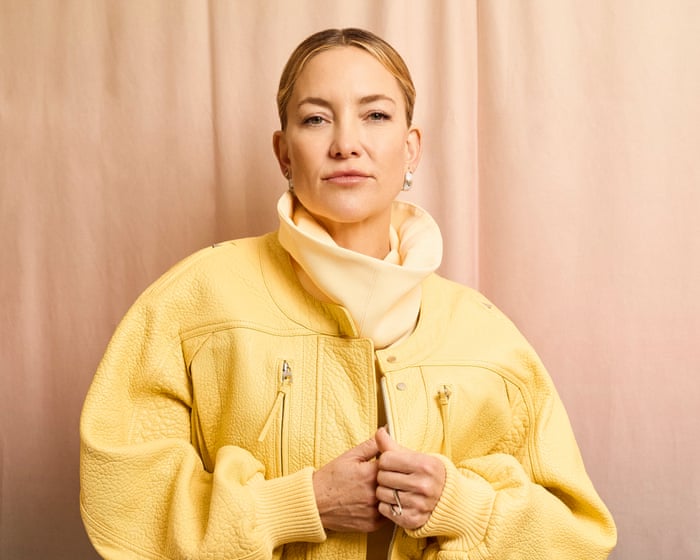
The first voice I hear when I enter the hotel room to meet Kate Hudson belongs to her 21-year-old son, Ryder, who calls out from the phone: “Love you, Mum!” Doesn’t everyone? You don’t have to be related to Hudson to see her as a delight—a great performer who hasn’t yet starred in a truly great film. It was a quarter-century ago in Almost Famous, her breakthrough role, that she first showed she could lift a movie out of the ordinary, making it look as easy as blow-drying her hair. Without her turn as Penny Lane, the rock ’n’ roll muse who calls herself a “band-aid” rather than a groupie, Cameron Crowe’s sentimental tribute to his 1970s youth would have been almost forgettable.
Her energy powered that film, and her face alone drove its marketing, so it was fitting that Hudson, then just 21, earned an Oscar nomination. The years that followed brought a flurry of rom-coms like confetti, including How to Lose a Guy in 10 Days and Bride Wars, both huge hits despite their undercurrent of bitterness. There were overlooked dramatic risks (The Killer Inside Me, The Reluctant Fundamentalist), cringe-worthy misfires (the cancer drama A Little Bit of Heaven, Sia’s clumsy autism film Music), and the occasional sparkling comeback, like Glass Onion: A Knives Out Mystery, where Hudson shone as a ditzy fashion designer prone to facepalm moments.
Now 46, she has just landed a Golden Globe nomination and likely another Oscar nod on the way. Once again, it’s for a music-steeped film: Song Sung Blue, a real-life underdog love story based on the 2008 documentary of the same name. Hudson plays Claire Sardina, aka Thunder, who forms a Neil Diamond tribute act with her husband, Mike (Hugh Jackman), the Lightning to her Thunder. The first half, where Claire meets Mike and their partnership turns romantic, is charmingly quirky. The second half takes more tragic turns than a mournful country ballad. Throughout, Hudson is a beacon of resilience, humanity, and tenderness.
Dressed all in black today, with straight, glossy blonde hair, she is relaxed, though easily distracted. “Should I eat this if it was already open?” she wonders aloud, inspecting the sachet that came with her tea. “Do you think someone did something to this?” She pours it into her cup anyway. “Cut to the end of the interview and I’m, like, on the floor…”
Hudson also has one eye on her plans with her son later. “We’re going to see Radiohead. I’m so excited!” The last time she saw them live, she was Ryder’s age: it was October 2000, Almost Famous had just opened in the U.S., and the avant-garde band from Oxfordshire were the musical guests on Saturday Night Live, which she was hosting. Hudson stripped down to reveal “Radiohead is here” painted on her bikini-clad body, along with flowers and peace symbols. To frenetic, groovy music, she danced and shimmied as the camera zoomed in and out at high speed.
The whole spectacle was a nod to Rowan & Martin’s Laugh-In, the dizzy late-1960s comedy show that made her mother, Goldie Hawn, a star—often seen frolicking in swimwear and body paint. That SNL moment was an early acknowledgment, as if any were needed, that Hudson would have her work cut out for her trying to step out of her mother’s shadow.
Hawn is an invisible presence in this London hotel room. It’s her 80th birthday, and Hudson is missing the celebrations back home to promote Song Sung Blue.At least she can feel symbolically close to her mother by being in the city where it all began. “It’s so awesome that I was conceived in London,” she says, ignoring the teatime rain clattering against the window. Conception occurred in Regent’s Park, about a mile from where we are sitting. “Not in the actual park. That would have been a way cooler story. It was in an apartment my mom was renting. I bet she’ll remember which one.”
Her parents—Goldie Hawn was married to the musician Bill Hudson—split when she was 18 months old and her brother Oliver was four. Their stepfather, the actor Kurt Russell, whom their mother has been with for more than 40 years, is the man they call “Pa.” Asked last year about her relationship with her biological father, who blasted her as “spoiled” in his memoir but was largely absent from her life, Hudson said: “I don’t really have one.” She then modified her statement: “It’s warming up.”
Music has been the connective tissue throughout her life and work. Bill Hudson was a member of the Hudson Brothers, who spent much of the 1970s as teen idols signed to Elton John’s record label. Hawn released a country-tinged album, Goldie, in 1972. All three of Hudson’s children have musician dads: Ryder’s father, and Hudson’s first and only husband so far, is the Black Crowes singer Chris Robinson; she had her second son Bingham, who is 14, with Matt Bellamy of Muse; and her current fiancé, Danny Fujikawa, formerly of the LA band Chief, is the father of her daughter Rani, who is seven.
Hudson has sung on screen plenty of times before, including a boozy duet with Matthew McConaughey of Carly Simon’s “You’re So Vain” in How to Lose a Guy in 10 Days, and the showstopping sequence in Nine in which she belts out “Cinema Italiano” while trooping up and down a catwalk in silver boots. “WHY hasn’t a musical been written for Kate Hudson?” demanded one YouTube commenter, not unreasonably.
Song Sung Blue is different. The Neil Diamond songs are all wrapped up in Hudson’s performance: she’s singing in character, expressing Claire Sardina’s pain, yearning, and indefatigability through music. “In the studio, I’d find these harmonies myself and do my own vocal riffs,” she says proudly. The director, Craig Brewer, encouraged her. “I’d be saying, ‘But Craig, is it really Claire?’ And he’d go, ‘It is now!’” That freedom might not have been possible had she modeled herself too closely on the real Sardina, whom she only met when shooting was under way. “By that point, my version of Claire was in my body. But it was good to have her there to ask, ‘Did this bit really happen like this?’”
Hudson’s singing in the film has more authentic gusto than anything heard on her own rent-a-rocker debut album, Glorious, released last year. It was while promoting the album on US television that she caught Hugh Jackman’s eye. “Hugh saw me being interviewed, where I’m talking about how I simply had to be singing and writing music, and he was like: ‘Well, she obviously needs to be Claire.’” You can see his point. It’s the urge to perform that sustains Sardina as fate dishes out one flabbergasting blow after another. “I understand what it’s like to love something so much that you can’t face losing it,” says Hudson.
She might not have recorded Glorious in the first place if it weren’t for Paul McCartney. “It was Paul’s 80th birthday and I was sitting at the side of the stage watching him headline Glastonbury.” The story ends in an epiphany. “I woke up the next morning and felt so emotional. I was, like, ‘I am not happy with my output!’ I mean, I have so much gratitude. But I am not just an actor. I’ve been a musician my whole life and I never hI had the courage to do anything with it. I decided I want to take more chances. I want to fail more.” Perhaps she won’t be too hurt, then, that the Times described Glorious as “the very essence of a vanity project.”
Watching McCartney made her think “about those who compromise and those who don’t. I thought about being a woman in the industry and all the compromising you do for other people. About doing comedies and being successful in them but still feeling like you’re constantly having to compromise.”
Not that she’s dissing rom-coms. “You know what? They’re my favourite. I love them and I will never stop making them. I just think they need to be better. When you’re trying to make a great one, you’re fighting a lot of algorithms. I think they’ve dumbed down the rom-com. The ones I loved were written and directed by the best talent. Nora Ephron, Jim [James L.] Brooks: those are the great ones that last forever. They’re like comfort blankets.”
Other films are more like hair shirts. Take The Killer Inside Me, a necessarily repulsive adaptation of Jim Thompson’s noir novel about a psychopathic deputy sheriff, played by Hudson’s old pal Casey Affleck. It was Affleck and the picture’s British director, Michael Winterbottom, who persuaded her to take the role of the killer’s fiancée, who is shown being spanked. For real, as she confirmed in 2010: “There were a couple [of slaps] in there when I thought: God, Casey! He got a bit of power behind it.” Before being murdered by him, she is spat on and punched in the stomach. It’s a contentious film but hardly the work of a compromiser.
“That stretched different muscles,” she says now. “I didn’t get into acting to only do one thing.” Affleck intimated at the time that his then-wife was no fan of the film. What feedback did Hudson receive? “Oh, it was fine. It was such a small movie.” Meaning, presumably, that no one saw it anyway. I tell her I admire it, but I never want to watch it again. “That’s how I felt,” she says.
She claims not to pay any attention to what is said about her, good or bad. “It all falls into the category of what Kurt calls ‘noise.’ His thing is always: just do great work.” Presumably, that goes for all the Oscar chatter, too. “That’s nice noise,” she concedes. I ask how often she has been checking Variety magazine’s regularly updated Oscar predictions. Should I get them up for her on my phone? “No, don’t!” she squeals in horror. “It freaks me out. I can’t even.” I refrain from telling her that Jessie Buckley is the current favourite to take the prize for Hamnet. Where Buckley’s performance as Shakespeare’s wife, grieving the death of their young son, is studied and self-consciously elemental, Hudson’s work in Song Sung Blue has an undemonstrative fluidity. It feels like life, rather than acting.
Nomination or not, she has plenty to keep her busy, including Sibling Revelry, the family-dynamics podcast she co-hosts with her brother Oliver. Guests have ranged from A-list (Michelle Obama and the occasional Kardashian) to niche, such as the “psychic medium” John Edward. He was credulously indulged across two hour-long episodes, egged on by Hawn, who is no stranger to psychics; and Oliver, a garrulous sometime actor who claims to consult oracles before choosing whether to accept a role. Let’s just say this doesn’t reflect well on the oracles.
Hudson is not quite so woo-woo. “Psychic readings are fun,” she says. “But I take them with a grain of salt.” On a recent episode, the siblings were diagnosed with ADHD live on air.The diagnosis came from a doctor who seemed unsure of who he was speaking to; at one point, he mistook Oliver for Hudson’s partner. Was it an official diagnosis? “Oh yeah, it was real,” she says, describing it as “validating. I’ve spent forever trying to figure out how to organize my life, and now I feel I have the tools.” She distinguishes their diagnosis from what she calls the general ADHD of the world: “the kind that’s due to phones. What we have is the real deal.”
Her next goal for the podcast is to interview more directors. Turning the tables, she asks me: “What kind of interviews do you like best? Who’s been your favorite?” Then, with a comical flutter of her eyelashes, she adds, “Apart from me, obviously.” But the experience of being interviewed by Hudson ends almost as soon as it begins—time is up, and Radiohead is waiting. As for her career: here’s hoping for more alarms and more surprises, please.
Song Sung Blue will be in UK cinemas starting 1 January.
This article was amended on 15 December 2025. Kate Hudson’s eldest son is named Ryder, not Tyler as an earlier version stated.
Frequently Asked Questions
FAQs Kate Hudson on Risk Compromise and Finding Her Voice
BeginnerLevel Questions
Q1 What does Kate Hudson mean by I am not happy with my output
A Shes expressing a feeling of creative dissatisfaction It means that despite her success she feels her work hasnt fully represented her true self talents or ambitions
Q2 Why is she talking about this at age 46
A Midlife is often a time of reflection With more life experience she likely has greater clarity on what she genuinely wants versus what she felt pressured to do earlier in her career
Q3 What kind of risks is she referring to
A These are creative and personal riskslike starting a new business taking on challenging acting roles outside her type or publicly sharing her unfiltered opinions and passions
Q4 What does rejecting compromise mean in this context
A It means no longer saying yes to projects roles or situations that dont align with her core values artistic integrity or personal happiness even if they come with money or fame
Q5 What is finding your voice
A Its the process of understanding and confidently expressing your authentic selfyour true opinions creative style and what you stand forwithout being overly influenced by others expectations
Advanced Practical Questions
Q6 What are the benefits of taking these kinds of risks later in life
A The benefits include deeper personal fulfillment a legacy that feels authentic inspiring others and often discovering a second act in your career that is more aligned with who youve become
Q7 Whats a common problem or fear when trying to reject compromise
A The biggest fear is financial or professional instabilityworrying that saying no will lead to fewer opportunities or criticism for being difficult
Q8 Can you give an example of how she found her voice
A Launching her wellness brand INBLOOM is a prime example It combines her longstanding personal interests in health and nutrition into a business that reflects her authentic passions rather than just taking another movie role for a paycheck