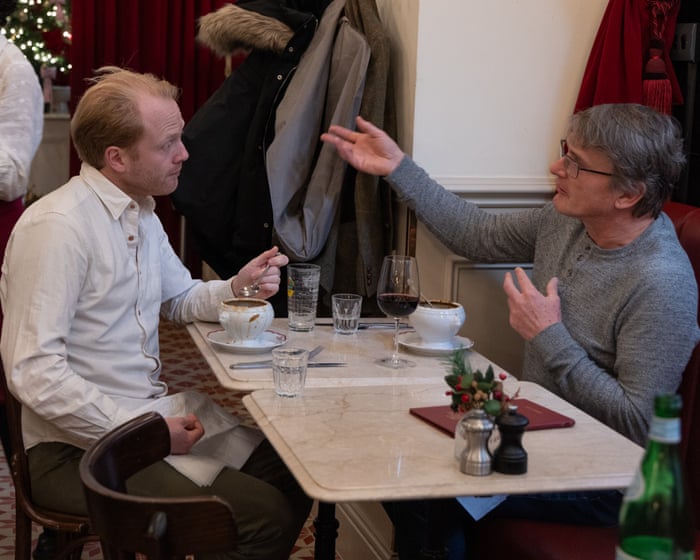
Rupert, 36, from Worthing, is training to be a psychotherapist. He first voted for David Cameron when he became eligible, toward the end of a long period of Labour government. He used to do a lot of comedy improv, enjoying the supportive group dynamic and the “yes, and…” culture.
Paul, 62, from London, is a retired software engineer. He traditionally voted Labour but chose the Green Party last time because he dislikes Keir Starmer. He has skydived for 20 years, wanting to know what it felt like to fall from a plane—he says it’s surprisingly like flying if you’re skilled.
First Impressions
Paul thought Rupert seemed very nice. Rupert’s first impression was that Paul seemed a bit difficult, admitting he found it hard to get the conversation flowing initially. He felt a twinge of resentment when Paul mentioned coming from a very well-paid job. Both ordered French onion soup and bavette steak.
The Main Topic: Gentrification
Paul sees gentrification as a social good overall. He believes it mixes communities, prevents the formation of non-diverse ghettos, and encourages people living side-by-side to treat each other as human beings, though he acknowledges it doesn’t address underlying inequality.
Rupert found the conversation flowed more easily once they discovered they’d both lived abroad. On gentrification, he took a more experiential view, associating it with the predictable, homogenised results like uniform apartment blocks and chain stores. He mentioned Worthing now having a Gail’s bakery as a sign of its ascent up the coffee shop ladder.
Paul argued that while unique local character might be lost, it’s more important to avoid social fragmentation—using the software term “sharding” to mean partitioning off communities. Neither felt they convinced the other, but both found it an interesting discussion.
Rupert shared his experience living on the fringes of gentrifying Brooklyn. As a white couple, he and his wife could be seen as disruptors, but he noted there was little real mixing—people just used different bars and supermarkets.
Sharing Views on Mental Health
Paul, speaking as an uninformed bystander, feels there’s an over-medicalisation in mental health today. He thinks society used to accept and cope with a wider range of behaviours, and that constantly trying to “fix” them isn’t necessarily good—we need some variation.
Rupert, noting Paul’s background in the neurodiverse software sector, emphasized the value of diagnosis. He believes that if a label helps someone feel heard, seen, and understood, that can be a wonderful thing.
Final Topic: Second Homes
Paul, a second-home owner, admitted his bias. He would worry about any measures to prevent second homes, seeing them as trying to stop outsiders.
Rupert doesn’t have a strong stance but stressed the importance of accountability. If he owned a second home, he’d want to be aware of his impact on the local community. He sensed an undercurrent from Paul of “What’s the alternative?” but admitted he doesn’t really have one.I’m not saying I’m in favor of socialist town planning.
Paul: The area where my second home is located—my parents have lived there for 40 years, and I spent part of my teenage years there, so I feel quite connected. I’m not a typical newcomer.
Takeaways
Paul: We left on very friendly terms; we even swapped phone numbers. The restaurant had to ask us to leave.
Rupert: Reflecting on the conversation, it reminded me of one of my fears: the underlying expectation that if I took a different position from him, I would be dismissed or devalued. There’s safety in going along with things, in agreeing. But we shared our perspectives, and there was room for both of us at the table.
Additional reporting: Kitty Drake
Paul and Rupert ate at Chez Antoinette in London SW1.
Want to meet someone from across the divide? Find out how to take part.
Frequently Asked Questions
FAQs Dining Across the Divide Gentrification
Beginner Definition Questions
1 What is gentrification
Gentrification is the process where a lowerincome often historically marginalized neighborhood experiences an influx of investment and wealthier residents leading to rising property values and changes in the areas character
2 What does Dining Across the Divide mean in this context
It refers to a conversation or structured dialogue where two people with opposing views on gentrification come together to discuss the issue aiming to understand each others perspectives
3 Who is typically for and against gentrification
Theres no single group but often supporters include new residents developers and some city planners who see economic improvement Critics often include longterm residents community activists and sociologists who see displacement and cultural erosion
Benefits Arguments For Improvement
4 How can gentrification improve a neighborhood
It can lead to reduced crime rates better public services and infrastructure new businesses and increased property values for homeowners
5 Doesnt investment and economic growth benefit everyone
Proponents argue it can through increased city tax revenue that could be reinvested in community programs job creation in new businesses and revitalizing neglected areas
Problems Arguments Against
6 Whats the main problem with gentrification
The core issue is displacement As rents and property taxes soar longterm residents and small businesses can be forced to move out breaking apart established communities
7 Does it only affect housing
No It also impacts local culture Beloved affordable local shops may close replaced by chains or upscale boutiques The social fabric and historical identity of a neighborhood can be lost
8 Is gentrification just about race and class
Often yes It frequently involves lowerincome communities of color being displaced by wealthier often white newcomers raising serious issues of equity and social justice
Examples Nuance
9 Can you give a realworld example of this debate
Think of neighborhoods like Williamsburg in Brooklyn NY or Brixton in London They transformed from workingclass areas into highpriced hubs showcasing both economic revival and significant displacement