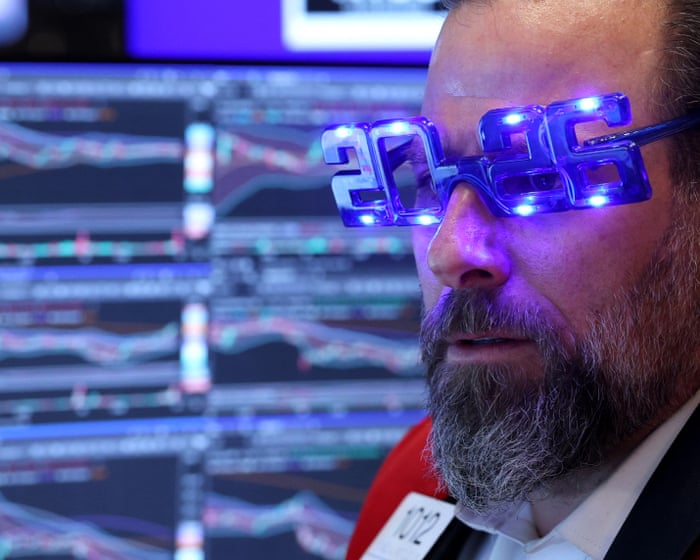
Investors anticipate global stock markets will continue to climb in 2026, even amid concerns about a potential AI bubble bursting and turmoil at the US Federal Reserve.
Wall Street strategists generally expect the S&P 500 index to keep rising over the next year, but warn volatility could increase if geopolitical tensions escalate or inflation remains stubborn.
Top Threats: AI Fears, Fed Turmoil, and Private Credit
A Deutsche Bank survey of 440 investors, economists, and analysts found that 57% see a sharp drop in tech valuations or waning AI enthusiasm as the top risk to market stability in 2026. The survey notes investors have never been so unified on the biggest risk for the year ahead, stating, “AI/tech bubble risk towers over everything else.”
The second major concern is that Donald Trump could appoint a new Federal Reserve chair who aggressively pushes for deep interest rate cuts, causing market disruption. Trump said on December 17 he would soon name a Fed chair who believes in “a lot” lower rates.
The third significant worry is a crisis in private capital markets, such as private equity, venture capital, and private debt. A Quilter poll of fund managers found private credit market stress is the most underappreciated risk, despite warnings from global regulators about dangers in the shadow banking sector.
UBS has advised clients that markets could “face new challenges” if AI progress slows, inflation rebounds, or debt problems resurface.
Will the UK Stock Market Keep Rising?
After a strong 2025, with the FTSE 100 blue-chip index surpassing 10,000 points for the first time, analysts and retail investors are confident about further gains in 2026.
Russ Mould, investment director at AJ Bell, said the outlook is positive, with analysts forecasting 14% profit growth for the FTSE 100 in 2026. Total dividend payments are expected to hit a new record of £85.6 billion, finally exceeding the 2018 peak of £85.2 billion.
A poll by eToro found 53% of UK retail investors are optimistic the current bull market will continue throughout 2026.
UK Bonds Could Do Well
Robert Timper, chief global fixed income strategist at BCA Research, said UK government bonds (gilts) could perform strongly if the Bank of England cuts interest rates faster than other central banks. He predicted UK gilts will become the best-performing bond market in 2026, supported by a dovish BoE and reduced fiscal concerns.
Global Markets Forecast to Rise
UBS predicts “supportive economic conditions should underpin global equities, which are expected to rise by about 15% by the end of 2026,” with gains likely in the US, China, Japan, and Europe.
Double-digit gains are expected on Wall Street. Under UBS’s base case, the S&P 500 would end 2026 at 7,700 points—a 12.5% gain. Deutsche Bank targets 8,000 points (+17%), while Oppenheimer Asset Management is even more bullish, forecasting 8,100 points.
Oxford Economics says above-consensus growth and below-consensus inflation in the US next year will lift US stocks.
UBS also recommends Chinese stocks, noting, “China’s tech sector stands out as a top global opportunity. Strong liquidity, retail flows, and earnings—expected to rise 37% in 2026—should sustain momentum for Chinese equities.”
Ostrum Asset Management predicts European equity markets will perform positively.The global economy is expected to avoid a downturn in 2026, supported by a return to earnings growth. However, this outlook depends on companies meeting high expectations. Investor Michael Burry, known from The Big Short, is less optimistic, predicting several difficult years ahead.
The impact of artificial intelligence will be a key factor. After massive investments in AI infrastructure, the technology sector is likely to shape long-term economic outcomes. Investors will watch to see if leading AI companies justify their high valuations and deliver the anticipated productivity gains. If they fall short, their market values could decline. While AI investment is still in early stages, concerns exist about complex ties between companies and their suppliers, which could create vulnerabilities if optimism wanes.
Beyond the focus on chatbots in 2025, capital expenditure may shift toward agentic AI, physical AI (like robots and self-driving vehicles), and AI video. UBS projects global AI capital spending could reach $4.7 trillion by 2030.
Economically, the world is expected to remain resilient in 2026, with little risk of a global recession. Goldman Sachs forecasts sturdy global growth of 2.8%, led by a strong U.S. economy supported by tax cuts, reduced trade drag, and easier financial conditions. China is also expected to perform well, driven by strong exports. UBS anticipates accelerated global growth, boosted by improved confidence and fiscal stimulus, while ING remains upbeat about the U.S. due to looser financial conditions.
In commodities, oil prices will be sensitive to geopolitical events, such as developments in the Russia-Ukraine war and Middle East conflicts. Oxford Economics predicts Brent crude could fall to $58 a barrel by the end of 2026. Copper prices, however, may rise due to a projected supply deficit.
Central banks are expected to continue easing monetary policy. Markets anticipate two U.S. interest rate cuts by December 2026, though this depends on the economic outlook and the next Federal Reserve chair appointment. In the U.K., at least one rate cut is expected, with some economists predicting two.
Despite the generally positive outlook, experienced market observers caution that consensus forecasts are often wrong—the question is how.Dario Perkins, an economist at TS Lombard, suggested the outlook might be stronger than anticipated. “The consensus is that 2026 will mirror 2025,” he told clients. “Steady global growth, some disinflation, and monetary policy returning to neutral—where it remains indefinitely. Zzzzz.”
He added, “Where could the consensus be wrong? We expect a stronger rebound in activity, which could reignite inflation and spark a debate [in the second half of the year] about monetary tightening.”
However, William Davies, global chief investment officer at Columbia Threadneedle Investments, cautioned that “the risks of a misstep are growing.” He warned, “Growth has been surprisingly resilient, inflation has eased (though unevenly), and markets have continued to rise. But beneath the surface, imbalances are building. We believe the coming year will be defined by how well policymakers and investors can navigate this narrowing path.”
Frequently Asked Questions
Of course Here is a list of FAQs about the topic From AI hype to concerns over the Federal Reserve what lies ahead for the global economy in 2026
Beginner Definition Questions
1 What are the main economic themes for 2026 being discussed
The two biggest themes are the realworld impact of Artificial Intelligence beyond the initial hype and the ongoing influence of central banks like the US Federal Reserve as they manage interest rates to control inflation and growth
2 What does AI hype mean in an economic context
It refers to the massive excitement and investment in AI technologies that drove stock market gains The question for 2026 is whether this will translate into widespread productivity gains and new business models or if progress will slow down
3 Why is the US Federal Reserve so important for the global economy
The Fed sets US interest rates When US rates change it affects the value of the dollar global investment flows and borrowing costs worldwide Many countries and companies base their financial decisions on what the Fed does
Impact What If Questions
4 How could AI actually boost the economy in 2026
If implemented successfully AI could make businesses more efficient lead to new products and services and potentially lower costs in areas like healthcare logistics and software development
5 What are the potential downsides or risks of the AI boom
Key risks include job displacement in certain sectors increased inequality if benefits arent widely shared high energy consumption by data centers and the possibility of a market bubble if investments dont pan out as expected
6 What is the biggest concern about the Federal Reserve for 2026
The central concern is whether the Fed can achieve a soft landingbringing inflation down to its target without causing a recession A misstep could trigger a downturn in the US which would ripple across the globe
7 Could high interest rates from the Fed cause a global recession in 2026
Yes its a significant risk Persistently high US rates can slow global demand make it harder for heavily indebted countries and companies to repay loans and cause financial stress in emerging markets