A surprise nighttime raid on the capital, capturing the country’s leader. By the next day, the invader announces it will rule indefinitely.
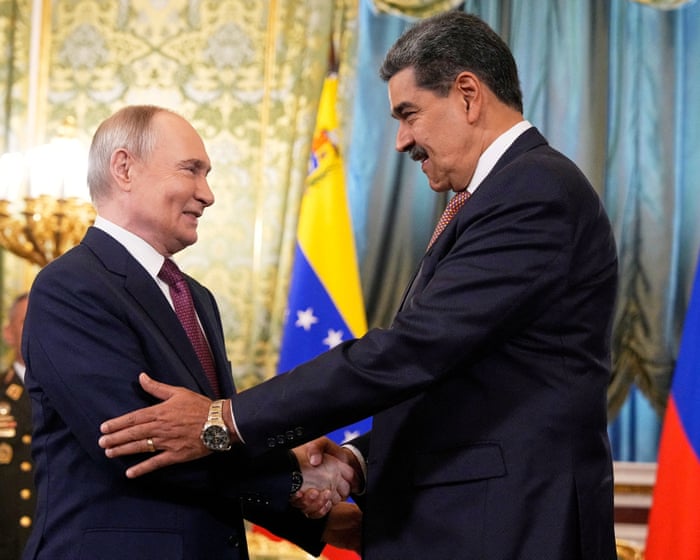
That was Vladimir Putin’s vision for the full-scale invasion of Ukraine in February 2022. Instead, it was Donald Trump who executed this playbook in Venezuela, in an operation widely condemned as illegal, spiriting away the Kremlin’s longtime ally Nicolás Maduro to face trial in New York.
Publicly, Russian officials have reacted with fury, calling the attack a blatant breach of international law and a dangerous precedent. But behind the rhetoric, there is a grudging respect—and even envy—for the effectiveness of a coup Moscow once imagined for itself but failed to pull off due to intelligence failures and fierce Ukrainian resistance.
“The operation was carried out competently,” wrote the pro-Kremlin Telegram channel Dva Mayora, which has close ties to the Russian military. “Most likely, this is exactly how our ‘special military operation’ was meant to unfold: fast, dramatic, and decisive. It’s hard to believe [Valery] Gerasimov planned to be fighting for four years,” it added, referring to Russia’s chief of the general staff.
Such commentary has fueled introspection among pro-war voices, with some openly questioning how Russia’s promised blitzkrieg in Ukraine turned into a protracted and bloody conflict.
Olga Uskova, a pro-Kremlin tech entrepreneur, said she felt “shame” for Russia given how brazen the U.S. intervention appeared. “In the space of a day, Trump arrested Maduro and seemingly wrapped up his own ‘special military operation,'” she wrote.
Margarita Simonyan, Russia’s top propagandist and head of RT, also commented on Telegram, saying Moscow had reason to “be jealous.”
For over two decades, Venezuela worked to build a network of anti-American allies—from Russia and China to Cuba and Iran—hoping to forge a new axis capable of challenging Washington.
Yet despite Russia’s foreign minister pledging support for Maduro’s regime as recently as late December, few serious analysts ever expected Moscow to mount a meaningful rescue.
Bogged down in Ukraine, Russia has watched other key allies lose power or weaken sharply over the past year—from Bashar al-Assad in Syria to an increasingly strained Iran—exposing the limits of the Kremlin’s reach.
“For Russia, the situation is deeply uncomfortable,” said Fyodor Lukyanov, a foreign policy expert who advises the Kremlin. “Venezuela is a close partner and ideological ally, and Maduro and Putin have longstanding ties, leaving Moscow with little choice but to express outrage at U.S. actions. Yet providing any real assistance to a country so distant, and operating in a fundamentally different geopolitical reality, is simply not feasible—for technical and logistical reasons.”
There is also a more practical calculation.
Putin’s priority, analysts say, is Ukraine—and maintaining a good relationship with Trump on that front far outweighs the fate of Caracas. Despite Moscow’s pledges to defend Maduro, the Kremlin had little appetite to risk angering Trump over a distant conflict.
“Putin and Trump are currently focused on a far more consequential issue for Moscow: Ukraine. And for all the Kremlin’s sympathies toward Caracas, it is unlikely to upend a much larger strategic game with a critical partner over what it sees as a secondary concern,” Lukyanov said.
Still, losing Venezuela carries tangible costs for Moscow. If a U.S.-friendly government emerges in Caracas, American military and defense systems could be deployed near Russian allies like Cuba and Nicaragua. More immediately, U.S. access to Venezuela’s vast oil reserves could drive down global prices, threatening one of Russia’s most vital sources of income.Specialists could gain access to much of the Venezuelan military’s arsenal, including advanced Russian-made systems supplied over the past decade. This includes S-300VM air-defense systems delivered in 2013, along with an undisclosed number of Pantsir and Buk-M2 systems transferred in late 2025.
Moscow has also provided Venezuela with billions of dollars in loans, much of which it is unlikely to ever recover. A more immediate concern for Russia, however, is oil: U.S. access to Venezuela’s vast reserves could drive down global prices, threatening one of Russia’s key sources of income.
“If our American ‘partners’ gain access to Venezuela’s oilfields, more than half of the world’s oil reserves will end up under their control,” wrote Oleg Deripaska, a powerful Russian billionaire industrialist, on Telegram. “And it appears their plan will be to ensure that the price of our oil does not rise above $50 a barrel.”
Still, some in Moscow see a grim reason for optimism. They argue that Trump’s seizure of Maduro could deal a final blow to the rules-based international order, ushering in a more openly 19th-century-style world—one where power, not law, determines outcomes, and the globe is divided into rival spheres of influence, a model long favored by Russia.
“Team Trump is tough and cynical in advancing its country’s interests,” wrote Dmitry Medvedev, Russia’s former president and one of its most hawkish voices, with approval. “Removing Maduro had nothing to do with drugs—only oil, and they openly admit this. The law of the strongest is clearly more powerful than ordinary justice.”
Frequently Asked Questions
Of course Here is a list of FAQs about the topic From grudging respect to unease Russia assesses the potential fall of Maduro framed in a natural tone
Beginner Definition Questions
1 What is this topic about
This is about how Russias view of Venezuelas leader Nicolás Maduro is changing Russia has long supported him but is now worried about what might happen if his government collapses
2 Why does Russia care about Venezuela
Venezuela is a strategic partner for Russia in Latin America Its a major buyer of Russian weapons has allowed Russian military presence and together they hold large oil reserves which helps counter US influence
3 What does grudging respect mean in this context
It means that while Russia may not have always admired Maduros leadership style or economic management they respected him as a steadfast ally who stood up to the United States and maintained power against pressure
Intermediate Analytical Questions
4 Why is Russia feeling unease now
Russia is uneasy because Maduros hold on power looks increasingly shaky due to Venezuelas deep economic crisis US sanctions and internal political challenges Russia fears losing its billions of dollars in investments military influence and a key ally if a new potentially proWestern government takes over
5 What would a fall of Maduro actually mean for Russia
It could mean
Financial Losses Russia has loaned Venezuela billions of dollars often repaid in oil A new government might reject these debts
Geopolitical Loss Losing a foothold in Americas backyard weakens Russias global standing
Military Setback Potential loss of access to airbases and ports used by Russian forces
6 Hasnt Russia propped up Maduro for years What did they do
Yes Russia has provided military equipment economic aid political support at the UN and sent technical advisors to help Venezuelas oil industry and security forces
7 Is Russia likely to intervene militarily if Maduro is about to fall
A largescale direct military intervention like in Syria is highly unlikely due to the huge distance and logistical challenges However Russia might increase military advisors private security contractors or diplomatic efforts to broker a deal that