The possibility of the United States taking direct control of Venezuela seemed to fade on Sunday following the dramatic removal of President Nicolás Maduro. However, U.S. officials warned they might consider another military intervention if interim President Delcy Rodríguez did not meet their demands.
Speaking to reporters late Sunday, Donald Trump also raised the prospect of military action in Colombia.
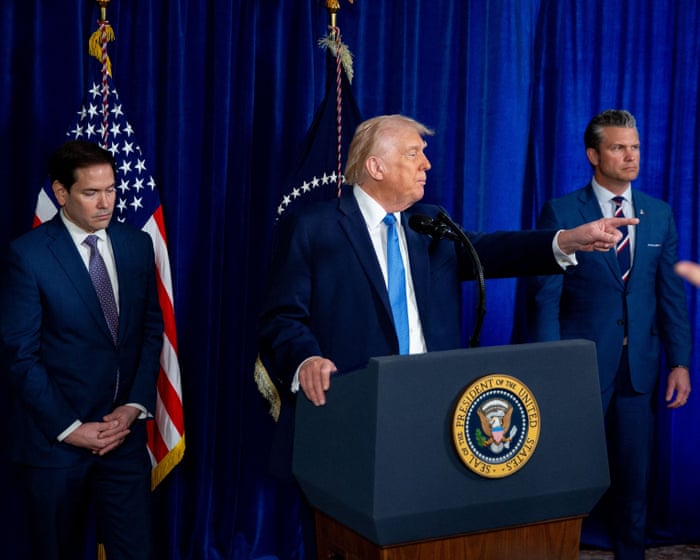
In the wake of Maduro’s capture on Saturday, Trump stated the U.S. would “run” the South American nation of 30 million people. On Sunday, he cautioned that the U.S. might launch a second strike if remaining members of the administration did not cooperate with his efforts to get the country “fixed.”
Rodríguez, 56, had pledged loyalty to Maduro on Saturday and condemned his capture as an “atrocity.” However, on Sunday she called for a “balanced and respectful” relationship with the U.S.
“We extend an invitation to the U.S. government to work together on an agenda for cooperation aimed toward shared development,” Rodríguez said after holding her first cabinet meeting since Maduro’s ouster.
U.S. Secretary of State Marco Rubio spoke with Rodríguez, who told him “we’ll do whatever you need,” Trump told reporters.
“She, I think, was quite gracious, but she really doesn’t have a choice,” he added. The New York Times reported that Trump officials had identified the technocrat weeks earlier as a potential successor and business partner, partly due to her ties with Wall Street and oil companies.
In the capital, Caracas, senior government and military figures demanded Maduro’s return but pledged support for Rodríguez as interim leader and called for a return to normalcy.
“I call on the people of Venezuela to resume their activities of all kinds—economic, work, and education—in the coming days,” Defense Minister Vladimir Padrino López said in a televised address.
Maduro’s son, Nicolás Ernesto Maduro Guerra, said his father’s supporters are more determined than ever to back the ousted president, according to an audio message shared on social media.
“They will not see us weak,” Maduro Guerra said. “President Nicolás Maduro will return… we will take to the streets, we will convene the people, we will unite.”
In comments to reporters aboard Air Force One, Trump raised the possibility of further U.S. interventions in Latin America, suggesting Colombia and Mexico could also face military action if they did not reduce the flow of illicit drugs to the United States.
“Operation Colombia sounds good to me,” Trump said. He also remarked that Cuba, a close ally of Venezuela, “looks like it’s ready to fall” on its own without U.S. military action.
Earlier on Sunday, Trump said the U.S. might intervene in other countries as well, stating, “We do need Greenland, absolutely.” Katie Miller, the wife of Trump’s deputy chief of staff Stephen Miller, posted a social media image of Greenland painted in U.S. flag colors with the word “soon,” prompting a protest from Greenland’s prime minister.
In a series of TV interviews, Rubio downplayed the likelihood of invading or occupying Venezuela but confirmed the U.S. was maintaining a 15,000-strong force in the Caribbean.
“There’s not a war. I mean, we are at war against drug trafficking organizations, not a war against Venezuela. We don’t have U.S. forces on the ground,” he told NBC.
Troops were in Caracas for two hours.He described the action as a “law enforcement function” that did not require congressional approval. “This was not an invasion. This was not an extended military operation.”
Rubio stated that the US will maintain a “quarantine” around Venezuela to block sanctioned oil tankers from entering or leaving, in order to sustain “leverage” over Maduro’s successor. “We are going to make our assessment on the basis of what they do, not what they say publicly.”
He called Cuba—Venezuela’s main ally—a “huge problem” and said it was in a “lot of trouble,” but declined to elaborate.
The Cuban government confirmed on Sunday that the US operation in Venezuela killed 32 Cuban military and police officers who were there at the invitation of the Caracas government.
In a joint statement, the governments of Spain, Brazil, Chile, Colombia, Mexico, and Uruguay said US actions “constitute an extremely dangerous precedent for peace and regional security and endanger the civilian population.” Keir Starmer said Britain was not involved in the attack but refused to condemn it.
All EU countries except Hungary issued a statement calling for restraint by “all actors” and respect for the will of the Venezuelan people to “restore democracy.”
In Caracas, some shops and cafes reopened, offering a semblance of normality as authorities assessed the damage from Saturday’s raid.
Large queues formed outside stores in the capital as anxious residents stocked up on basic supplies, worried about the future and the possibility—suggested by Trump—of a “second wave” of attacks.
“It’s the same everywhere, there are queues in the supermarkets, there are queues in the bakeries, queues at the pharmacy,” said a 71-year-old pensioner waiting in a line of 20 people outside a small grocery market in northeast Caracas on Sunday morning.
“There’s so much uncertainty because people don’t know what might happen in the coming days and nobody wants to see another situation like the early hours of Saturday or to be caught with their pants down and an empty fridge,” added the man, who asked not to be named.
Outside a major supermarket chain in Petare, on Caracas’s east side, a young couple waited in a line of about 100 people to buy milk, butter, and flour. So many shoppers had arrived that staff were letting people in groups.
“[I feel] angry,” said the 23-year-old woman, who gave only her first name, Sauriany. “They don’t have the right to meddle like this in another country and to do whatever they like,” she said of the US raid.
In neighboring Colombia, there was also deep unease. President Gustavo Petro ordered 30,000 troops to the eastern border with Venezuela in case of violence or a sudden influx of refugees.
On Sunday, Trump called Colombia “very sick” and run by a “sick man.” He accused Petro of producing and selling cocaine to the US, adding, “He’s not going to be doing it very long.” Asked directly whether the US would pursue a military operation against the country, Trump answered, “It sounds good to me.”
Petro rebuffed the accusations in an online post, saying: “Stop slandering me, Mr. Trump. That’s not how you threaten a Latin American president who emerged from the armed struggle and then from the people of Colombia’s fight for Peace.”
Petro has previously…Maduro had previously claimed his government was seizing cocaine at record levels and even invited Trump last month to witness the destruction of drug labs. However, over the weekend, U.S. authorities unsealed a four-count indictment charging Maduro with narco-terrorism and conspiracy to import cocaine. The indictment also targets Flores, their son, two Venezuelan officials, and an alleged leader of the Tren de Aragua gang, which the Trump administration has designated a terrorist organization. Maduro is scheduled for arraignment in a Manhattan federal court on Monday.
The White House released footage showing the deposed dictator handcuffed and undergoing a “perp walk” to Drug Enforcement Administration offices in New York before being taken to the Metropolitan Detention Center in Brooklyn. This prosecution is expected to deepen the humiliation among Maduro loyalists and complicate the delicate balancing act faced by his successor.
In Caracas on Sunday, Chavistas marched to protest Maduro’s capture. Meanwhile, Rodríguez, who served as vice-president and oil minister until Maduro’s removal, must now balance Washington’s demands for oil and security guarantees with a regime that still holds onto the socialist and anti-imperialist ideals of its late founder, Hugo Chávez.
The Trump administration’s apparent satisfaction with merely tweaking the regime, rather than pursuing full regime change, has disappointed many Venezuelans who hoped Maduro’s downfall would bring democracy. Trump was dismissive of opposition leader María Corina Machado—the Nobel Peace Prize winner who helped mobilize Edmundo González’s winning presidential campaign last year—claiming she lacks “support” in Venezuela. While millions revere Machado, she is deeply disliked by the military hierarchy that supports the regime.
Rubio stated that the U.S. desires a transition to democracy but ruled out immediate elections, emphasizing that Venezuela’s military and police leadership must choose their path forward: “We hope they will choose a different direction than the one Nicolás Maduro picked. Ultimately, we hope this leads to a holistic transition.”
In Caracas, joggers and cyclists have returned to the streets, but residents remain nervous and uncertain about the future.
Frequently Asked Questions
Of course Here is a list of FAQs about the statement Donald Trump warns Venezuela will face severe consequences if it does not comply with his demands framed in a natural tone
BeginnerLevel Questions
1 What is this about What did Trump say
This refers to statements made by former US President Donald Trump particularly during his administration warning the Venezuelan government under Nicolás Maduro that if it did not meet certain US demandslike holding free elections or stepping downit would face serious penalties like harsh economic sanctions or other political pressure
2 What kind of severe consequences is he talking about
Typically this refers to escalating economic sanctions diplomatic isolation support for opposition leaders and in extreme rhetoric not ruling out potential military intervention
3 Why does the US care about Venezuela
The US has longstanding interests in Latin America including regional stability countering foreign influence promoting democracy and protecting economic interests Venezuelas political crisis and mass migration also directly impact the region and the US
4 Who is Trump making these demands of
Primarily of Nicolás Maduro and his government The US under Trump recognized opposition leader Juan Guaidó as the legitimate interim president of Venezuela in 2019 so demands were framed as supporting a democratic transition away from Maduro
Advanced Practical Questions
5 What were the specific US demands under Trumps policy
The core demands were for Maduro to cede power to allow a democratic transition hold free and fair presidential elections monitored by international observers and release political prisoners The policy was often called maximum pressure
6 Did these threats and sanctions work to remove Maduro
No they did not achieve the primary goal of ousting Maduro While sanctions severely damaged Venezuelas economy Maduro retained control with support from the military and foreign allies like Russia Cuba and China Critics argue the sanctions worsened humanitarian suffering without achieving political change
7 What is the difference between Trumps and Bidens approach to Venezuela
While both administrations maintain sanctions and recognize the 2015 National Assembly as democratic the Biden administration has engaged in more direct diplomatic negotiations with the Maduro government offering limited sanctions relief in exchange for concrete