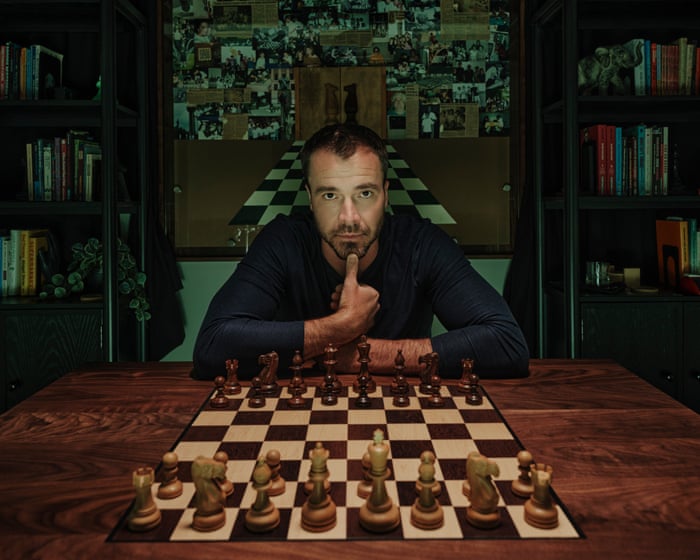
I first discovered chess when I was nine, after watching the movie Searching for Bobby Fischer on HBO. I was living in a small mountain village in Arizona at the time. Many people assume the film is about Bobby Fischer, the reclusive chess genius who beat the Soviet Union’s Boris Spassky in 1972 to become the first US-born world chess champion. But it’s actually about the American chess world’s search for the next great prodigy after Fischer vanished. The story follows Josh Waitzkin, a kid from New York’s Greenwich Village, who sits down to play chess with some homeless men in the park and discovers he’s a natural—at least, that’s the Hollywood version.
For me, Searching for Bobby Fischer was what Star Wars was for slightly older kids. I didn’t just love it—I was obsessed. Any child who’s ever felt lost, misunderstood, or stuck in the middle of nowhere has dreamed of picking up a lightsaber and finding the Jedi within. That was me in the summer of 1995, only with chess.
We were dirt poor. Tonto Village, where my siblings and I lived, had nothing but dirt roads, and we ran around barefoot most days. We’d disappear into the forest for hours, playing cops and robbers, building forts, and creating our own worlds. For many kids, living in such a small, remote place would mean loneliness, with only a handful of others to play with.
But that wasn’t the case in Tonto Village. On any summer day, there were about a hundred of us, all under 12, running shirtless and barefoot through the dusty streets, hills, streams, and forests. We were all being raised in the Church of Immortal Consciousness—a cult.
My mother was a lost soul, and it was her spiritual searching that led us to the church, which insiders called the Collective or the Family. It was based on the teachings of Dr. Pahlvon Duran, who supposedly lived his last life as a 15th-century Englishman. But his teachings weren’t passed down in ancient texts—they were channeled through a trance medium named Trina Kamp, who first encountered Duran’s spirit when she was nine.
In the Church of Immortal Consciousness, led by Trina and her husband-manager Steven Kamp, we were taught that “there is no death and there are no dead.” Your soul inhabited a body to learn lessons. You’d lived many lives and might live many more. Finding and fulfilling your “purpose” was everything, and to do that, you had to live a morally upright life. Integrity was the key. If you kept your word and were a good person, you were “in integrity.” If you failed, you were “out of integrity,” which was considered the worst sin in the Collective.
Finding your purpose meant both what you were meant to achieve as an individual and the life you’d build with a partner and family. The right partner was your “like vibration”—an energy from the center of the universe that lived inside us. Sharing a like vibration meant having a healthy marriage, with shared values about raising kids and managing money. If your marriage struggled, people questioned whether you’d really found your like vibration.
Steven and Trina’s followers were drawn to Duran because they needed real help. Many were running from something—alcoholism, addiction, abuse.They felt a void in their lives—something missing within themselves and their families. To fill that emptiness, they turned to something that promised answers. That’s how a small, isolated village in the middle of a national forest became a refuge for broken people, all searching for help.
That’s where my parents, Deborah Lynn Sampson and Steve Rensch, came in. From what I’ve gathered, their marriage was still fairly happy and stable when they joined. At the first Collective Halloween party they attended, my mom dressed as Barbie and my dad as Ken, and by all accounts, they had a wonderful time. But it wasn’t long before the cracks in their relationship began to show, widening into deep divides.
Although it was my mother’s idea to join the Collective, my father quickly became the more devoted follower. He threw himself into serving Duran and, by extension, Steven and Trina. Eventually, my dad was ordained as a minister in the church and became Kamp’s chief lieutenant and right-hand man. As his influence grew, their marriage fell apart. Less than six weeks after I was born, my 38-year-old father announced he was leaving my mother—not for the other woman he’d gotten pregnant while married to my mom, but to marry Steven and Trina’s 19-year-old daughter, Marlow.
All the community’s money flowed into a single set of bank accounts controlled by the Collective’s leaders.
Marrying the Kamp’s daughter and becoming stepfather to her one-year-old son, my stepbrother Dallas, cemented my father’s status and power. As he rose in prominence, my mother’s standing collapsed. She became the discarded first wife—a scarlet woman with no importance. For a time, she was even “de-merged” from the Collective and asked to leave, which she did when I was five. Our family—now including my younger brother Josh and my mom’s new husband, Dennis—moved to Colorado.
You might think this would have turned her against the Collective forever, but in the long run, it had the opposite effect. When Steven Kamp invited her back a year later, she returned and, after some hesitation, committed to working even harder to prove her worth to the group where her ex-husband now served as pastor.
When we moved back to the village, I was tainted by association, just like my mom. I was the bastard child of Steve Rensch, living proof that his marriage to my mother had failed to meet the group’s standards. I barely knew my father. In fact, I didn’t even know he was my father until I was seven, nearly two years after returning from Colorado. No one—not even my mother—acknowledged his paternity, despite the fact that he lived just around the corner in a village of only a few hundred people, all of whom knew I was his child.
I might have had a vague sense that Dennis Gordon, a mechanic, hadn’t always been my father, but since he’d been raising me since I was four, I was too young to question it. I wasn’t Danny Rensch—I was Danny Gordon, and that felt normal. Then one day, Steve and Marlow asked their daughter Bean if she had a crush on anyone. Bean said she had a crush on me. That’s when they realized they had to tell everyone that Bean and I were actually half-siblings—her dad was my dad.
If it all sounds a bit incestuous, that’s because it was. In many ways, that’s what collectives become. No one owned anything personally. Adherence to Duran’s teachings mattered more than material possessions—the real goal was to find your purpose.
In the village, nothing belonged to you. Everyone’s assets were “merged,” a term chosen deliberately. The idea was to let go of the material world and devote yourself to the spiritual journey of becoming your highest self.It was essentially a form of communism. Glenn, who was like a godmother to me, often told the story of the day she and her husband Jim arrived in a U-Haul. As soon as they opened the back of the truck, people showed up and started taking things. Bikes were scattered all over the village because no one actually owned them. If you needed to go to a friend’s house and saw a bike, you’d take it. Later, when you came back out, the bike was often gone—someone else had taken it.
I spent most of my childhood sharing bedrooms with five to ten kids who weren’t related to me in any way.
In the Collective, your money wasn’t yours either. Duran taught that “money is God in circulation,” meaning it had to flow freely to be shared equally. But no matter where the money came from, it all went into a single set of bank accounts controlled by the leaders.
For years, we were told about a mythical “shoe list.” If you needed shoes, you’d ask your mom, and she’d say, “I’ll try to get your name on the list and see how fast you move up.” But it turned out there was no list—it was made up to hide the fact that there was no money for shoes. Kids only got new shoes when they had to go to the doctor or make some other public appearance. Most of the time, we didn’t go to the doctor or the dentist. The idea of a regular checkup or cleaning was foreign to us. You only went to the dentist if your tooth hurt, and that was it.
Families were constantly moved between different houses. Steven and Trina told us where to go. Between the ages of six and twelve, I probably lived in eight different houses. I spent most of my childhood sharing bedrooms with anywhere from five to ten unrelated kids. Sometimes we even had to share bathwater.
Every cult has a hierarchy of status and power. In the spiritual structure of the Collective, my mother and I were at or near the bottom, which was hard on her but great for me. It meant I was free. When you’re that young, you accept the world as it is, so I was happy. I was just a poor village kid, building forts, playing cops and robbers, running from mountain lions, and having what felt like an amazing childhood. Aside from my mom, no one knew about me, no one cared, and no one wanted anything from me. Then Steven Kamp found out I could play chess.
After I watched Searching for Bobby Fischer on HBO, that whole summer was nothing but chess. My stepbrother Dallas had also seen the movie and become obsessed. We found one of those red-and-black Mattel chess sets—the kind you get at Walmart—and played for hours every day. We even practiced speed chess by hitting a book after each move, just like the characters in the movie did with their clocks in Washington Square Park. One afternoon, out of the blue, Dallas said, “Hey, why don’t you come with me and play chess with my grandpa?”
By “grandpa,” he meant Steven Kamp. For Dallas, going to Kamp’s house was no big deal, but I was terrified. I’d only had a few interactions with this powerful, distant figure. Still, I went along, and from the moment I walked in, I was overwhelmed. The place had an energy, partly because it was the Kamps’ home. While everyone else lived with three or four families under one roof, the Kamps lived alone.
Kamp had a real passion for chess. He’d learned from his father, owned lots of chess books, and loved to play.I was a decent player compared to most. The whole experience felt surreal. I remember being in the kitchen later that day and thinking, “Oh my God, they have Cheerios.” While everyone else was living on food stamps, Kamp had cigars and stacks of Cigar Aficionado magazines. It didn’t bother me—I thought it was cool, and the smell of cigars added to his mystique. He had nice things that others didn’t, and that just seemed right.
Throughout September and into the fall, Dallas and I were regularly invited over to play. Kamp was much stronger than us at first, and he gave us a proper introduction to the game. He shared his chess books, showed us strategies and moves, taught us how to read descriptive notation, and how to say cool things like “pawn to queen’s bishop 5.”
By October, Kamp was excited enough about our progress to start looking for a tournament we could enter. As it turned out, the Copper State Open was coming up, so he signed us up. I found out about it on my birthday. On the morning of October 10th, I opened presents from Dennis and my mom. They gave me a tournament chess set—the kind with a vinyl board you roll up like wrapping paper, stored in a bag with a zipper, two pockets for pieces, and a middle pocket for a clock. They got me the clock too, the classic kind you see in movies where players slam the brass buttons after each move. It was the best birthday ever.
The day of the tournament was a blur because I was a nervous wreck the whole time. I couldn’t think straight. I gave up one winning position after another and ended up with zero wins and five losses. Not a great start. Dallas, being a year older and more mature, won four and lost one. Kamp had promised to pay us five dollars for every game we won, so Dallas got $20 and I got nothing.
The following Monday at my elementary school, Shelby School, the other kids teased me mercilessly for losing so badly. I was so upset I ran home in tears during recess. That evening, my mom sat me down and told me she’d spoken to Kamp. “Honey,” she said, “we talked to Uncle Steven, and even though Dallas won more games, he could tell you have a knack for chess. He saw how much you care, and he believes you have a gift for the game.” Hearing that felt amazing. Here was this impressive man saying he believed in me—and if he did, maybe I could believe in myself too.
After seeing the potential Dallas and I showed in that first tournament, Kamp announced, “We’re starting a chess team at Shelby School. Let’s see how many other kids want to play.” And because Kamp was the kind of person who made things happen, it did. Whatever we needed to get better at chess, we got. Soon enough, we even had our own van—a big white one we called The Whale—and there was always a parent on call to drive us to tournaments. All through that winter and spring, we played tournament after tournament. We dominated everyone. The Shelby School chess team was making a name for itself, and people started wondering how this little school from northern Arizona could get so good, so fast.
In the Collective, attending a trance session with Duran was like going to church in a more traditional faith. Once a week, we’d gather on rows of folding chairs in a quiet, carpeted room with blacked-out windows, dimly lit by a few red lightbulbs—the perfect setting for Trina to enter a trance. She’d sit facing us in a big, comfortable wingback chair.
The trances could get intense if Duran’s message was heavy. Sometimes the sermon addressed the group’s broader shortcomings, or it focused on individual members, touching on sensitive topics that affected them personally. People were encouraged to open up and ask questions about their marriages, relationships with each other, or issues with parents or children.
One evening, not long after I had tu—When I was 12, at a typical Sunday trance circle for young members, the topic of the chess team and my performance came up. Duran turned to me and said in his raspy whisper, “Chess is your purpose, Danny. And you will accept chess as your purpose.” It came out of nowhere. It wasn’t like a formal anointment—I wasn’t being knighted by the queen. It felt more like a spiritual correction or a reminder to stay on track, to avoid distractions, and not to stray from God’s path.
In the weeks and months that followed, Duran’s words were echoed by everyone—my teachers, coaches, parents, and Kamp—always as a prompt to practice more and work harder: “Chess is your purpose, Danny. Remember that.” I had been given a purpose by God, a blessing, which meant I now had a duty and responsibility to live up to it. From that moment on, my life began to change dramatically.
That fall, I got my own dedicated, full-time chess coach: Igor Ivanov, the infamous Russian defector in the Arizona chess scene. Kamp hired him. Officially, Igor was there to coach all the Shelby school kids, and he did, but working with me quickly became his full-time job, and working with him became mine.
This purpose I’d been given by Duran, this gift that had filled me with joy and self-worth, began to show its downsides. Whenever I struggled or spent too much time being a kid—like playing basketball with my friends—Duran would say it was because I wasn’t committing to my purpose. “Danny, you’re in your ego,” he’d tell me. “You need to dedicate more time to your purpose and less to other things. Don’t forsake the gift that was given to you. You are given your gifts, and then you earn them.”
I heard that phrase often: I had been given the gift of knowing my purpose, and now I needed to earn it. So I did, for the most part. But if I ever struggled—had a bad tournament or lost too many rating points—it meant someone wasn’t being spiritual enough, and it was time for a “process.” In a process, members would confess their mistakes, fears, shortcomings, and judgments of others so the assigned minister and the group could help them return to integrity. These ideas, along with the golden rule—“Do unto others as you would have them do unto you”—formed the core teachings of the church.
One day, my mom, Debby, and her husband, Dennis, were called into a process with Steven and Trina Kamp, who told them that Debby wasn’t doing enough to support my chess playing. After the process, Debby and Dennis got home late, around 10:30 p.m., and by then my mom was completely drunk. She sat me down at the table, stumbled into the kitchen, turned on the stove, and started rummaging through the fridge and cabinets, saying, “Danny, they told me you’re too skinny. I need to put some more meat on your bones.” She pulled out some ground beef, went to the stove, and started cooking, drunk.She was making me a hamburger, talking in a way that felt scripted: “I’m not feeding you enough. I’m not taking care of you. Aunt Trina wants you to be healthier and stronger—like her!”
It was late, I was tired, and I wasn’t even hungry. But she put the burger down in front of me and started saying she loved me and that we’d get through this. Dennis sat at the table next to us, silent, head down, clearly simmering with anger.
To this day, I can still feel the knot in my stomach as I forced down a few small bites before saying I didn’t want any more. She insisted I keep eating, but I kept telling her I just wanted to sleep. Eventually, she gave up—too drunk and tired to keep pushing. I went to bed but couldn’t sleep.
The next day, the other shoe dropped. My mom came home after another meeting with Steven and Trina and said, “Uncle Steven says it’s time for you to take a break from chess.”
“Taking a break” didn’t mean I was off the team right away. I couldn’t play in tournaments, but I still took lessons with Igor, and chess was still technically my purpose. But it was clear something had been set in motion, and Kamp was calling the shots.
“What you’re doing in chess,” Kamp told me again and again, “is more important to the spirit than anything or anyone here. With everything coming your way, I’m not sure Debby and Dennis are up to handling all you need. I’m working on it—trying to help them. But stay close to me, and we’ll figure this out.”
That summer, I had more talks with Kamp where he gently, kindly began to turn me against my mother and stepfather. What started as “Debby and Dennis are good parents but maybe not quite enough” quickly became: “Let’s talk about your relationship with your mother. It’s troubling. It’s like she’s married to you, and that’s not right. Who knows—maybe she’s attached to you because she senses you weren’t really meant to be her kid? I remember when you came, there were questions about that. Your mom was sick, you were passed around, lots of women took care of you, and no one was sure where you belonged. I’m just saying… maybe it’s time to be open to that possibility.”
My separation from my mom and stepdad began with a bang: I went on a hot streak, gaining a ton of USCF rating points and becoming the youngest national master in Arizona history. Steven was thrilled, and it was all the proof he needed to turn a temporary “fly the coop” experiment into a permanent break from my mother. It would be more than ten years before I saw her again.
The church never had a violent, bloody moment like Waco or Jonestown, but the damage it did was deep.
As an orphaned “cult kid,” people helped me travel for chess tournaments, but my mental, physical, and emotional needs were often ignored. My dream of becoming a professional chess player fell apart in my late teens when I lost all my hearing after both ear canals collapsed on a flight home from the US Junior Chess Championship in Kansas. Years of neglected ear infections had caused benign scar tissue to grow around the stapes bones and canals in each ear, and the cabin pressure made them collapse. I was permanently grounded just as chess was moving online.
I was stuck in bed in Arizona, completely deaf and broke. Miraculously, my fiancée Shauna, who also grew up in the Collective, stayed by me through the ear surgeries, even as my drinking got worse and it looked like my whole life might fall apart.Everything was falling apart. To stay true to ourselves and build a life with purpose, we felt pushed to take our relationship further. During a short period of good health between my surgeries, we decided to try for a baby, and Shauna got pregnant almost immediately with our first son, Nash. Even though I was frustrated about not being able to travel and compete in chess, Shauna saw this as a chance for something new. She encouraged me to focus on my role at Chess.com and embrace the vision of what the website could become.
Meanwhile, Kamp was losing interest in me as a potential top player. Once he saw my attention shifting from playing chess to building an online community and business, he slowly withdrew his support, both professionally and personally.
In movies, leaving a cult often involves a sudden realization of abuse followed by a dramatic escape, or a rescue by loved ones. That wasn’t my reality. The process took years, and morally, it was messy and unclear. What holds a cult together isn’t just the abuse from the leaders—it’s the way members hurt each other. Victims are also perpetrators, and perpetrators are victims. Leaving isn’t just about breaking free from an abuser; it’s about facing your own role in the harm that was done.
Not long after Shauna and I left Tonto Village around October 2021, Steven and Trina Kamp went completely broke. They tried to sell the Shelby school building and the Collective’s shared property to recover financially—which they legally could, since everything was in their name. But the Collective had paid for it all, so people were rightfully angry. The community turned on itself, fighting over what was left, like a circular firing squad. In a way, that’s what the Collective was always meant to become.
The Church of Immortal Consciousness never had a violent event like Waco or Jonestown, but the long-term damage to its members was deep. After the collapse, a whole generation of young people scattered across the Southwest and the rest of the country, all trying to make sense of how we grew up. Some are doing better than others, but we’re all marked by the experience.
There’s no denying that Steven and Trina Kamp, along with Duran, were responsible for much of my pain. They filled me with the idea that being a child prodigy was my purpose—that if I didn’t become a grandmaster, I had failed my divine mission. By instilling that single-minded, impossible ambition, they burdened me with years of anxiety, self-hatred, and fear.
They also shaped me—or encouraged me to become—a cold, controlling, self-righteous person. In my mind, I thought I was being the best husband and father I could be, but really, I was mostly self-absorbed. I was still chasing the international master and grandmaster titles I felt I deserved.
Even when I was working tirelessly on my business and creating content for Chess.com, my motivation was still about proving to everyone that I was “the man.” Looking back, I can see how self-centered I still was. I was falling short as a good dad, and especially…The truth is, Shauna and I were still struggling because I didn’t respect women. I grew up in a toxic patriarchal environment where men could abandon their wives without facing real consequences or accountability. Like every young man raised in the Family, I was taught to see women as tools for a man’s spiritual goals. I was clinging to Shauna for dear life—she was my only anchor in the storm. But my attitude reflected what I’d been taught and seen other men do all my life: “If this marriage isn’t serving my needs, if Shauna is holding back my spiritual growth, maybe I should move on.”
During her pregnancy with our third child, Hazel, Shauna and I had one long, drawn-out fight that finally woke me up. We argued about our marriage, the Collective, chess—everything. Shauna rarely yelled, but that night, after hours of arguing, she finally snapped and screamed: “Your purpose isn’t chess! Your purpose isn’t anything you do! Your purpose is just to be you. Your purpose is us—me and you, raising our kids. Chess is just something you do if you enjoy it or it helps people. But your purpose is what you choose, and you don’t only matter if you become a grandmaster.”
It took courage for her to say that. She wasn’t just rejecting Duran and the Collective’s philosophy—she was challenging my whole sense of self. She’d made similar points before, but that night, for some reason, I finally listened, and it broke me. I realized I had confused having purpose in what you do with turning purpose into a “goal.” In doing so, I had treated everyone in my life as a means to that goal. I cried hard that night, overwhelmed by the heartbreak of being a failed child prodigy. I finally saw what a terrible husband I’d been—so obsessed with myself and my supposed purpose that I could only see my wife as someone to support me in pursuing it.
The big lie at the heart of the Collective was that everyone’s purpose, assigned by Duran, was your special reason for being here—whether chess, sports, ballet, or fixing cars. Your purpose was always something you did, and perfecting that thing was supposed to bring fulfilment. You’d keep living lifetimes until you achieved that perfection. But that’s wrong.
What I learned, and have tried to live by ever since, is that your purpose isn’t something you do or a goal you achieve. It’s the reason why you do something, not the thing itself. And the main reason for anything we do should always be to help something greater than ourselves—to serve others and bring joy.
Frequently Asked Questions
Of course Here is a list of FAQs about the topic designed to be clear concise and empathetic
General Definition Questions
Q What does it mean to be a chess prodigy
A A chess prodigy is a young person who possesses an extraordinary natural talent for the game of chess often mastering complex strategies and competing at a high level from a very early age
Q How can a religious cult impact a childs development
A Cults often use intense control fear isolation and manipulation This can severely damage a childs sense of selfworth create deep anxiety and stunt their emotional and social development
Q Is it common for prodigies to come from difficult backgrounds
A While not always the case highpressure or traumatic environments can sometimes channel a childs focus into a single skill like chess as an escape or a way to gain approval
Personal Experience Emotional Impact
Q Why would being in a cult make you hate yourself
A Cults often teach that your natural thoughts desires and identity are sinful or wrong This constant message can make you believe you are inherently bad or unworthy leading to intense selfhatred
Q How did the fear from the cult show up in your life
A The fear could manifest as a constant anxiety about making mistakes a fear of authority figures difficulty trusting others or even panic when thinking for myself outside of the cults strict rules
Q Did your chess talent conflict with the cults beliefs
A It might have The cult may have seen the individual attention and worldly success as a threat to their control and isolation creating a major internal conflict between my gift and my imposed beliefs
Recovery Moving Forward
Q How did you start to heal from this experience
A Healing often begins with leaving the environment followed by therapy building a new support system and slowly rediscovering my own identity and values separate from the cult
Q Were you able to return to chess after leaving
A This is a personal journey Some may return to chess as a reclamation of their own talent and joy For others it might be too connected to the past and they may choose to find a new path entirely