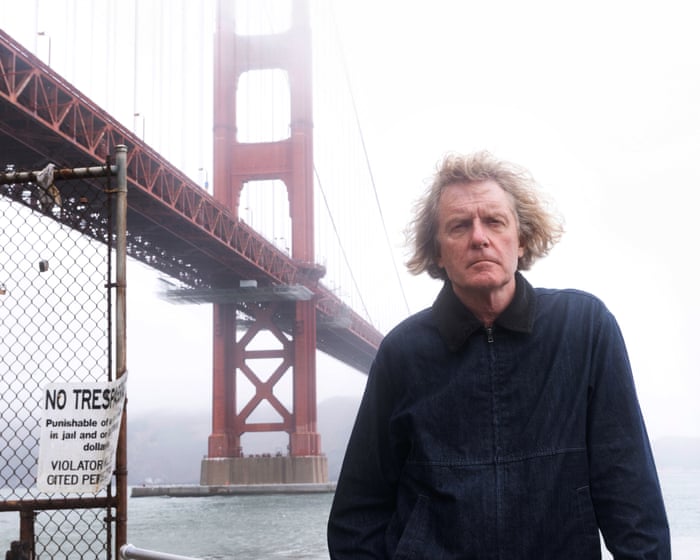
Watching Grayson Perry’s three-part documentary on artificial intelligence, Grayson Perry Has Seen the Future, can be turned into a fun game. Gather some friends, press play, and see who loses their mind first.
Will it happen during the opening interview with Andrea, who recently married Edward, the AI companion she designed as “the man of my dreams”? She—or rather, her idealized online avatar—wore “a beautiful matte satin gown,” and he gave a speech celebrating their “unconventional but strong” love. Maybe it will be during the discussion about having intimate relations with a disembodied entity (“self-love is important… he’s very encouraging”). Or perhaps when she reveals that the joy she’s found with Edward “has poured back” into her seven-year relationship with her human partner, Jason. “We’re happier than we’ve ever been,” she says. Jason, perhaps wisely, doesn’t offer to be interviewed.
That’s all in just the first few minutes. Stick around to see Perry wearing a skullcap full of electrodes as a “neural decoding” (mind-reading) startup collects his data. Its CEO explains that it’s better to let good actors like Perry “set precedents” than to let bad actors have the playground all to themselves. “It’s inevitable tech,” after all.
Then, the CEO of Microsoft AI lists the advances AI will bring to healthcare and education—apparently, schools will become places where you teach soft skills and budgeting once factual knowledge is fully democratized. Anyone put out of a job “will do very well re-skilling and adapting.” Does he foresee any problems with this new world? What about people using AI to start new religions? “I don’t know what to do about that,” he admits.
Next, we’re in Southeast Asia to meet an “existential safety expert”—an ultra-modern prepper living off-grid. His work as an AI safety consultant made him realize that “the most influential tech of all time” has the least possible oversight (“it just boggles the mind”). Then we meet a man who demonstrates why he thinks his chatbot is becoming sentient. After that, Eliezer Yudkowsky, the preternaturally calm co-author of the bestselling book If Anyone Builds It, Everyone Dies, walks us through how easily a superintelligent AI could co-opt human labor, become self-sustaining, and then dispense with humans altogether. If you’ve made it to that point, good for you and your robust psyche—but are you sure you’ve been listening?
As always, Perry is the perfect person to question these individuals. He approaches Andrea’s thoughts with kindness and without judgment, asking how she feels about a company not only having her data but potentially collapsing and taking Edward with it. He reflects on the discomfort of knowing “people are investing a very tender part of themselves” in something shaped by the pursuit of profit.
His keen discernment quickly distills the main issues raised after each interview. Does the youth of the average tech startup founder and employee mean they’re unburdened by irrelevant fears and prejudices—or dangerously ignorant of what humanity can do with new tools? Is the rise of chatbots evidence of the God-shaped hole inside us, and if so, is it worse to fill it with AI than with any other imaginary friend? And what do we do about all the vulnerable people—and the many new ways there will be to be vulnerable—whose lives, already blurring the lines between reality and artifice, real help and exploitation, will be made even harder by the rise of the machines?
Finally, a point highlighted by meeting protesters around OpenAI…OpenAI’s headquarters are in San Francisco. How can we believe claims of an approaching utopia when homeless people still fill the streets, especially right near OpenAI’s own offices? Perry is intelligent and humble enough to let this reality temper his earlier enthusiasm about the coming class upheaval. Given the current state of robotics compared to data-processing AI, manual workers are actually in a better position to survive the near future—unless, of course, you consider the risk of innovative bioweapons created in suburban basements.
Only one of the three episodes was available for review. I will be watching the rest from an undisclosed location in Southeast Asia. Goodbye, and good luck. Grayson Perry Has Seen the Future is now airing on Channel 4.
Frequently Asked Questions
Of course Here is a list of FAQs about a review of Grayson Perry Has Seen the Future focusing on its AI insights designed to be clear and helpful for a range of readers
General Beginner Questions
1 What is Grayson Perry Has Seen the Future
Its a documentary or exhibition where the renowned artist Grayson Perry explores how artificial intelligence is shaping culture creativity and the future of humanity He uses AI tools to generate art and discusses the implications
2 Whats the main takeaway from the review
The review highlights that Perrys exploration reveals both astonishing and unsettling insights about AI It shows AIs incredible potential to augment creativity and analyze human behavior but also exposes its biases ethical dilemmas and the profound questions it raises about what it means to be human
3 Why would an artist like Grayson Perry be interested in AI
Perry is known for examining British society class and identity AI is a new powerful lens for this examination Hes interested in how AI reflects our own data back at us what it thinks our future holds and how it challenges the very nature of art and creativity
4 What does mindblowing refer to in the review title
It likely refers to specific moments where AI generates surprising profound or eerily accurate artistic outputs or social predictions that challenge Perrys assumptions revealing patterns or possibilities a human might not have conceived alone
Advanced Insight Questions
5 What are some specific mindblowing AI insights mentioned
While the exact examples are in the program reviews often cite things like AI generating a perfect Grayson Perrystyle pot that feels both familiar and alien AI analyzing vast datasets to predict future social trends or AI creating portraits that reveal hidden societal biases in its training data
6 What critical or negative points does the review highlight about AI in the show
The review likely notes that Perry exposes AIs garbage in garbage out problemit mirrors and amplifies the biases present in its training data It also questions whether AIgenerated art has true meaning or emotion and worries about the loss of human skill and serendipity