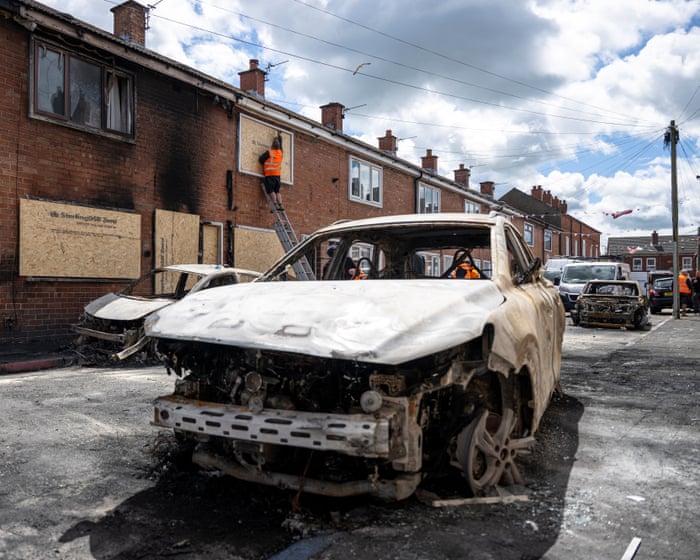
Police in Northern Ireland have fired plastic bullets and received reinforcements from Great Britain as they try to control race riots. Since the unrest began on Tuesday, officers have used 17 of these projectiles while facing crowds throwing rocks, petrol bombs, and other objects.
The news came on Thursday amid ongoing condemnation of violence targeting ethnic minorities, sparked by the spread of a graphic video showing a knife attack in north Belfast on Monday night.
Hilary Benn, the Northern Ireland secretary of state, told Sky News: “If you are targeting people because of the colour of their skin, what else can you call it? It’s racist thuggery, no question about it.”
An extra 200 officers from Great Britain will support the Police Service of Northern Ireland (PSNI), which is preparing for a possible third night of unrest. So far, 12 officers have been injured and 16 people arrested. Police have also released images of two males they want to question.
The Police Federation for Northern Ireland welcomed the reinforcements but said the PSNI is still 1,200 officers short of the 7,500 it was promised, due to long-term underfunding. Liam Kelly, the federation’s chair, said he hopes those found guilty of rioting will receive the maximum sentences. “Violent racist and fascist lawbreakers offer nothing but hopelessness and mindless thuggery.”
Police said a 24-year-old woman has been charged with disorderly behaviour and possessing an item with intent to cause damage, and a 28-year-old man has been charged with failing to remove a disguise when asked, obstructing police, and resisting arrest. Both were due in court in Lisburn on Thursday.
The police ombudsman confirmed reports that officers had fired plastic bullets. “We have been told by police that ‘attenuating energy projectiles’ have been used 17 times,” the watchdog said on Thursday. “Each incident will now be reviewed by Police Ombudsman investigators.”
This confirmation came after reporters found plastic bullet casings among debris near the Sandyknowes roundabout in Newtownabbey, where intense clashes occurred on Wednesday night. Police also used water cannons to break up the crowds there.
Patrick Corrigan, Northern Ireland programme director for Amnesty International, said police have a difficult job restoring order but expressed concern about the use of plastic bullets. He said: “With so many children on the streets, and the risk of serious injury from a direct hit or ricochet, using them in these circumstances carries significant risk.”
More reports emerged of intimidation against immigrants and ethnic minority families. The South Eastern Trust said four masked men chased a nurse on her way to work. “We strongly condemn this racist attack. This nurse bravely insisted on staying at the hospital to care for the most vulnerable in our community. Her behaviour is in stark contrast to the people who terrified her as she tried to do her job.”
Lists claiming to show the names and addresses of foreigners have been shared on social media. The Irish News reported that at least one property management company has contacted tenants on the list and advised them to keep their homes safe and secure.
The case of Hadi Alodid, a 30-year-old Sudanese man charged with attempting to murder Stephen Ogilvie on Monday night, continued to stir political debate. Alodid, who travelled from Sudan to Paris and then Dublin before taking a bus to Belfast in 2023, was granted asylum through a fast-track application scheme without an interview. He was given permission to stay in the UK until 2028.
Benn said the previous Conservative government had set up that system, and now asylum seekers are interviewed in “almost all cases.”
Kemi Badenoch, the Conservative leader, told LBC Radio: “I wasn’t leader at the time, and I wasn’t in the Home Office either. All I can do is apologise to people.” She said the home secretary at the time was responsible.Suella Braverman and the immigration minister, Robert Jenrick, have both since left to join Reform UK.
Frequently Asked Questions
Here is a list of FAQs regarding the use of plastic bullets by police during race riots in Northern Ireland written in a natural clear tone
BeginnerLevel Questions
1 What exactly are plastic bullets
They are nonlethal projectiles fired from a specialized gun They are designed to be less lethal than metal bullets but they can still cause serious injury or death
2 Why did the police use them during the race riots in Northern Ireland
The police used them as a tool to disperse violent crowds and stop attacks on property or people without using live firearms They are seen as a middle ground between batons and guns
3 Are plastic bullets meant to kill people
No They are classified as lesslethal ammunition meaning they are intended to stop a threat without causing death However they have caused fatalities usually when they hit the head neck or chest
4 How do plastic bullets work to control a riot
They cause a sharp painful sting on impact The goal is to make a person stop what they are doing and move away or to prevent a crowd from advancing
5 Is it legal for police to use plastic bullets in Northern Ireland
Yes they are legally authorized for use by the Police Service of Northern Ireland in situations where there is a risk of serious public disorder or violence
Advanced Specific Questions
6 What type of plastic bullet was used specifically in these race riots
The PSNI primarily uses the L21A1 ATK round This is a modern more accurate plastic baton round designed to reduce the risk of serious injury compared to older models
7 What are the specific rules for when police can fire a plastic bullet
Officers must follow strict guidelines They can only fire a plastic bullet when there is an imminent threat of violence causing serious injury or damage and only after a verbal warning They are trained to aim at the lower body to avoid hitting the head or torso
8 Why are plastic bullets so controversial in Northern Ireland
They have a deeply troubled history During the conflict known as The Troubles the older L5 plastic bullet