New research has uncovered the story of Spain’s first transgender political organisation, a pioneering group formed in 1978 as its members dealt with the ongoing persecution that had lasted through the country’s four-decade dictatorship.
Founded in Barcelona, the Colectivo de Travestis y Transexuales (Collective of Transvestites and Transsexuals) aimed to join the intense discussions happening across Spain as it moved toward democracy after the death of dictator Francisco Franco in 1975.
The group held weekly meetings with around 20 members, pushing for rights like legal gender recognition in the civil registry, according to Iago Mora, a PhD researcher at King’s College London. His work uncovered the collective’s story decades after it faded from memory.
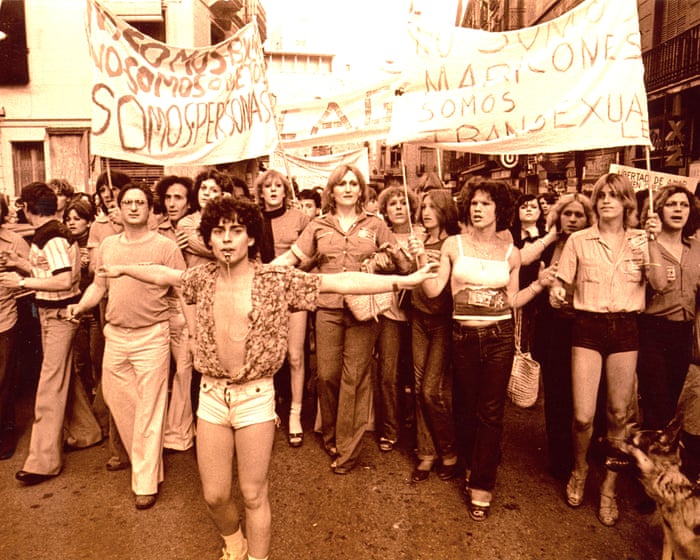
“People were shocked to see that this existed in 1978,” he said. “They weren’t just meeting in private; they were marching in the streets, calling themselves transsexuals and transvestites, and holding banners that, for example, spoke out against being objectified and criticised the Catholic Church’s attitude.”
Mora spent over two years reconstructing the group’s history by talking to former members and searching through archives and personal collections.
What he found was a look at how trans people have long stood up to those who try to use their identity against them, offering a broader view of a debate that has once again become urgent as trans people face a tougher political climate.
“A lot of today’s rhetoric presents trans people as a very recent invention,” said Mora. “But stories like this show that trans people have been around for a long time, have faced serious challenges, and have pushed back against arguments that are similar to what we see now.”
As Mora explored the group’s history, he uncovered the issues that drove them. “They had clear ideas about the role they wanted to play in Spain’s transition to democracy and its wider social context. They also had specific demands about legal reform, being shut out of the job market, public attitudes, and cultural representation—areas they saw as deeply connected.”
The shadow of Franco’s dictatorship hung over the group’s actions. During that time, thousands of LGBTQ+ people were jailed, sent to forced labour camps, or locked up in institutions.
For much of the collective’s existence, Franco-era laws were still in effect, meaning members took huge risks by speaking out, said Juan Martínez-Gil, an affiliated lecturer at the University of Cambridge who studies transgender representation during Spain’s transition to democracy.
“The laws at the time still allowed police to step in, so they risked being arrested and locked up,” said Martínez-Gil, who was not involved in the research on the collective.
At that time, trans people faced deep discrimination and were often shut out of the job market. Openly trans women were mostly limited to working in show business or prostitution, said Martínez-Gil. “In that sense, what Iago [Mora] is doing is very new, because he’s adding a new layer to this: political activism.”
Much of what the collective achieved was about making their presence seen and their demands heard.Mora pointed to photos showing members at major unauthorized protests in the 1970s. “They were key figures in the fight against anti-gay laws and police raids, and for the first time in the country, they raised a political awareness specifically around trans issues,” he said. “So I’d say that’s an impact in itself, even if they didn’t succeed in changing laws like those on ID.”
It took nearly 30 years, after renewed efforts from the movement, for Spain to pass its first law in 2007 allowing gender recognition on official IDs, though with strict conditions.
Alongside the UK’s short-lived GLF Transvestite, Transsexual and Drag Queen group, launched in 1972, the Spanish collective was “new and pioneering” in Europe as a public-facing political organization, Mora said. Its emergence was even more remarkable given the decades of repression the community had endured, he added.
Protesters at the door of Barcelona Cathedral in June 1978. One sign reads: ‘The Church does not accept us, but God loves us. There is a reason why he created us!’ Photograph: Oscar Laser/Personal collection of Nazario Luque
Formed as an independent group within a larger platform aimed at overturning anti-gay laws, the collective appears to have been active for about two years.
While there’s little explanation for why it ended, its demise coincided with a broader decline in social movements as Spain solidified its transition to democracy. This shift, along with a legal change that decriminalized homosexuality, led many in the wider community to feel their main goal had been achieved, Mora said.
“That wasn’t necessarily the case for the trans people involved here, but we have to remember they were a fairly small group compared to the gay movement as a whole,” Mora said. “And they relied on the support and mobilization of their allies, who were far more numerous.”
The issues facing the collective’s members were far from over, Mora said, pointing to the Franco-era crime of “public scandal,” which remained in Spanish law until 1988. “Trans people continued to face intense repression through the 1980s, from informal police harassment to judicial persecution for these offenses, as well as ongoing social and economic exclusion,” Mora said.
Mora described the collective’s activity as part of the broader story of how many in Spain had long fought for their rights—a story that sometimes challenges assumptions about a country now seen as one of Europe’s leaders in LGBTQ+ equality.
“People often say, especially from outside Spain: ‘It’s almost unbelievable how the country went from an authoritarian regime and a deeply homophobic, Catholic nation to being an international leader in queer rights,'” Mora said. “But looking at experiences like this shows us it wasn’t always a straight path from zero to everything. A vibrant, pioneering activist scene fought for many of these changes even while the regime’s anti-gay laws were still in place.”
Frequently Asked Questions
Here is a list of FAQs about the article Revealed the story of Spains fearless 1970s transrights political group
BeginnerLevel Questions
1 What is this article about
It reveals the untold story of a transrights activist group that existed in Spain during the 1970s a time when it was incredibly dangerous to be openly transgender
2 Why is this group considered fearless
Because they fought for their rights under the brutal dictatorship of Francisco Franco where being LGBTQ was illegal and punishable by imprisonment or worse
3 When did this group exist
They were active in the 1970s specifically during the final years of Francos regime and the early transition to democracy
4 What did the group want
They wanted basic human rights the right to exist to dress as they wished to work and to not be arrested simply for being transgender
5 Is this a wellknown part of history
No thats why the article is called Revealed Their story has been largely hidden or forgotten even within LGBTQ history
IntermediateLevel Questions
6 How did they organize under such a repressive government
They operated in secret often meeting in private homes or hidden bars They used coded language and built a tightknit community to protect each other
7 What specific actions did they take
They organized small protests wrote letters to authorities and provided mutual aid for members who were arrested or kicked out of their homes
8 Who were the main people in this group
The article likely highlights key figures often trans women from workingclass backgrounds who acted as leaders and organizers despite facing extreme personal risk
9 How did the groups work connect to Spains later LGBTQ rights
They were the pioneers Their early activism laid the groundwork for the massive LGBTQ rights movements that emerged in Spain after Francos death in 1975
10 What was societys reaction to them at the time
Society was overwhelmingly hostile They faced constant police harassment social rejection violence and were often forced into sex work to survive
AdvancedDeepDive Questions
11 Why was this specific groups story hidden for so long
Because the dominant narrative of