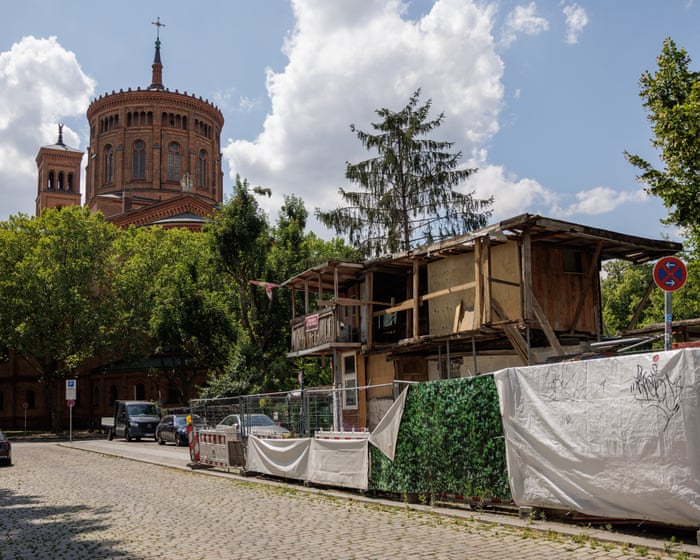
Sometimes, history’s currents converge in one place. In Berlin, one of the most fascinating spots is a small traffic island with a carefully tended garden and a ramshackle two-story building known as the Treehouse at the Wall.
In 1983, Osman Kalin, a Turkish “guest worker,” was searching his corner of Berlin—a city split by the Wall—for a bit of soil to grow onions, garlic, and cucumbers. Right near his home in the Kreuzberg district lay a strip of no man’s land beside the concrete barrier and barbed wire. Although it was in West Berlin, Cold War rules meant the plot officially belonged to communist East Germany.
The east-west border cut a sharp angle near a curved street called Bethaniendamm. The Wall was built straight across the road, leaving a triangle of land on the wrong side. Neither side could use it, so locals turned it into a dump—until Kalin came along.
Maybe it took an outsider like Kalin to see the potential in that tiny patch of fertile soil beneath abandoned furniture and discarded needles. And it took real nerve to build something right next to a Wall patrolled by East German soldiers with orders to shoot on sight.
Over the years, this “guerrilla garden” came to symbolize a rebel spirit in dark times, the resourcefulness of immigrants often made to feel unwelcome, and the tragedy and absurdity of superpower rivalry in a city where people on both sides just wanted to breathe free.
That’s a lot of myth for one place to carry, and four decades of upheaval have left their mark. Now, supporters of the Treehouse at the Wall worry it could be torn down by city authorities as a safety hazard, and they’re rallying to save it.
Kalin, one of the first generation of so-called Gastarbeiter brought to West Germany to fill labor shortages, was “a remarkable figure,” said Suat Özkan, general secretary of a Turkish community group in Berlin. “Maybe he wasn’t a master of language, maybe he wasn’t the perfect architect, maybe he wasn’t the perfect artist, but he created something artistic—something that became totally unique.”
Kalin, born in 1925 in Anatolia, arrived in West Germany in the late 1960s as a manual laborer. Under the program, about 14 million guest workers came to the country between 1955 and 1973. Despite the scheme’s temporary nature, many stayed. Nearly 3 million people of Turkish origin now live in Germany, about 200,000 of them in Berlin.
Kalin first squatted on the land with his flower and vegetable garden and a small makeshift shed. Then, against all odds, he won permission from East German authorities to stay, as long as anything he built wasn’t taller than the Wall.
In time, he replaced the shed with the larger “treehouse,” which despite its name isn’t up in the branches but built around a mature trunk on the site.
After the city reunited in 1990, Kalin faced eviction orders but found an unlikely ally in the neighboring St. Thomas church, which found 18th-century documents showing it owned the land and let him stay.
Since Kalin’s death as a local hero in 2018, his son Mehmet has cared for the property and his father’s legacy.
“Right when two global political systems were facing off,” Özkan said, Osman Kalin carried out an “act of defiance against the GDR regime, against the system, to show that it is possible to stand up and carry out a kind of revolution.”
He added: “It’s a symbol of resistance as well as a symbol against racism, discrimination, and hostility.”
Tongue-in-cheek NATO and Soviet flags whip from poles outside.Here’s the rewritten text in fluent, natural English:
Özkan said that more than sixty years after West Germany launched its guest worker program, it was well past time for the reunited nation to honor its waves of immigrants. “We still haven’t managed to build a central memorial,” he said, referring to the foreign laborers who helped create the postwar economic miracle. “This house should serve as a kind of memorial.”
Stefan Zeppenfeld, a historian who published a book in 2021 about Turkish workers in West Berlin during the cold war, said it took decades for Germany to recognize that it had become a “country of immigration.” He noted that migrant workers like Kalin were pushed into neighborhoods near the wall, such as Kreuzberg, which became valuable property after the wall fell in 1989.
Zeppenfeld said the treehouse captured many elements of what defined Berlin and its people. “The history of German division and the iron curtain is still absolutely crucial and defining for Berlin, for Berlin’s sense of identity,” he said. “And I find it absolutely fascinating that this building is still standing – it’s one of the few tangible legacies where we can actually see the impact of Turkish guest workers as a real part of the cityscape.”
As a first step, Özkan is planning an open-air exhibition on the chain-link fence around the structure, featuring archival photos and Kalin’s remarkable life story.
The tension with city authorities ahead of a Berlin election in September is that supporters of the treehouse want to keep its rough, authentic character, while safety and legal concerns have sparked discussions about its structural soundness.
Outside, the wooden facade is made of crooked, mismatched planks. Tongue-in-cheek NATO and Soviet flags flutter from poles, while plum and apple trees mark the changing seasons. Inside, a mix of black-and-white photos and construction tools reflect the Kalin family’s past and future in their garden haven. A donated chandelier adds an unexpected touch of elegance.
Florian Schmidt, a Kreuzberg district councillor, said his office was working closely with the Turkish community and Kalin’s son Mehmet, who has done extensive repairs on the house, to “grant the necessary permits” for it to stay. “Due to the unusual situation – the site being a no man’s land and the lack of planning permission – use of the treehouse was initially prohibited,” Schmidt said in an emailed statement, noting that Mehmet had been given a temporary exemption to work there. “Issues relating to ownership rights are also being clarified.”
Adrian Sampson, of Alternative Berlin Tours, which highlights the city’s subculture and street art, was leading a group of visitors past the treehouse on a hot July day as he explained Kalin’s legacy. “His story is about three things: resistance, community spirit, and multiculture all together there. And that’s what Kreuzberg is about,” said Sampson, who is originally from Melbourne. Asked about speculation that the site’s days could be numbered, he said: “I think it’d be an absolute shame, like really a pity for the city, because it just makes a lot of people happy.”
Frequently Asked Questions
Here is a list of FAQs about the treehouse built on no mans land beside the Berlin Wall often referred to as the Treehouse of Resistance
BeginnerLevel Questions
Q What exactly was the treehouse on no mans land
A It was a small makeshift wooden platform and shelter built in a tree in the death stripthe heavily guarded empty land between the Berlin Wall and the actual border It was built by a group of squatters and activists in the 1980s
Q Why did they build a treehouse there
A It was a political protest The land was officially offlimits and controlled by East Germany but not technically part of West Berlin By building there the activists were claiming a space that no one officially owned mocking the border and showing that freedom could exist even in the most restricted zone
Q Who built it
A It was built by a group of West Berlin squatters punks and activists The main figure associated with it was a man named Wilfriede Wilde Maa though it was a collective effort
Q Did the authorities try to tear it down
A Yes West Berlin police tried to remove it several times because it was technically in a restricted zone However because the land was a legal gray area they had trouble getting a clear order to demolish it The activists also used media attention to protect it
Q Is the treehouse still there today
A No The original treehouse was eventually dismantled However a replica and memorial now stand near the original site as part of the Berlin Wall Memorial and the tree itself became a symbol of resistance
IntermediateLevel Questions
Q What did the treehouse symbolize for people living in Berlin at the time
A For many it symbolized defiance against the absurdity of the Cold War It showed that ordinary people could challenge the massive militarized border system It was a small fragile act of freedom in a city that was physically divided by concrete and barbed wire
Q Why was it so difficult for the police to remove the treehouse