On 18 June 1940, Charles de Gaulle, then a little-known army officer, sat in a BBC studio in London and made his famous call for the French to resist the Nazi occupation and its puppet Vichy government. To British Prime Minister Winston Churchill, De Gaulle was an arrogant, stubborn, and defiant thorn in his side and in the side of the Allies. But the Frenchman never stopped believing in the greatness of France and the need for resistance.
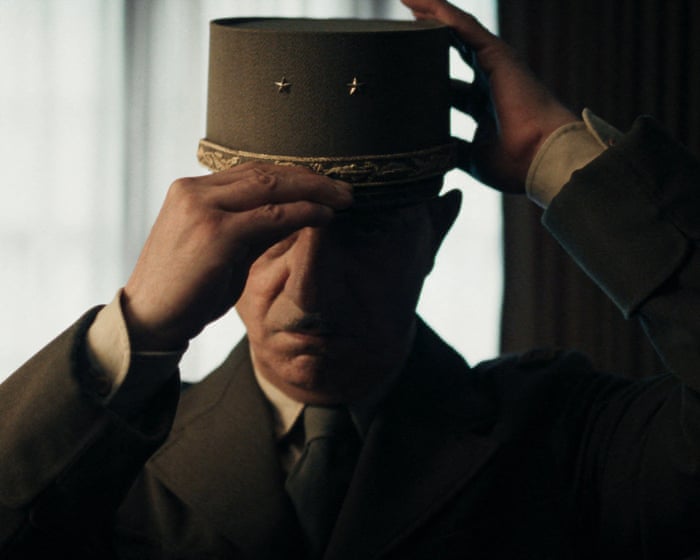
Now a new two-part biopic, based on a biography of De Gaulle by a British author, has become a surprise summer hit in French cinemas and given the country’s young people a new old hero. La Bataille de Gaulle, which will be released in UK cinemas on 28 August and 19 September, has drawn an audience of 5 million people since its release in June, rivalling Hollywood blockbusters like Spider-Man: Brand New Day and The Odyssey. And not just because cinemas have been air-conditioned refuges from the successive heatwaves.
French historian Alya Aglan, a professor at the Panthéon-Sorbonne university in Paris and co-author of the bestselling book De Gaulle, France and the World, said: “In the history of France, we have always had a ‘providential man’, someone who arrived at the right time and turns a situation of weakness into a position of strength.”
“The enthusiasm for the film among young people is because they are discovering parts of a story they did not know: a man who knew failures, hesitation, hard knocks, and who embodied the spirit of resistance because he remained himself against everything, even at the cost of being occasionally ridiculous.”
“There is emotion, there is information they didn’t know, and it resonates with today’s young people, particularly in the run-up to a presidential election in which we will find ourselves in a very divisive situation.”
The films, both nearly three hours long and costing up to £80m to make, are adapted from the 2018 De Gaulle biography A Certain Idea of France: The Life of Charles de Gaulle by Julian Jackson, a professor of history at Queen Mary University of London.
The first installment, L’Âge de fer (Iron Age), follows De Gaulle’s journey to London in June 1940 and the founding of the Free French forces to combat the Nazis. It highlights the Battle of Bir Hakeim, in which 3,700 Free French soldiers held out in the Libyan desert against 37,000 Nazi troops led by Erwin Rommel for 16 days, allowing Britain’s Eighth Army to retreat. The second, J’écris ton nom (I Write Your Name), covers the rest of the war up to the liberation of France in 1944.
Directed by Antonin Baudry, a French diplomat and former ministerial adviser, the cast includes Simon Abkarian, who played a James Bond villain, Alex Dimitrios, in Casino Royale, as General de Gaulle, and the award-winning British Shakespearean actor Simon Russell Beale as Winston Churchill.
Baudry told French radio that he wanted the films to “speak to young people … and the themes of war, resistance and engagement.”
After the first release, the biopic appeared to be a flop. But to appeal to a younger audience, the film company Pathé organised watch parties hosted by the YouTube and Instagram influencer Inoxtag for young guests to meet Baudry. Local councils also offered free tickets for students, and word spread.
Outside one central Paris cinema last week, business student Alex and friends said they had enjoyed the film. “We heard about it on social media and decided to see what it was all about,” he said. “We’re taught about the Free French and De Gaulle in school, but there were a lot of things I didn’t know. It was interesting to see how Paris students heeded De Gaulle’s call to resist.”Simon Abkarian as Charles de Gaulle in L’Âge de fer. Photograph: TCD/Prod.DB/Alamy
Historian Henry Rousso, a specialist in World War II, said: “There are very few films in French cinema that can be called a historical ‘epic,’ and this is one of them. The director may have succeeded because it is one of the greatest epics in French history.”
“De Gaulle was an exceptional figure in his lifetime, and he remains one for the French today, as there is no equivalent political figure now.”
Not everyone shares this enthusiasm. Arnaud Teyssier, a historian and De Gaulle biographer, dismissed the biopic as a “comic strip” that failed to do justice to its subject.
“The film is not without great appeal: it had a big budget, a good cast, and is based on a rightly respected biography. But the disappointment is equally great,” he wrote in Le Point magazine.
View image in fullscreen: Simon Russell Beale plays British Prime Minister Winston Churchill (left). Photograph: TCD/Prod.DB/Alamy
“De Gaulle, with his elusive demeanor, is far more complex to portray than Churchill, for whom one only needs to cast a portly actor who cracks one good joke after another while always puffing on a cigar,” Teyssier wrote.
Nathalie Cieutat, deputy director general of distribution at Pathé Films, said the company’s research showed “it is the theme of resistance that has made the film particularly popular with young people.”
As France approaches what promises to be a bitter presidential election next year, which current polls suggest could result in a battle between the far-right National Rally and the far-left France Unbowed, Aglan said the character of De Gaulle had a particularly modern resonance.
“When French people are divided and faced with the extreme right and extreme left, and are wondering who to vote for when they don’t want either, they would like to have the choice of a providential man or woman who can save us from such terrible choices,” she said.
“De Gaulle gives hope because he resisted, and right now everyone is thinking about how to resist.”
This article was amended on 16 August 2026. Due to a translation error, an earlier version said that Arnaud Teyssier had mentioned “good distribution” – that should have been “good cast.” Also, a reference to Charles de Gaulle being a junior army officer in June 1940 has been removed; he was a brigadier general.
Frequently Asked Questions
Here is a list of FAQs about the surprise hit biopic The Spirit of Resistance focusing on its appeal to younger audiences
General Background
Q What is this movie about
A Its a biopic about Charles de Gaulle focusing on a specific intense period in June 1940 As France is falling to Nazi Germany de Gaulle then a junior general refuses to accept defeat The film intercuts his political struggle in London to launch the Appeal of June 18 with his personal struggle to reunite his family who are fleeing the invasion
Q Is this the same as the 2020 movie De Gaulle
A Yes thats the one It was released internationally as De Gaulle and is now being marketed in some regions as The Spirit of Resistance to highlight its theme
Q Why is it suddenly a surprise hit with younger people
A It went viral on TikTok and Instagram Young viewers started making edits of the films dramatic speeches and the stoic defiant character of de Gaulle They see him as a figure of antiestablishment rebellion against a doomed complacent governmentwhich resonates with current political frustrations
The Appeal Themes
Q Im not into history Will I find it boring
A Probably not Its less of a dusty history lesson and more of a tense political thriller and family drama The pacing is fast and the dialogue is sharp It feels like a modern story about standing up to a broken system
Q What does The Spirit of Resistance actually mean in the film
A Its the idea that even when a situation looks hopeless and all authority figures say to surrender you must fight back with whatever you have The film argues that resistance isnt just about physical force its a mindset of refusing to accept a bad outcome
Q Why are young French people comparing this to their current politics