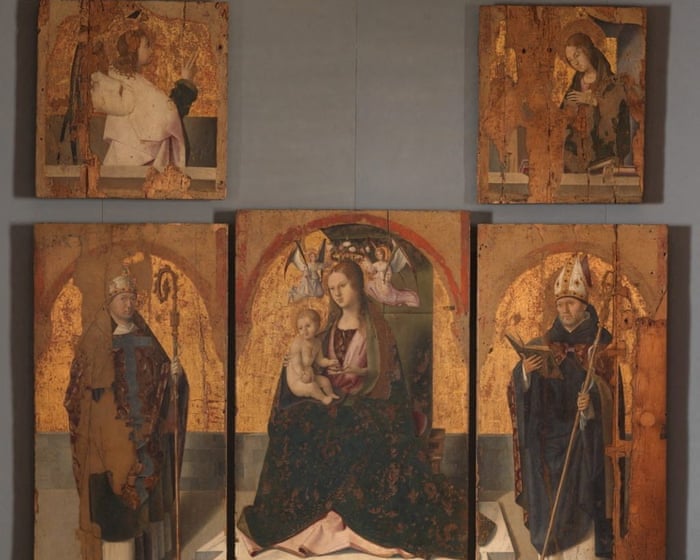
Four of the most important works by the 15th-century Renaissance master Antonello da Messina were stolen from a museum in the Sicilian port city of Messina during a national holiday.
The thieves broke into the Regional Museum of Messina, also known as MuMe, on Saturday evening. They may have taken advantage of the fact that attention was focused on La Vara, a huge religious festival held in the city on 15 August, when Italy celebrates the ferragosto national holiday.
The gang got past the alarm systems, broke into a security display case, and stole four wooden panels painted by Antonello. He is widely credited with changing the direction of Renaissance art.
The thieves took three of the five surviving panels from an altarpiece called the Polittico di San Gregorio, one of the Sicilian painter’s most important works. The fourth stolen piece was a smaller painting showing the Virgin and Child.
Marisa Mercurio, the director of the Regional Museum of Messina, said, “This is an extremely serious and significant loss. They have stolen works of enormous cultural, artistic and symbolic importance, not just for Messina but for all of Sicily. All we can do now is hope they are recovered as soon as possible.”
The altarpiece was originally made up of six panels created for the Monastero di San Gregorio, which was destroyed in the 1908 Messina earthquake. It was the only work by the Sicilian painter that had never left his home city.
A fourth work was taken from a secure display case: a small double-sided painting showing the Virgin and Child on one side and a Franciscan monk on the other, with Christ on the reverse.
That painting had belonged to the Wilhelm Soldan collection and was sold by Christie’s to the Sicilian regional government in 2003, the year it was attributed to Antonello.
The theft could have been even bigger: six paintings were stolen in total, but for no clear reason, two of the panels were left on a low wall outside the museum.
Antonello was born around 1430 and trained in Naples, where he studied the works of Provençal and Flemish artists. Their influence is clear in his own work.
Valentina Certo, an art historian linked to the University of Messina and author of the illustrated children’s book The Workshop of Antonello da Messina, said, “Antonello was key in bringing Flemish oil-painting techniques to Italy, which made possible a new softness, delicate glazing and subtle shading. Even on very small panels, he was capable of extraordinary precision and detail.”
She added, “The overnight theft is a wound inflicted on the historical memory and cultural identity of the city of Messina. These were works that had survived the earthquake, destruction and five centuries of history. To see them taken from the public in this way makes the loss impossible to measure in purely economic terms.”
On 28 December 1908, the city of Messina was hit by what is still considered the deadliest natural disaster in modern European history: a 7.1-magnitude earthquake lasting 37 seconds that killed half the population and flattened much of the city.
Along with homes, churches and monuments, invaluable historical sources and documents were lost, including works by Antonello.
In February, the Italian government secured a rare Antonello masterpiece at auction in New York, spending $14.9m (£11m) on his Ecce Homo. The painting, sold at Sotheby’s, is an intensely human portrait of the suffering Christ, believed to have been completed around 1460.
Prosecutors in Messina have opened an investigation into the theft. Police sources said the museum was fitted with several surveillance cameras and that the works were protected by a sophisticated alarm system.Investigators are looking into several possibilities, including whether the paintings were stolen for the illegal art market. According to the state news agency Ansa, they are also considering the chance that the theft was done on order for an art dealer. The theft happened after Italian police recovered three paintings by French masters Paul Cézanne, Pierre-Auguste Renoir, and Henri Matisse on Friday. These works had been stolen earlier this year from a private museum near the northern city of Parma.
Frequently Asked Questions
Here is a list of frequently asked questions about the theft of Antonello da Messinas paintings from a Sicilian museum ranging from beginner to advanced levels
General Background Questions
1 Wait is this a recent event I havent heard about this
Actually this refers to a famous historical heist On October 21 1969 two paintings by Antonello da Messina were stolen from the Regional Gallery of Palazzo Abatellis in Palermo Sicily They were recovered a few days later
2 Which paintings were stolen
The thieves took two of the museums most prized works The Annunciation and St Gregory the Great Both are small powerful portraits on wood panels
3 Why is Antonello da Messina so important
He was a 15thcentury Sicilian master who revolutionized Italian painting He is credited with mastering and popularizing the oil painting technique in Southern Italy bringing a new level of realism light and detail to Renaissance art
4 Where is the museum located
The museum is the Palazzo Abatellis in Palermo the capital of Sicily Its one of the most important art galleries in Italy
The Theft Investigation
5 How did the thieves manage to steal the paintings
The theft happened during a power outage The thieves took advantage of the blackout disabled the alarm system and removed the paintings from their frames on the wall They escaped before anyone noticed
6 Were the paintings damaged
Fortunately yes but only slightly When they were recovered the panels had suffered some minor scrapes and paint loss likely from being hastily removed and transported They were fully restored
7 Who was behind the theft
The theft was attributed to a group of Sicilian art thieves with ties to local crime networks However the mastermind was believed to be a wealthy collector who commissioned the heist The investigation was complex and involved local police and art experts
8 How were the paintings recovered
They were found just a few days later on October 26 1969 in a hotel room in Palermo The thieves who were not professional art experts