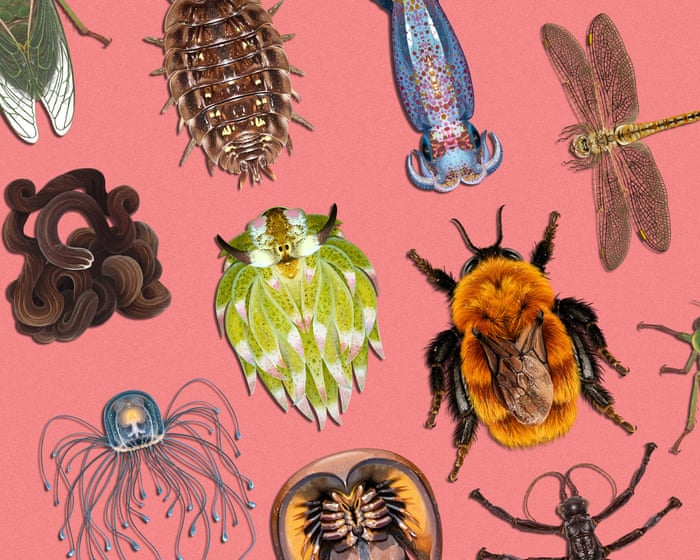
“You’d want one as a pet”: the irresistibly cute solar-powered sea slug
A neon green, solar-powered sea slug that lives underwater has won the Guardian’s increasingly popular Invertebrate of the Year competition. The leaf sheep, known scientifically as Costasiella kuroshimae, came out on top in the global vote after hundreds of thousands of readers worldwide learned about and shared their love for these spineless creatures, which make up the vast majority of animal life on Earth.
The leaf sheep, found in tropical waters near Japan, Indonesia, and the Philippines, was only first described by science in 1993. It won the competition after broadcaster and environmental campaigner Chris Packham praised it, saying: “It’s very, very beautiful but also very smart too. It harvests photosynthetic material from the algae it feeds on and builds its own solar panels.”
This year’s contest was much closer than in previous years, when the tardigrade and the common earthworm won by huge margins. The leaf sheep, with its charming, beady eyes, fought off strong competition from the world’s largest bumblebee, the moscardón (Bombus dahlbomii), which came in second. This giant ginger bumblebee is increasingly threatened in its native Patagonia due to invasive bumblebee species introduced by humans in recent decades.
In third place was the horseshoe crab, a remarkable arthropod that predates the dinosaurs and has blue blood, followed closely by the common woodlouse.
Although worms have historically done very well in the competition, this year’s 10th place went to the astonishing bootlace worm, one of the longest animals in the world.
The competition was launched three years ago to celebrate overlooked and often derided invertebrates, which number at least 1.7 million species—about 97% of all animals—with likely millions more still to be discovered and described by science. Without the unpaid work of wild invertebrates, who pollinate vital crops, filter water, recycle waste, clean up pollution, and enrich soils, human life on Earth would quickly collapse.
This year, several thousand spineless candidates nominated by Guardian readers, from scientists to children, were narrowed down to a shortlist of 10. As each candidate was announced during a two-week celebration of invertebrates, experts shared their insights: Erica McAlister highlighted the importance and beauty of flies, wildlife photographer Dara Ojo revealed the joys of macro photography, and Connor Butler pointed out that there is no “other” in the natural world—we are all part of the same living systems.
The leaf sheep, which lives in tropical waters around Japan, Indonesia, and the Philippines, was only first described by science in 1993. Since then, it has become increasingly celebrated in human culture, thanks to advances in underwater macro photography that have revealed its remarkably cute appearance, which has even inspired at least one Pokémon character.
Frequently Asked Questions
Here is a list of frequently asked questions about the announcement of the 2026 Invertebrate of the Year along with clear and concise answers
General Beginner Questions
1 What is the Invertebrate of the Year award
Its an annual competition to raise awareness about invertebratesanimals without backbones It highlights how interesting and important these creatures are rather than just focusing on cute mammals or birds
2 Who won Invertebrate of the Year 2026
The winner is a tiny marine animal called a tardigrade Its often called a water bear or moss piglet
3 Wait the article says its the size of a grain of rice Is that really the winner
Yes The winning species is a giant among tardigrades but still tiny Most tardigrades are microscopic but this specific species can grow to about 15 mmroughly the size of a grain of rice Thats huge for a tardigrade
4 Why did a tardigrade win What makes it so special
Tardigrades are famous for being nearly indestructible They can survive extreme heat freezing radiation vacuum of space and even being dried out for decades They are the ultimate survivors on Earth
5 Where can I find one
You can find them almost anywhere Look in damp moss lichen leaf litter or gutters Youll need a microscope to see most of them clearly but the ricesized winner might be visible to the naked eye if you look very carefully
Advanced Specific Questions
6 What is the scientific name of the winning species
The article refers to the winner as Milnesium swansoni It belongs to a group of tardigrades known for being big and having a voracious appetite
7 How does a creature that size actually win a public vote
The competition is typically a bracketstyle tournament where the public votes online Tardigrades have a massive fan base online because of their cute appearance and their superpower of survival They usually beat