The “jaw-dropping” El Niño currently heating up the planet has already broken the highest temperature ever recorded for the phenomenon, months before its expected peak. The latest data shows the temperature rise at the heart of El Niño in the Pacific Ocean has reached 3.05C. That is higher than the 3.02C set in late November 2015, the previous high in 150 years of modern records. This temperature is measured against the 1991-2020 average.
Most meteorologists prefer a measure that uses a 30-year rolling average as a reference, which accounts for human-caused global heating. This metric, called ONI (Nino3.4), is on the brink of breaking the record, just one-hundredth of a degree below the 2015 record. Both metrics rely on data from the US National Oceanic and Atmospheric Administration (NOAA).
View image in fullscreenDamaged beachfront homes in Dana Point, California. Photograph: Mario Tama/Getty Images
The most recent forecasts predict a peak of 4.0C in November and December, according to the average of 14 different models assessed by climate scientist Zeke Hausfather. That is so far above previous events that Hausfather called it “mind-blowing,” while others have described it as “Godzilla-level.” Any temperature rise above 0.5C is considered an El Niño; above 2C is officially called a “very strong” El Niño – often referred to as a “super” El Niño.
The current El Niño is likely to be the largest in at least 1,000 years and will add extra heat to an atmosphere where temperatures are already rising rapidly due to human-caused global heating. This double whammy means 2027 is expected to “blow apart” previous records and become the hottest year ever recorded.
The climate crisis, caused by pollution from fossil fuels, is already intensifying extreme weather and killing people. The El Niño will make the impacts even worse, and has already begun to affect regions across the planet as weather patterns change.
View image in fullscreenThe Panamanian-flagged LPG tanker G. Spririt on the Panama canal. Photograph: AFP/Getty Images
“Very strong El Niño events like those in 1997/1998 and 2015/2016 were associated with hundreds of billions of dollars in damages globally – this event is leaving those past ones in the dust,” said Hausfather, a contributor to Carbon Brief.
Prof Friederike Otto, at Imperial College London, said: “This event is a huge redistribution of energy in the climate system and is dangerous because it is unfolding on top of a much warmer, human-influenced climate system.
“So, in many places around the world we will see never-before-experienced heat extremes, with all their consequences for health, food security and water stress,” she said. “El Niño comes and goes, but as long as we continue to burn fossil fuels it occurs on an increasingly hotter baseline, making it much more difficult for communities to deal with the consequences.”
Graph
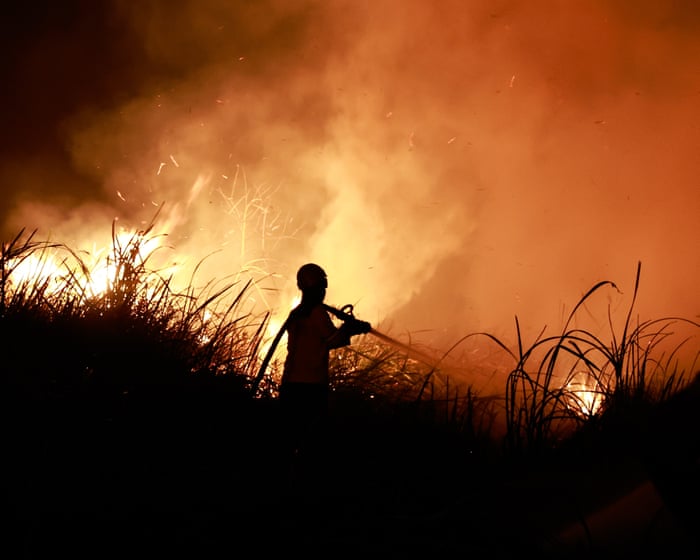
Hot and dry conditions in Indonesia have already spurred record wildfires and deadly levels of air pollution, while India has seen vital monsoon rains curtailed. Drought conditions in Central America and the Caribbean are causing crop losses and slowing trade due to low water levels in the Panama canal. The World Food Programme said in August that the impacts of El Niño were likely to push about 50 million people into acute hunger and drive prices up.
‘Forcing a reckoning’: How Asia is preparing for a ‘supersized’ El Niño
Read more
El Niño years also bring more intense rains and flooding in some regions, with Peru and Chile already suffering, and access to Machu Picchu disrupted. The Horn of Africa is also very vulnerable to increased downpours, while the southern US is expected to experience fierce rains in the winter.
The southern hemisphere summer is predicted to be hotter and drier as a result of the huge El Niño, meaning greater wildfire risk and droughts in AustAustralia and southern Africa. Typhoons in the Pacific are expected to be more intense, but El Niño is suppressing Atlantic hurricanes, and unusually, none have occurred yet this year. While the usual effects of El Niño are well known, scientists are concerned that the multiplying impact of the climate crisis could shift these patterns, making it harder for countries and communities to prepare. The UN World Meteorological Organization said it has launched the biggest mobilization in its 50-year history to help national weather services deliver “life-saving” forecasts. ‘The physical toll is visceral’: How Indonesia’s fire haze affects millions – visual guide Read more UN Secretary-General António Guterres said earlier in September: “El Niño is being supersized before our eyes. The science leaves no room for doubt: the planet is in uncharted waters and the world is in the danger zone of extreme weather. The race now is between rising risks and our commitment to take climate action and protect people.” In the Guardian on Tuesday, meanwhile, Prof Bill McGuire said: “What is happening in the equatorial Pacific is jaw-dropping and could well mark one of the biggest global weather upheavals in a millennium. It will spawn a string of weather catastrophes around our world.” He said strong El Niños can have a devastating effect on the global economy: “While the great recession of 2008 resulted in global GDP reducing by around $2tn, the 1997–98 super El Niño resulted in losses of $5.7tn.” That El Niño has already been surpassed by the current one. Recent research shows global heating is now intensifying El Niño cycles, which then in turn intensify the impacts of the climate crisis. Data from analysis of corals, tree rings and historical documents suggest no El Niño has reached this level in the last millennium, added Hausfather. “All effects from El Niño are magnified by global climate change,” said Prof Kevin Trenberth, at the National Center of Atmospheric Research in the US. “The northern summer of excess heat and wildfires in Europe, North America and Asia are but a sample of what is to come.”
Frequently Asked Questions
FAQs JawDropping El Niño Breaks Temperature Records Months Before Its Peak
Beginner Questions
1 What is El Niño in simple terms
El Niño is a natural climate pattern where the surface waters of the central and eastern Pacific Ocean become unusually warm This warmth shifts global weather patterns affecting rainfall storms and temperatures worldwide
2 What does it mean that El Niño broke temperature records months before its peak
It means global temperatures hit new alltime highs while El Niño was still strengthening before it reached its maximum strength Normally the biggest heat impact comes after the peak so records this early were surprising and alarming to scientists
3 Why is this called jawdropping
Because the records werent just broken they were smashed by unusually large margins and they happened earlier in the El Niño cycle than expected Scientists were stunned by how far above previous records temperatures climbed
4 When does El Niño normally peak
El Niño typically peaks in late fall or winter and then weakens through spring
5 Does El Niño cause global warming
No El Niño is a temporary natural cycle that releases extra heat into the atmosphere Humancaused global warming is the longterm rise in temperatures El Niño adds a shortterm spike on top of that longterm trend
Intermediate Questions
6 Why do temperatures often peak after El Niño peaks not during
The ocean releases heat into the atmosphere gradually Even after the oceans warmth starts fading the extra heat already in the air and the lag in the climate system keep global temperatures elevated for several months
7 How much did temperatures rise above previous records
During the 202324 El Niño several months exceeded 15C above preindustrial levels and individual days briefly crossed 2C These were the highest global averages ever measured
8 What makes an El Niño strong or super
Scientists measure the ocean warmth in a key region of the Pacific A super El Niño exceeds about 2C above average there Stronger El Niños usually cause bigger global temperature and weather effects
9 What are the main effects of a recordbreaking El Niño
Heat waves on land and in the ocean
Heavy rain and floods in some