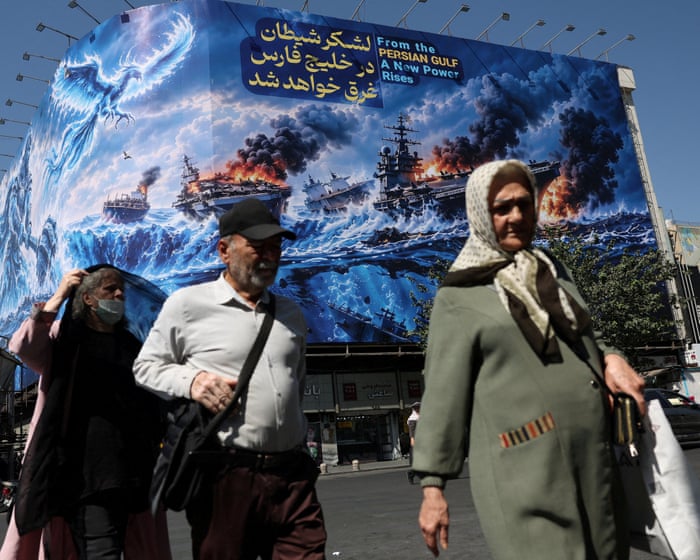
Iran is waiting for an official US response to its proposal to reopen the Strait of Hormuz within a week and resume nuclear talks in exchange for the US lifting its naval blockade of Iranian ports. However, Donald Trump is reported to have rejected the deal.
Although Iran has not yet received his official response, the US president is said to be privately doubtful that Iran would meet his demands to dismantle its nuclear programme, according to unnamed US officials cited by the Wall Street Journal.
Trump has told aides he expects to resume bombing Iran after the November midterm elections in the US, the newspaper reported.
Meanwhile, on Friday evening, he posted on his Truth Social platform a graphic showing a map with the Strait of Hormuz renamed the “Trump Strait”.
During a three-hour meeting at the UN general assembly in New York earlier this week, Iran proposed reopening the strait, which would have eased pressure on global energy markets, and restarting talks on its nuclear programme within seven days.
In return, along with lifting its naval blockade, Iran wants the US to allow the release of some of Iran’s frozen assets, restore the waiver that lifted sanctions on Iran’s oil exports, and observe a “ceasefire on all fronts”.
That would involve the US president convincing Israel to end its attacks on Iran-backed Hezbollah in Lebanon — a tall order — and allowing the strait to reopen largely on Iran’s terms, with the new route running mainly through Iranian waters.
Saudi Arabia is also said to be concerned that the route deal is bilateral between Iran and Oman, rather than signed jointly with the Gulf states.
Reports of the rejection came as Iranian state media reported on Saturday morning that Iranian president Masoud Pezeshkian was on his way back to Tehran from New York.
After a meeting with UN secretary general António Guterres, Pezeshkian said: “Iran has not walked away from the negotiating table, but given past experiences, it no longer trusts the United States.”
Earlier, a US official had said discussions with Iran through mediators were “positive and constructive”, and on Friday, Iranian foreign minister Abbas Araghchi had detailed the proposal to reporters outside the UN security council.
He said the seven-day timeline to open the strait and resume talks could start as soon as the US accepts Iran’s proposal. The initial steps would take about four to five days to complete, the strait would be opened on the sixth day, and talks on the nuclear programme would start on the seventh day, he said.
This would include a protocol to allow UN nuclear inspectors back in to examine Iran’s damaged sites and its stockpile of highly enriched uranium.
“If there is seriousness on the US side to come to a deal and reopen the Strait of Hormuz, everything is now prepared,” Araghchi said. “Iran has conveyed to the United States, through Qatar [mediators], a concrete seven-day plan. If the necessary conditions are met, the strait can be reopened, and normal maritime passage restored within seven days.
“The choice now rests with the United States. Iran does not accept coercion, threats or intimidation, and Iran will not surrender its sovereign rights under pressure.”
Trump faces tough choices as Iran dangles deal to reopen Hormuz before US midterms
The US naval blockade is putting intense pressure on the Iranian economy, while the seven-month-old conflict in the region has disrupted oil flows through one of the world’s most critical shipping lanes and is driving up the cost of living around the globe.
Pezeshkian, in an interview with the CBS show Face the Nation, said Tehran was ready for talks on its nuclear programme and other issues, but would not accept “bullying or coercion”.
“Iran is no“We are not seeking war, but we will defend ourselves against pressure, threats, and attacks,” Pezeshkian said, adding that Iran had already agreed that “we’re not supposed to develop nuclear weapons.”
Previous diplomatic efforts have failed to end the war, which began on 28 February with US and Israeli attacks.
View image in fullscreen
Donald Trump during his address to the UN general assembly. Photograph: Mike Segar/Reuters
Since then, the conflict has alternated between pauses and renewed strikes, killing thousands, weakening Iran’s conventional forces, and damaging its already struggling economy.
Iran and its allies have retaliated by spreading the conflict across the region. Iran has struck US allies in the Gulf with drones and missiles, while its Houthi allies in Yemen have targeted Saudi interests. Iranian-aligned militias in Iraq were blamed for a pipeline attack that temporarily removed more Saudi oil from the market.
The violence in Yemen has caused a new humanitarian crisis, the UN children’s agency said on Friday, reporting a rise in acute malnutrition among children.
Trump has previously said he was in no rush to reach a deal, even as high oil prices fuel inflation. On the Iranian side, it is unclear whether the hardliners who dominate the security forces would accept compromises supported by moderates such as Pezeshkian.
Diplomatic efforts surrounding the UN general assembly highlighted the global stakes in the conflict.
With Reuters and AP
Frequently Asked Questions
FAQs Trump Reportedly Rejects Irans SevenDay Peace Deal Proposal for the Strait of Hormuz
1 Whats this story about in a nutshell
Reports say Iran offered a sevenday ceasefire or peace deal that would include reopening the Strait of Hormuz and Trump turned it down
2 What is the Strait of Hormuz
A narrow waterway between Iran and Oman that connects the Persian Gulf to the open ocean Roughly a fifth of the worlds oil passes through it
3 Why does the Strait of Hormuz matter so much
Because so much global oil and gas shipping goes through it If its blocked energy prices can spike worldwide and shipping costs go up
4 Why would Iran propose a sevenday deal
Likely to pause tensions ease military pressure and buy time for negotiations while getting something in return like sanctions relief or a halt to strikes
5 Why did Trump reportedly reject it
Reports suggest he wanted a permanent opening of the strait and a broader deal not a shortterm pause that could let Iran regroup
6 Is this confirmed by official sources
Not fully Much of it comes from media reports and unnamed officials Treat details as unverified until confirmed by governments
7 What does reopening the strait mean if it isnt closed
It can mean lifting a de facto blockade stopping attacks on ships or removing threats that make shipping companies avoid the route
8 Why is a sevenday timeframe significant
Its short enough to test compliance or deliver aid but too short to resolve root causes Its more of a pause than a peace
9 What could happen if the strait stays disrupted
Higher oil and gas prices longer shipping routes rising insurance costs and more global inflation
10 Who is affected most by a blocked strait
Oil importers like China India Japan and Europe plus Gulf exporters and ultimately consumers everywhere via fuel prices
11 Whats the difference between a ceasefire and a peace deal
A ceasefire stops fighting temporarily A peace deal resolves the underlying dispute longterm Irans offer was closer to a ceasefire
12 Could this lead to a wider war
It could escalate tensions but a short truce offer also signals both sides may want to avoid fullscale war