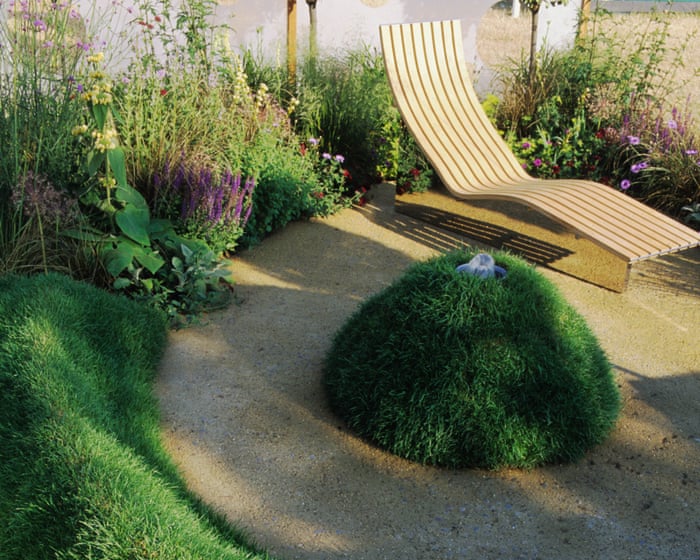
The work has started. The dry, scorched patch that used to be the garden is now a big pile of dirt—and, excitingly, a large hole for the rainwater harvesting tank. I’m hoping that tank will help us cope with the drier summers and wetter winters we’ve been having. I’ll share more once it’s installed.
For now, though, the focus is on soil. There’s so much of it! It’s everywhere! I’m determined to keep as much of it as possible from ending up in a skip. And what do you do with piles of earth? You make mounds.
I’ve admired plenty of impressive mounds over the years, but one standout is the crushed substrate mounds in the walled garden at Knepp in West Sussex. When the rewilding estate’s caretaker showed me around, she mentioned that head gardener Charlie Harpur and his team demolished an outbuilding and dumped the entire thing on the croquet lawn. What could have been hauled away in a skip became a stunning base for a dry garden. We visited on the hottest day last summer, and it was a golden, shimmering sea of swaying color and umbellifers, with its rolling landscape supporting all kinds of insect life.
I don’t have an outbuilding to knock down or a croquet lawn to fill, but I will be making mounds in our much smaller garden. It’s a classic long, narrow urban plot, and I’m giving up the biggest possible lawn for my kids because we live near a park, and, well, the garden isn’t just for them. Instead, I want to create the kind of surprise and intrigue that makes the best gardens, and that requires some division.
I’m thinking of a few mounds at the far end of the plot: a couple near where the compost pile will go, and then one or two more toward the end, where I’m planning wilder, looser planting so the kids can run around freely (I’m not completely heartless).
If you’re not digging up a load of soil, hugelkultur is an ancient method of building mounds from decaying wood, mulch, rotting branches, and twigs, topped with soil and plants. Start by removing any turf, which you can then layer upside down on the wooden base before mulching—this compacts the materials and speeds up the decay that boosts soil nutrition.
Once your mound is in place, plant it like you would a flowerbed, thinking about repetition, structure, and a mix of heights, colors, and textures.
Mounds can also be great for creating privacy without the need for a formal boundary: trees and shrubs can be planted alongside smaller perennials and ground cover, expanding your planting space both upward and outward.
Frequently Asked Questions
Here is a list of frequently asked questions about building mounds in your garden covering everything from the basics to more advanced tips
General Benefits
1 What exactly is a garden mound
Its simply a raised bed of soil that isnt enclosed by wood or stone You just pile soil up into a hill or gentle slope and plant directly into it Its also often called a berm or a raised mound
2 Why should I bother building a mound instead of just planting in the ground
There are a few big reasons It improves drainage which is great for plants that hate wet feet It creates a deeper area for roots to grow and it adds visual height and interest to a flat yard It can also help define different rooms in your garden
3 Will a mound help with my poor rocky or clay soil
Absolutely Instead of fighting to dig into hard compacted soil youre building a new growing environment on top of it You can fill the mound with highquality loose and nutrientrich soil that your plants will love
4 Can building a mound help with drainage in a boggy area
Yes its one of the best solutions Because the mound is raised above the surrounding ground level water will drain away from the plant roots much faster Just be sure to use a soil mix that drains well
5 Is it expensive to build a mound
It depends on the size If you have your own compost and topsoil it can be very cheap For a large mound youll need to buy soil by the cubic yard which can get pricey A good tip is to use a cheaper fill dirt for the core of the mound and save the good topsoil for the top layer where the roots will be
Planning Design
6 How big should my mound be
Theres no perfect size but a good rule of thumb is to make it 3 to 4 times wider than it is tall This creates a naturallooking slope For example a 2foottall mound should be about 68 feet wide This gentle slope also helps prevent soil erosion
7 What shape should my mound be
For a natural look avoid perfect circles or domes Try to make it more of an organic