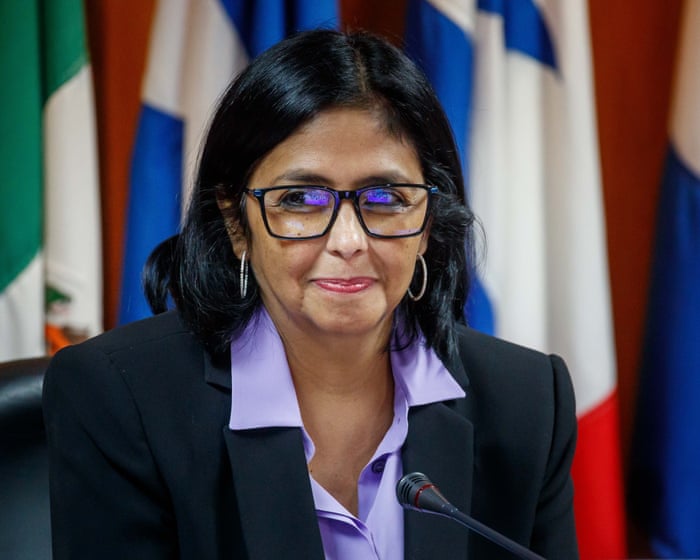
In her first speech as Venezuela’s interim leader, Delcy Rodríguez condemned the U.S. and pledged loyalty to Nicolás Maduro. However, the Trump administration has calculated that she will ultimately yield to Washington’s demands.
Rodríguez is a political veteran who served as Maduro’s vice president and oil minister, defending his regime against accusations of terrorism, drug trafficking, and election fraud. Yet for now, she is Donald Trump’s preferred choice to lead Venezuela. “She’s essentially willing to do what we think is necessary to make Venezuela great again,” Trump said.
The U.S. president has not ruled out sending ground troops but seems to prefer to “run” Venezuela through Rodríguez, who now heads a regime shocked and demoralized by Maduro’s abduction but still in power.
The 56-year-old former labor lawyer struck a defiant tone in her televised speech on Saturday night. She condemned the abduction of Maduro and his wife, Cilia Flores, and demanded their return.
“What is being done to Venezuela is an atrocity that violates international law. History and justice will make the extremists who promoted this armed aggression pay,” she said. “There is only one president in Venezuela and his name is Nicolás Maduro.”
In a crisis mixing political theater, military power, and economic interests, her defiance may have been partly performative—a gesture to the humiliated loyalists of the Bolivarian revolution, especially within the armed forces, as Rodríguez consolidates her position.
To stay in power—assuming that is her goal—she must meet U.S. demands while propping up an authoritarian regime despised by many Venezuelans. One misstep could trigger an internal coup, a popular uprising, or further U.S. military action.
U.S. Defense Secretary Pete Hegseth elaborated on Trump’s statement that the U.S. would run the South American country. “It means we set the terms. President Trump sets the terms,” he said. “It means the drugs stop flowing, it means the oil that was taken from us is returned, ultimately, and that criminals are not sent to the United States.”
This suggests a puppet ruler of a vassal state, but Rodríguez still has some room to maneuver. While Venezuelan opposition figures see her as an apparatchik of Maduro’s dictatorship, the Trump administration views her as a potential business partner.
A senior official told the New York Times: “I’m not claiming that she’s the permanent solution to the country’s problems, but she’s certainly someone we think we can work with at a much more professional level than we were able to do with [Maduro].”
According to the report, the English-speaking technocrat impressed Trump’s team with her management of Venezuela’s oil industry, and intermediaries convinced the administration that she would protect and promote future American energy investments in the country.
For Trump, that was enough to abandon an alternative candidate to replace Maduro: María Corina Machado. The opposition leader mobilized Edmundo González’s winning presidential campaign last year—which Maduro ignored—and won the Nobel Peace Prize.
Machado dedicated the prize to Trump as she sought his support and backed the Pentagon’s military buildup in the Caribbean. But on Saturday, Trump said she lacked support and that it would be “very tough” for her to lead Venezuela. An informed source in Caracas noted that while millions of Venezuelans revere Machado, she is unacceptable to the military hierarchy that supports the regime.
For now, leadership of the revolution launched by Hugo Chávez in 1999 and continued by Maduro since 2013 has fallen to a soft-spoken woman known as a tough pragmatist.When she was a child, her father—a Marxist activist—died under interrogation by Venezuelan authorities for his involvement in the kidnapping of a U.S. citizen. The irony that U.S. forces later kidnapped her boss would not have been lost on Rodríguez.
A student leader, she studied law in Caracas and Paris before joining Chávez’s government in 2003, following in the footsteps of her brother, Jorge Rodríguez, a psychiatrist who served as vice president and now heads the national assembly.
Under Maduro, she rose to senior roles, including foreign minister, and became vice president in 2018. Her colorful outfits stood out on podiums dominated by military uniforms, but no one questioned her dedication, and her responsibilities grew to include the economy and oil.
Unlike many in Maduro’s inner circle, Rodríguez has not been indicted by the U.S. for drug trafficking or other charges. Trump’s team hopes they have found a market-friendly technocrat who can guide the regime while taking direction from Washington. For Rodríguez, a dizzying tightrope lies ahead.
Venezuela’s opposition leaders, though sidelined by Trump, sense an opportunity. “Today we are prepared to assert our mandate and seize power,” said Machado. Having tasted military success, Trump appears eager for more chances to use force.
What remains of the Bolivarian revolution—a socialist experiment that shifted toward quasi-capitalism—still needs rhetorical justification. Rodríguez declared that Venezuela “will never again be anyone’s colony—neither of old empires, nor of new empires, nor of empires in decline.”
Frequently Asked Questions
Here is a list of FAQs about Delcy Rodríguezs role as Venezuelas interim leader designed to cover a range of perspectives
Beginner Definition Questions
1 Who is Delcy Rodríguez and what is her role right now
Delcy Rodríguez is the Vice President of Venezuela She is currently serving as the countrys interim leader while President Nicolás Maduro is on an international tour
2 What does interim leader mean in this case
It means she is temporarily acting with the powers of the president in Maduros absence making daytoday governmental decisions until he returns
3 What does striking a defiant tone refer to
It refers to her strong confrontational public statements defending the Maduro government against international criticism sanctions and opposition often framing Venezuela as a victim of foreign aggression
4 What is the tightrope she has to walk
She must balance projecting strong unwavering leadership to her domestic base and allies while not making decisions or statements so extreme that they destabilize delicate diplomatic or economic situations in Maduros absence
Context Analysis Questions
5 Why is her interim leadership significant right now
Venezuela is in a prolonged political and economic crisis Her leadership during Maduros travel tests the governments stability and unity and her actions can signal policy directions or shifts in diplomatic strategy
6 Who is her audience when shes being defiant
Primarily three groups 1 The governments loyal political base and military 2 International allies like Russia China and Iran and 3 Opposition figures and foreign governments that she is directly challenging
7 What are the main risks she faces while in this role
The main risks are a major domestic crisis that she mishandles a diplomatic misstep that undermines ongoing negotiations or appearing weak or disloyal which could threaten her position within the ruling party
8 How does this relate to Venezuelas economic situation
Her defiance often targets the sanctions she blames for Venezuelas economic woes As interim leader she must manage the practical realities of hyperinflation and scarcity without the ability to change core economic policy making her rhetoric a key tool to assign blame elsewhere
Advanced Strategic Questions