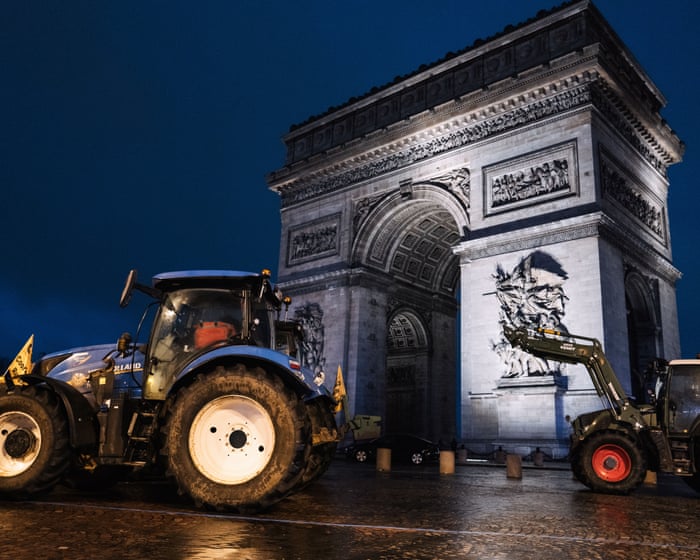
French farmers driving tractors have blocked roads near the Eiffel Tower and the Arc de Triomphe. They are protesting an upcoming EU trade deal with South American countries, which they argue will lead to unfair competition.
On Thursday, farmers blocked highways outside Paris. Dozens of tractors then bypassed police checkpoints early in the morning to reach the city center in a protest organized by the Coordination Rurale union.
EU member states are scheduled to vote on Friday on the trade agreement with Argentina, Brazil, Uruguay, and Paraguay—the four countries that make up the South American trade bloc Mercosur. If approved, the deal would create a common market of nearly 800 million people and increase EU exports of cars, machinery, wine, and spirits.
Many European farmers worry they will be undercut by cheaper agricultural imports from the Mercosur market. Belgian farmers also protested recently, driving more than 1,000 tractors into Brussels last month.
“We are between resentment and despair. We have a feeling of abandonment—with Mercosur being an example,” said Stéphane Pelletier, a senior member of Coordination Rurale, speaking to Reuters near the Eiffel Tower.
The French government stated that authorities would “not stand by.” Government spokesperson Maud Bregeon told French radio that blocking roads or “attempting to gather in front of parliament—with all the symbolism that entails—is, once again, illegal.”
Under heavy police presence, farmers also demonstrated in front of the lower house of the French parliament. They heckled National Assembly President Yaël Braun-Pivet when she came out to meet them.
The Mercosur deal is supported by Germany and Spain, but France, influenced by its strong farming lobby, has long opposed it. Although Paris has secured significant last-minute concessions, it remains cautious about the agreement ahead of municipal elections in March.
“The treaty is still not acceptable,” Bregeon said, without revealing how President Emmanuel Macron would vote. Farming Minister Annie Genevard added that even if the deal is approved, France would continue to oppose it in the European Parliament.
Negotiations between the two blocs have lasted 26 years, with talks gaining urgency due to the Trump administration’s protectionist policies and growing competition from China.
European Commission President Ursula von der Leyen signed the agreement in late 2024, despite opposition from France, Poland, and a few smaller states. However, it still needs ratification by EU member states and the European Parliament.
The free trade deal aims to reduce South American tariffs on European cars, clothing, food, fine wines, and medicines. In return, the EU will open its markets, though it has set limits on imports of beef, pork, ethanol, honey, and sugar.
To gain member states’ support, the European Commission this week proposed making an additional €45 billion in EU funding available to farmers in the bloc’s next seven-year budget. This would largely make up for a planned 20% cut in agricultural funding.
France is still pushing for stricter safeguards, such as allowing the EU to reimpose tariffs if prices drop by 5% instead of the 8% specified in the deal. It also wants the ability to ban imports of crops grown with pesticides that are prohibited in the EU.
The commission’s latest proposal seems to have won over Italy, whose support was previously uncertain. Italian Prime Minister Giorgia Meloni praised what she called a “commonsense approach to supporting European agriculture.”
While Rome is also…Analysts believe Italy’s apparent support should now secure the qualified majority needed for the deal’s approval on Friday, even without France’s backing. While France is still thought to be pushing for stricter price protections—a position shared by Ireland, Austria, and Poland—it likely lacks the numbers to block the agreement.
Under EU rules, approval requires support from at least 15 of the 27 member states, representing 65% of the population. To block the deal, at least four countries representing 35% or more of the population must oppose it. With Italy’s decisive vote—accounting for 13% of the EU’s population—now in favor, the opposing coalition appears to fall short of the threshold needed to stop the accord.
Frequently Asked Questions
Of course Here is a list of FAQs about the French farmers protests against the EUMercosur trade agreement designed to be clear and conversational
Beginner Core Questions
1 What are the French farmers protesting about
They are protesting against the proposed EUMercosur free trade agreement which they believe will flood the European market with cheaper imported food that doesnt meet the same strict environmental and health standards they have to follow They see it as unfair competition that will drive down their prices and put them out of business
2 What is the EUMercosur trade deal
Its a proposed free trade agreement between the European Union and a group of South American countries called Mercosur The goal is to remove most tariffs on goods traded between the two regions to boost commerce
3 Why are they protesting in Paris
Paris is the capital of France and a major political hub By protesting thereoften by blocking major roads and highways around the citythey aim to get the direct attention of the French government and pressure it to oppose the deal at the EU level
4 What do the farmers want
Primarily they want the French government to officially reject and block the EUMercosur agreement They are also demanding more government support to cope with high costs and stricter EU environmental rules they feel put them at a disadvantage
Advanced Detailed Questions
5 Whats the main argument against the deal from an environmental perspective
Protesters and environmental groups argue that increased beef production in South America particularly in Brazil leads to deforestation of vital ecosystems like the Amazon rainforest and the Cerrado savanna They say the EU should not sign a deal that rewards and incentivizes this environmental damage
6 Dont free trade agreements usually benefit consumers with lower prices
Yes in theory consumers might see slightly lower prices for some imported goods However farmers argue this comes at too high a cost the potential collapse of local farming a loss of food sovereignty and lower overall standards for animal welfare and pesticide use in food production
7 What are mirror clauses and why are they a key demand
Mirror clauses are rules that would require all agricultural