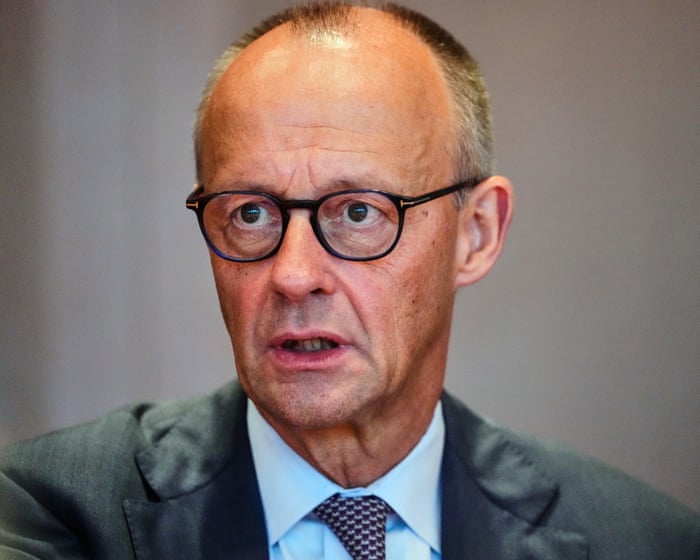
Powerful state leaders from Friedrich Merz’s party have rallied behind him as speculation grows that his time in office may be running out. The chancellor’s grip on power has looked increasingly shaky since a shocking regional election result earlier this month, in which the far-right Alternative für Deutschland (AfD) routed his Christian Democratic Union (CDU) in Saxony-Anhalt. With two more states voting on Sunday, where the AfD is expected to do well, Merz cancelled a planned speech at the UN general assembly in New York next week because “his presence is required in Berlin,” a government official said on condition of anonymity. The announcement sparked fresh rumours that the unpopular chancellor could be preparing to step down or wants to stay and fight off a potential coup. With Merz on the ropes after just 16 months in office, eight CDU state premiers issued a surprise joint statement backing him.
Firewall compromised: has Friedrich Merz blown ‘democracy’s last shot’? Read more
Citing the threat posed by nativist parties across Europe, they wrote: “Now more than ever, Germany’s political landscape needs stability,” pointing to elections next year in Poland, Italy, Spain, Greece and France, where the political establishment faces a far-right challenge. “The path to restoring public trust in Christian Democrats lies in listening and taking political action, not in debates over personnel.” They added that Germany needed “reliability and decisive action” and that, as state leaders, “we want to, and will, do our part to achieve this together with the chancellor.” The signatories included leaders who have been mentioned as possible Merz successors, such as North Rhine-Westphalia’s Hendrik Wüst. Markus Söder, the Bavarian premier and an ambitious conservative populist, has also said he backs Merz.
View image in fullscreen Voters in the Berlin state parliament election are expected to punish the CDU again. Photograph: Markus Schreiber/AP
It remains to be seen how long this show of solidarity with Merz will hold, with much depending on the outcome of the weekend elections. Polls indicate voters are very likely to punish the CDU again in Berlin and Mecklenburg-Western Pomerania on the Baltic coast, amid widespread dissatisfaction with Merz’s federal coalition government formed with the Social Democrats. Merz, who is also the CDU’s chair, will convene a meeting of its leadership on Sunday evening to coordinate a response as the results come in, in what senior party members called a pre-emptive “show of unity” behind the chancellor.
The anti-immigration, pro-Kremlin AfD’s resounding win in Saxony-Anhalt sent a shockwave through Europe’s largest economy and beyond, although the party fell just short of the absolute majority required to govern alone in the state. It is seeking enough support from other parties’ lawmakers in the state parliament to make its chief candidate, Ulrich Siegmund, the first far-right regional leader in Germany since the Nazi period.
View image in fullscreen The AfD candidate Ulrich Siegmund came out on top during Saxony-Anhalt’s state elections earlier this month. Photograph: Matthias Schräder/AP
Merz took office in May 2025 promising to cut the surging AfD back down to size by reviving the moribund economy and addressing fears around “irregular” migration. Instead, the AfD is now topping the national polls with clear momentum behind it. The party’s co-leader, Alice Weidel, has targeted the CDU for “destruction” and pledged last week in parliament that Merz’s party would “never win another election again”.
Skip past newsletter promotion Sign up to This is Europe Free weekly newsletter The most pressing stories and debates for Europeans – from identity to economics to the environment Enter your email Sign up After newsletter promotion
During the same debate in the Bundestag, a pale and defensive Merz lashed out at Weidel and the AfD’s lawmakers, accusing them of seeKing “ethnic cleansing” with their calls for “remigration,” a legally dubious programme of mass deportations. Critics said he failed to outline a clear vision for the remainder of his term. Weidel, whose party received congratulations from Donald Trump and Elon Musk for its Saxony-Anhalt victory, taunted the state leaders backing Merz on Wednesday. “The CDU is making it clear that it is committed to ‘business as usual’ rather than the positive changes that citizens need,” she posted on Musk’s social media platform X. “The only way to achieve those changes is with the AfD!” View image in fullscreen. Alice Weidel, the AfD’s parliamentary group leader, speaks in the Bundestag last week. Photograph: Christoph Soeder/DPA/AP. The month’s developments have triggered a sense of helplessness and fear among the mainstream democratic parties, with even the opposition Green party calling on the CDU to right the ship before it is too late. “Get your shit together,” said the Greens co-leader Felix Banaszak in Berlin, appealing to Merz and the CDU to end speculation that he called destabilising. Banaszak said that while he was no fan of the centre-right-led government, he warned that calls for a Kanzlertausch, a swap of the chancellor from Merz in favour of another Christian Democrat, could trigger new elections in which the AfD could come out on top. “We live in such dramatic times that this country just can’t afford that right now,” he said. The next general election is due in 2029.
Frequently Asked Questions
FAQs German State Leaders Backing Friedrich Merz Despite Uncertainty About His Future
1 Who is Friedrich Merz
Hes a German politician and the leader of the Christian Democratic Union He became the CDUs candidate for chancellor ahead of Germanys 2025 federal election
2 What does it mean that state leaders are backing him
It means the leaders of Germanys 16 statesespecially those governed by the CDU and its sister party the CSUare publicly supporting him as their candidate for chancellor
3 Why are they backing him if his future is uncertain
Because they want to show party unity and avoid a damaging leadership fight Even if some have doubts openly opposing him could weaken the party before an election
4 What exactly is uncertain about Merzs future
Whether hell actually become chancellor That depends on election results and whether the CDUCSU can form a coalition government His personal popularity and internal party support also matter
5 What are Germanys states and why do their leaders matter
Germany is a federal country made up of 16 states like Bavaria or North RhineWestphalia State leaders hold real political power and influence so their support carries weight nationally
6 Why is party unity so important in German politics
German elections are often close and parties need to look stable and trustworthy Public infighting tends to turn voters off and can cost a party the election
7 Whats the CDUCSU and how do the two parties relate
The CDU operates in most of Germany while the CSU operates only in Bavaria Theyre separate parties but work together as a permanent alliance often called the Union
8 What could happen if Merz fails to become chancellor
The CDU might look for a new leader or he could stay on as party leader in opposition Either way it could trigger internal debates about the partys direction
9 What are the benefits of state leaders uniting behind one candidate
It projects strength pools resources and networks across the country and makes it easier to run a coordinated national campaign
10 What are the risks of backing him so early
If Merz stumbles or becomes unpopular the state leaders who supported him could be blamed It also