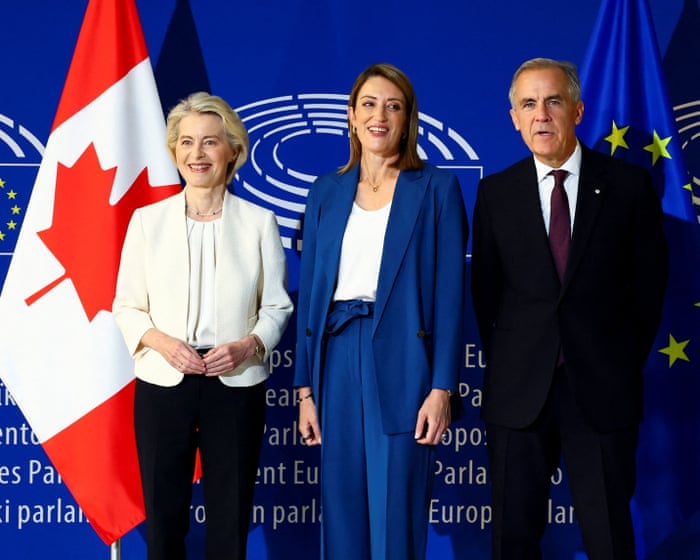
The European Commission president, Ursula von der Leyen, has invited Canada to become the EU’s first “associate member.”
In an unprecedented offer, von der Leyen said on Wednesday that the EU and Canada “see the world with the same eyes,” sharing democratic values and similar approaches to major issues ranging from AI to climate change, the war in Ukraine, and geopolitics.
Speaking at the European Parliament in Strasbourg alongside Canadian Prime Minister Mark Carney, she said: “We want to bring the relationship with Canada to the highest level possible. We must urgently reimagine our partnerships. So, I would like to work with you on opening the door for Canada to be the first associate member of the EU.”
Carney, who is due to address the parliament on Thursday, has called for a “unique alliance” with the EU as Canada looks to reduce its heavy reliance on US trade.
He later tweeted: “Canada and the EU are natural partners, united by shared values. With President von der Leyen and [European Parliament] President [Roberta] Metsola, we focused on what comes next: a deeper partnership that reinforces our mutual sovereignty to create more opportunities and prosperity for our peoples.”
The EU and Canada are due to hold a summit in late October to develop their future relationship.
Canada and the EU already have a trade deal and numerous bilateral agreements, but have been drawing closer since Donald Trump returned to the White House and raised tariffs on both longtime allies, while repeatedly suggesting Canada should become the 51st US state and criticizing the EU.
Von der Leyen said the existing EU-Canada trade deal would be upgraded to an “alliance for the future” to create a “common prosperity and economic security space.”
She said the two sides would also create a tech alliance, integrate defence industrial bases, and make the Arctic a “flagship joint project.” EU officials are especially interested in Canada’s energy and natural resources. Von der Leyen proposed joint work on energy, critical minerals, batteries, AI, quantum computing, cybersecurity, and economic security.
The 27-member EU has never had an associate membership category, though it has close ties with Norway, Iceland, and Switzerland, allowing deep economic integration with these countries, which follow many EU rules. It remains unclear what associate membership would mean, including for Canada’s relationship with the EU single market.
When the UK was negotiating its exit from the bloc and its post-Brexit relationship, EU officials repeatedly said there was no status that allowed a foreign country to be half in and half out of the single market. The EU also firmly defended the four freedoms of its internal market – the free movement of goods, services, people, and capital.
Carney is expected to receive an enthusiastic reception when he gives his own address to the European Parliament. His approach to dealing with Trump has drawn widespread praise among MEPs.
Last month, Carney announced he was breaking off trade talks with the US, saying Canada would not be subjugated, and then introduced retaliatory tariffs on billions of dollars’ worth of US goods. By contrast, the EU last year accepted 15% tariffs on many European goods while dropping its own duties to avoid a trade war.Javier Moreno Sánchez, a Spanish socialist MEP who leads the European Parliament’s Canada delegation, said the EU definitely had lessons to learn from Carney’s approach, because “Trump respects people who are strong.” He added: “Canadians are the most European people outside Europe, and that is the key point for developing our relationship.”
Carney’s speech at Davos, where he said there was a rupture in the international order and “middle powers” needed to unite, has also been widely praised. European officials, however, reject the suggestion that the EU, a bloc of 450 million people, is a “middle power.”
Sore points likely to be addressed include the fact that 10 EU member states, including France, Poland and Italy, have failed to ratify the EU-Canada trade deal, nearly 10 years after it was struck in 2016.
The offer of associate membership is certain to raise questions among other EU allies, including the UK, which has long sought a more flexible approach from Brussels.
Martin Leng at the Brussels Institute for Geopolitics thinktank said a world in flux was “pushing the EU towards far greater flexibility in its relations with third states.”
He said von der Leyen’s speech, with its focus on different sectoral areas of cooperation, “points to the ambition and strategic breadth of the associate membership which the parties have in mind, but also suggests that, in reality, Canada’s ‘membership’ may consist of ‘plugging in’ to existing programmes and frameworks, such as the European Defence Agency, rather than joining the union in any traditional sense.”
Frequently Asked Questions
Here is a list of FAQs regarding the European Union inviting Canada to become its firstever associate member
What does associate member actually mean
It is a new status that sits between being a full member and just a regular trading partner Canada would follow many EU rules and pay into some programs but it would not get a vote on major EU laws or have seats in the European Parliament
Is this a real thing that is happening right now
No As of now this is a hypothetical or proposed scenario The EU has never had an associate member and there is no formal invitation on the table These FAQs explore what it would mean if it did happen
Why would the EU want Canada as an associate member
Canada is a stable democracy with values similar to the EUs The EU wants closer ties with likeminded countries to strengthen its global influence especially on trade climate and security
Why would Canada want to join as an associate member
It would give Canada better access to the EUs single market more say in European decisions that affect Canada and a stronger voice on the world stage It is a middle path between staying fully independent and becoming a full EU member
Would Canada have to adopt the euro currency
No Associate membership would not require Canada to give up the Canadian dollar The euro is only for full EU members
Would Canada have to follow EU laws
Yes but only in specific areas agreed upon like trade standards environmental rules or data privacy Canada would not have to adopt all EU laws only the ones covered by the associate membership deal
Could Canada still make its own trade deals with other countries
Probably yes but with limits Canada might need to align some trade rules with the EU which could restrict new deals that conflict with EU standards The exact rules would be negotiated
Would Canadians need a visa to travel to Europe
No Canadians already travel visafree to the EU for short stays Associate membership would not change that
Would Canadians be able to work and live in the EU more easily
Possibly Associate membership could include easier rules for work permits or professional recognition But it would not be the same as full freedom of movement that EU citizens enjoy
How is this different from Canada just being in NATO or the G7
NATO is a military alliance The G7 is an informal group