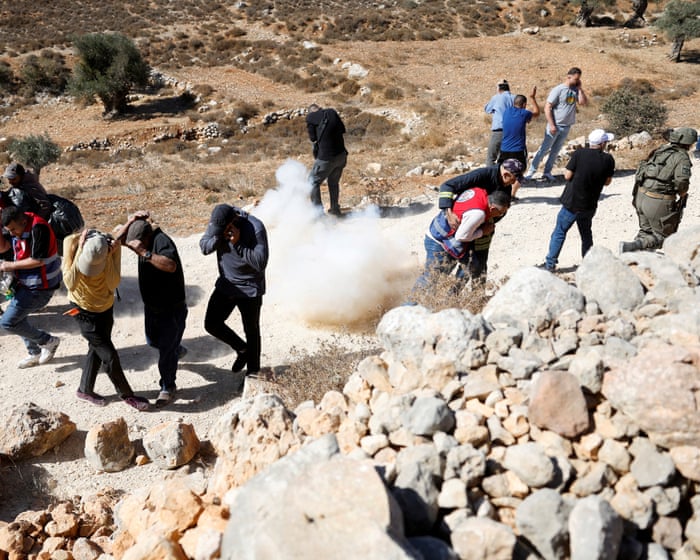
Israel’s military has become a tool for violent settlers to intensify their campaign against Palestinians throughout the occupied West Bank. According to Israeli soldiers, activists, and the United Nations, reserve units recruited from settlements are acting as vigilante militias.
These regional defense units, known as “hagmar,” were established across the West Bank starting in October 2023, as regular army units prepared to redeploy to Gaza. The system armed and empowered thousands of settlers, allowing them to form military units within their own communities with little oversight. While the state pays their salaries, these units effectively operate alongside, but independently of, regular army battalions.
Yaakov*, a reservist who served in the West Bank in 2024, described the hagmar as “armed militias doing what they want.” Speaking anonymously, he said, “Formally they are under the battalion commander, but on the ground they are given a free hand. The senior command looks the other way when incidents happen.”
His unit was often called to scenes by Israeli activists supporting Palestinians. Upon arrival, they would frequently find settler reservists already there, sometimes participating in attacks. “Most of the time, the hagmar would arrive ahead of us… When they do arrive, in the best case, they do not participate. In the worst case, they are together with the settlers,” Yaakov stated.
He reported witnessing daily violence, including vandalism of homes, trees, and crops, theft of livestock, intimidation, and reckless handling of weapons.
In other areas, hagmar forces have been linked to more extreme violence, including the killing of an elderly Palestinian man and running over another Palestinian with an all-terrain vehicle last year.
Nadav Weiman of the advocacy group Breaking the Silence said the system has led to “the establishment of what are effectively settler militias within the IDF’s own ranks. These soldier-settlers are driven by a violent, zero-sum ideology, and have all the authority of regular IDF soldiers to put that ideology into action.”
The Israeli military acknowledged “a few incidents” where regional defense reservists acted below expected standards but stated these “do not represent the majority.” A spokesperson said some reservists have been removed from duty and criminal investigations have been opened in certain cases.
According to the rights group Yesh Din, since October 2023, Israeli soldiers have been indicted for three violent offenses and three property offenses in the West Bank, where Israeli forces have killed over 1,000 Palestinians in that period. The last homicide indictment from a shooting occurred in 2019.
While there is a long history of collaboration between settlers and the military, the widespread deployment of these settler units represents a significant structural change. Yehuda Shaul of the Ofek thinktank noted, “Post 7 October, the military and settler are unified. The settlers are the IDF, the IDF are settlers. It is not any more about the IDF standing idly by while settlers attack, it’s not even just one or two soldiers joining settler attacks.””The level of complicity is unprecedented. You can see the impact by comparing how many Palestinian communities were forcibly displaced by settler violence before October 7th and how many after.”
According to UN data, settler attacks have completely displaced 29 Palestinian communities since October 2023, averaging more than one per month. In contrast, four communities were displaced in 2022 and the first nine months of 2023, or about one every five months.
This month, the UN warned that the “growing phenomenon of ‘settler-soldiers’… is further blurring the line between state and settler violence.” A report from the Office of the High Commissioner for Human Rights found that settlers have killed, destroyed property and livelihoods, forced Palestinians from their homes, and torn communities apart.
The report noted that the creation of ‘hagmar’ units has enabled these attacks and “further cemented” impunity for perpetrators. The mix of military uniforms and civilian clothing means “there is no clarity on whether Israeli attackers are acting as part of the army or in a private capacity.”
A second Israeli soldier deployed to the occupied West Bank in 2025 described an irregular dress code that amplified the “vigilante feel” of hagmar units. Moshe* spoke to the Guardian in an interview arranged by Breaking the Silence and also requested anonymity.
“When you see hagmar in uniform, they’re quite identifiable because they’re the only ones out there who aren’t us,” he said. But he added that they do not always wear uniforms, even during military missions. “In the West Bank, there is a very confusing mix of people—some in full uniform, some in partial uniform but with long-barrel weapons, or wearing military-style cargo pants that aren’t necessarily proper uniforms.”
In September last year, hagmar member Elyashiv Nahum approached international activists in Masafer Yatta, demanding to see their passports. Video of the incident shows Nahum driving a civilian vehicle and wearing civilian clothes, prompting the activists to question his legal authority. Nahum then changed into uniform and called a commander, who told the women: “It doesn’t matter what he looks like. He’s a soldier and he has the authority.”
Even serving Israeli soldiers often struggle to identify the chain of command for armed settlers due to the irregular approach to uniforms and the proliferation of weapons in the West Bank since October 2023.
Assault rifles are issued to hagmar members and to “first defender” security groups at settlements, and the government has also loosened gun licensing laws. In a post on X, far-right Security Minister Itamar Ben-Gvir said about 120,000 weapons were distributed to “Israeli citizens” in the first year of the war.
Yaakov described being called to an incident where a well-known settler, wearing military trousers, was waving a military-issue weapon with dangerous aggression and carelessness. He did not know whether the man was a fellow soldier from a hagmar unit, a first responder with an assault rifle, or a civilian with a borrowed gun.
The Israeli military stated that hagmar reservists “are required to operate in uniform and follow clear procedures under the supervision of regional units,” and must adhere to all IDF orders and rules of engagement. A military spokesperson added, “Any deviation from these rules is investigated and addressed.”
Regular forces deployed to the West Bank were not briefed on hagmar membership or its military division.Both reservists who spoke to the Guardian said there was a blurring of roles between units in the area. Moshe noted that this was “very unusual when there are other forces in the same area as you.” Over months of deployment, however, they came to recognize many serving settlers as the two groups built relationships that Yaakov described as “transgressing the operational.”
All settlements maintain a “warm corner” with coffee and biscuits for soldiers far from home. Hagmar soldiers often invite other reservists, who are frequently bored and lonely, to watch football or join Friday night dinners, fostering close bonds.
The hagmar units themselves are not new. The structure was created decades ago, envisioned as a backup line of defense in border kibbutzim and communities to be activated during wars or heightened threats. But after the October 7, 2023, Hamas-led attacks, as Israel prepared to send its standing army to fight in Gaza, hagmar reservists were activated on an unprecedented scale and duration in Israel’s history.
An Israeli military spokesperson said thousands were called up to units in border communities. While the number of serving hagmar reservists has since been reduced by 85%, hundreds remain deployed, mostly in the occupied West Bank. The military declined to provide exact figures, but Israeli media reported that 7,000 settlers were initially mobilized, and as of December 2025, at least 500 were still based at illegal farm outposts.
Both soldiers said that although conventional reservist units outnumbered the hagmar in the West Bank, the settlers’ presence was felt much more strongly on the ground. Their familiarity with the local terrain often means soldiers on temporary deployments seek their advice or defer to their decisions. “Even the senior officers don’t really know what’s going on, so they treat the hagmar as the people that know the area and know how to deal with stuff,” Moshe said.
At times, this extends to hagmar having effective command authority over uniformed reservists. In August, Nahum, the settler filmed changing into a uniform, drove to a small Bedouin community with several regular reservists in his pickup—even though traveling in a civilian vehicle while on duty typically violates Israeli military regulations. Upon arrival, Nahum, in civilian clothes, began directing the reservists to search Palestinian property and look for international activists, according to an Israeli activist present and a soldier serving in the area. “I wouldn’t say he was giving orders like an army commander, but he was in charge,” said the activist, who spoke anonymously for fear of professional repercussions related to their work protecting Palestinians. “You saw that he would talk with the soldiers, he would talk with the officers, and then in the end what he wanted, that would happen.” Even when a higher-ranking officer, a lieutenant colonel, arrived, it was “obvious that this guy was telling the soldiers what to do and what to say. Even the lieutenant colonel.”
Yaakov, who had served in the West Bank before, said the presence of hagmar units led to a clear escalation in attacks on Palestinians and their homes and property. “It was very clear that the friction is higher, and the friction between specifically those hagmar units which are new after October 7 and the Palestinians was much more intense,” he said. It was also clear that the escalation was caused by Israelis. “It’s not that Palestinians came to the settlement, the settlement came to them,” he explained. “The settlers were bringing their sheep to graze at the area of the [Palestinian] village. It was very obvious that the Palestinians were the side that could not fi…He fought back.
At the time, he didn’t realize Israeli soldiers had the authority to arrest fellow Israelis—he had only ever seen them detain Palestinians. “The violence came from only one side. Arresting the settlers would have stopped the attacks. The Palestinians were not armed or violent, and the threat to life came from the settlers.”
Shaul noted that Hagmar recruits include men with criminal records for violence, who now carry out their campaigns with the backing of the Israeli state. “Israel has taken some of the most extreme settlers—in some cases, people even convicted of assaulting Palestinians—and made them part of the IDF. They’ve been given the power to run things in the areas where they live, to carry out their plans, dreams, or fantasies—depending on how far they take it—through formal service in the IDF.”
* Names have been changed.
Frequently Asked Questions
Frequently Asked Questions About IDF Units Composed of Settlers in the West Bank
BeginnerLevel Questions
1 What does IDF units composed of settlers mean
It refers to Israeli military units part of the official Israel Defense Forces where a significant portion of the soldiers are also residents of Israeli settlements in the West Bank They are regular soldiers not a separate militia
2 Are these settler units the same as vigilante groups
No they are not the same These are official IDF units The term vigilante militias typically refers to unofficial armed groups of settlers who operate outside the formal military chain of command sometimes taking violent action against Palestinians The concern is that soldiers who are also settlers might blur the lines between their official duties and personalpolitical interests
3 Why is this topic controversial
Its controversial because of a potential conflict of interest Critics argue that soldiers from settlements may prioritize protecting their own communities or advancing settlement interests over the impartial enforcement of law and order for all West Bank residents including Palestinians This can undermine trust in the militarys neutrality
4 What is the official purpose of these IDF units in the West Bank
Their official purpose like all IDF forces in the West Bank is to maintain security prevent terrorism and protect all civiliansboth Israeli and Palestinianin accordance with military orders and international law
Advanced Practical Questions
5 What are the specific names of these units
The most commonly discussed example is the Netzah Yehuda battalion which has drawn scrutiny for incidents involving ultraOrthodox and settler soldiers Other regional defense and infantry brigades operating in the West Bank also naturally include settlers due to residencybased recruitment
6 What are the alleged benefits of having these units serve in their home areas
Proponents argue these soldiers have intimate knowledge of the terrain and local threats leading to more effective security operations They also say it fosters a strong sense of community defense and integrates settler populations into national service
7 What are the most common problems or incidents associated with these units
Documented problems include allegations of
Excessive use of force against Palestinians
Failing to intervene to protect Palestinians from settler violence