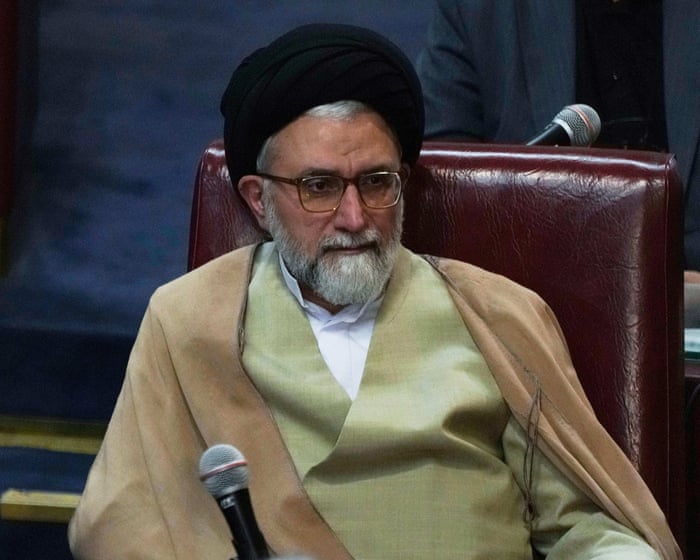
Israel claimed on Wednesday to have killed a third senior Iranian official within 24 hours, stating its forces had “eliminated” Tehran’s intelligence minister, Esmail Khatib, in an overnight strike.
If confirmed, his death would follow those of Ali Larijani, head of the supreme national security council, and Gholamreza Soleimani, commander of the Basij militia.
Israeli Defense Minister Israel Katz, who announced Khatib’s killing, said he and Prime Minister Benjamin Netanyahu had authorized the military to target any other senior Iranian official without needing further approval.
“Significant surprises are expected across all arenas today that will escalate the war we are conducting against Iran and Hezbollah in Lebanon,” Katz said during a security briefing, according to his office. “The intensity of the strikes in Iran is increasing.”
Israeli warplanes struck central Beirut early Wednesday, destroying apartment blocks in the Zuqaq al-Blat district.
The conflict between the U.S., Israel, and Iran has now entered its third week, with at least 2,000 people reported killed and no clear end in sight. The Strait of Hormuz remains largely closed; U.S. allies have resisted calls from Donald Trump to help reopen the vital shipping lane, through which about one-fifth of global oil and liquefied natural gas passes.
In a post on Truth Social on Wednesday, Trump appeared to suggest the U.S. could “finish off” Iran and then leave responsibility for securing the Strait of Hormuz to allied countries that depend on it—a nod to his longstanding complaints about burden-sharing.
“I wonder what would happen if we ‘finished off’ what’s left of the Iranian Terror State, and let the Countries that use it, we don’t, be responsible for the so called ‘Straight?'” Trump said. “That would get some of our non-responsive ‘Allies’ in gear, and fast!!!”
According to Israeli sources cited in national media, the Israel Defense Forces have gathered intelligence that allowed them to confirm the deaths of three senior Iranian officials in the past 24 hours, including Khatib, who was close to the new supreme leader, Mojtaba Khamenei, son of the late Ayatollah Ali Khamenei.
Khatib was appointed Iran’s intelligence minister in August 2021 by then-President Ebrahim Raisi. A cleric with deep roots in the Islamic Republic’s security apparatus, his career included roles within the Islamic Revolutionary Guard Corps (IRGC) and the judiciary. He was sanctioned by the U.S. Treasury in 2022 over alleged cyber operations targeting Washington and its allies.
The Israeli military stated that the intelligence ministry led by Khatib was “the Iranian terrorist regime’s primary intelligence organization, which also played a key role in supporting the regime’s repression and terrorist activities.”
The ministry “possesses advanced intelligence capabilities, overseeing surveillance, espionage, and the execution of covert operations worldwide, particularly against the state of Israel and Iranian citizens,” the IDF said.
Khatib had played a significant role in the brutal crackdown on recent anti-government protests in Iran, the IDF added in a statement on X.
His reported killing removes another pivotal figure from the core of Iran’s political and security establishment at a moment of acute crisis, following the deaths of Larijani—a linchpin of the system and the most senior figure killed since Ali Khamenei—and Soleimani, along with other senior paramilitary figures.
Taken together, the three killings suggest Israel retains detailed intelligence on the movements of Iran’s leadership inside Tehran and is able to act on it, leveraging near-total control of Iranian airspace alongside the U.S. to carry out strikes.A couple in their 70s were killed in an Iranian strike on Ramat Gan, east of Tel Aviv, on Wednesday.
Following the deaths of Larijani and Soleimani, whose funerals will be held in Tehran on Wednesday, Iran’s army chief threatened a “decisive and regrettable” retaliation. Overnight on Wednesday, Iran carried out renewed missile and drone attacks against its Gulf Arab neighbors and Israel.
Despite heavy Israeli and U.S. strikes on its missile infrastructure, Iran appears to retain the ability to launch targeted attacks. Israel’s medical service confirmed the two fatalities in Ramat Gan.
Israeli officials stated the couple were killed by Iranian cluster munitions, which Tehran has been firing at Israel since the start of the war. Even when intercepted by Israel’s air defense systems, such weapons remain highly dangerous: their submunitions scatter mid-air and can fall over urban areas, exploding on impact or lying unexploded, posing a lethal threat long after interception.
Meanwhile, Israeli warplanes struck central Beirut in the early hours of Wednesday, destroying apartment blocks in some of the heaviest air raids on the heart of the Lebanese capital in decades. Lebanon’s health ministry said at least 12 people were killed and 41 wounded in the strikes.
The Israeli military announced it would soon begin targeting bridges across the Litani River in southern Lebanon, again urging residents to flee north. Avichay Adraee, the army’s Arabic-language spokesperson, said the strikes aim to prevent Hezbollah from moving reinforcements and equipment into areas where Israeli forces are operating. “To prevent the transfer of reinforcements and weapons, the IDF intends to attack crossings on the river,” he wrote on X, repeating earlier calls for civilians to move north of the Zahrani River.
Frequently Asked Questions
Of course Here is a list of FAQs about the reported Israeli strike on Irans intelligence minister designed to cover a range of inquiries from basic to more advanced
Basic Information Context
1 What exactly happened
According to reports from Israeli and Western officials Israel conducted an airstrike overnight targeting a building in Damascus Syria They claim the strike successfully eliminated Irans Intelligence Minister and several other senior Iranian officials
2 Who is Irans Intelligence Minister
The target was reportedly Hossein Taeb He was a powerful hardline figure within Irans Islamic Revolutionary Guard Corps leading its intelligence organization for over a decade He was a key architect of Irans regional proxy network and domestic security apparatus
3 Why would Israel carry out this strike
Israel views Iran as its primary existential threat It frequently targets Iranian military and intelligence assets in Syria to prevent the entrenchment of Irans military presence and weapons transfers to proxies like Hezbollah Eliminating a top intelligence chief is seen as a major blow to Irans operations in the region
4 Has Iran confirmed this
As of now Iran has not officially confirmed the death of Hossein Taeb in this strike There have been conflicting reports and statements from Iranian media which is common in such sensitive situations Official confirmation may be delayed for internal security or political reasons
Deeper Analysis Implications
5 Isnt this a major escalation
Yes this represents a significant escalation While Israel has struck Iranian targets in Syria for years successfully eliminating a ministerlevel figureespecially the intelligence chiefcrosses a new threshold It is a direct attack on the Iranian states core security leadership not just its military assets abroad
6 How is this different from other Israeli strikes in Syria
Most previous strikes targeted weapons shipments warehouses or lowerlevel operatives This strike targeted the command and control level of Irans security establishment The rank and symbolic weight of the target are much higher
7 What is Iran likely to do in response
Iran is almost certain to respond but the scale and timing are uncertain Options range from a direct missile barrage from Syria to a more calculated delayed response through its proxies against Israeli interests abroad or a cyberattack They will weigh the need to retaliate