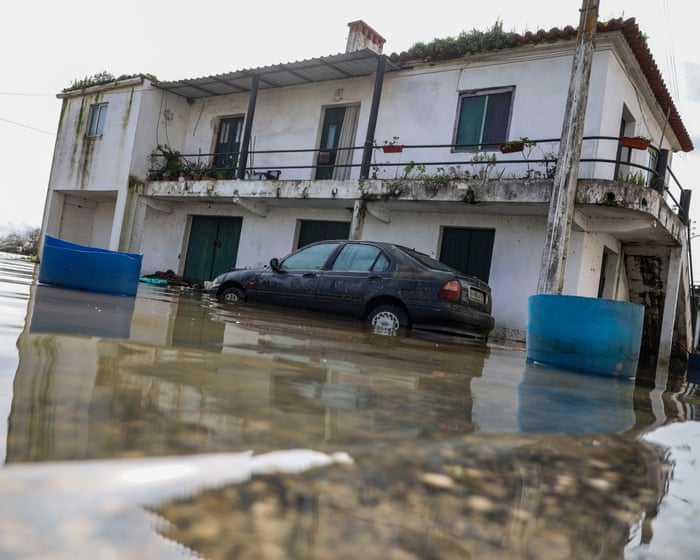
Portugal is facing pressure to develop plans for adapting to the climate crisis, as the country endures an unprecedented series of storms that have killed at least 16 people and left tens of thousands without power.
On Wednesday, over 3,000 people were evacuated from the Coimbra area in central Portugal as the Mondego River reached critical levels. Part of the country’s main highway, the A1, collapsed after a dyke on the river gave way under the pressure of floodwaters.
Since late January, what scientists describe as the “longest train of storms within living memory” has displaced hundreds more people across the nation. The extreme weather, impacting central and southern regions, has cut power to 33,000 people and caused an estimated €775 million in damage.
The severe conditions have destroyed homes and businesses. Portugal’s interior minister, Maria Lúcia Amaral, resigned on Tuesday amid growing public anger over her handling of the emergency, stating she lacked the “personal and political conditions necessary to carry out her duties.”
As the storms continue, scientists and experts have criticized Portugal’s failure to adapt to the extreme weather increasingly affecting the Iberian peninsula. “We are not prepared for the present climate, much less for the future,” said atmospheric physicist Pedro Matos Soares during a recent University of Lisbon climate conference. He noted that Portugal’s land-use planning is still based on 19th or early 20th-century climate patterns, urging a shift to address current and future conditions.
Nuno Martins, a professor of architecture and climate adaptation, reported that several storm victims died while trying to repair their roofs with donated tarpaulins in central Portugal, with hundreds more injured in falls. His NGO, Building 4Humanity—a team of architects, engineers, and designers—has been volunteering in the region and created a manual to teach safe roof repair techniques. “I saw how desperate people are to save their houses,” Martins said. He successfully urged municipalities to distribute the manual along with tarpaulins to raise awareness of the risks, a practice now adopted by the civil protection agency.
One woman in the Coimbra region, who wished to remain anonymous, expressed understanding for those risking their lives. Fearing part of her late mother’s house will collapse, she said, “I try not to go inside because I can’t stop crying when I’m there. I understand why people fell from their roofs. They’re desperate. If my legs allowed, I would have done so myself.”
Portugal’s centre-right government, led by Prime Minister Luís Montenegro, has faced ongoing criticism over its storm response. Following Amaral’s resignation, José Luís Carneiro, general secretary of the opposition Socialist Party, told the press, “The resignation of the interior minister is proof the government has failed in its response to this emergency.”The far-right leader André Ventura, who came second in last weekend’s presidential election, accused Montenegro of failing to handle the crises that have hit Portugal in recent months.
“The minister’s resignation shows the government’s inability to manage all the challenges the country has faced, from wildfires to the recent storms,” he said.
Neighboring Spain is also grappling with ongoing extreme weather, prompting the state meteorological office to issue orange and red warnings for the country’s northern coast and caution about waves as high as nine meters (30 feet).
On Thursday, schools across Catalonia in the northeast were closed, and dozens of flights at Barcelona’s El Prat airport were canceled. One person was seriously injured by a falling tree, while 24 others were hurt in the storms. Catalan civil protection services sent mobile emergency alerts urging people to stay indoors and avoid unnecessary travel.
The regional government thanked emergency services for their work during what it called “an exceptional storm,” adding that the official response had helped limit the storm’s impact.
Frequently Asked Questions
Of course Here is a list of FAQs about Portugals calls to bolster its climate defenses designed to cover a range of inquiries from basic to more advanced
Beginner General Questions
1 Whats the main issue being discussed
Portugal has been hit by several severe and deadly storms in recent years These events have exposed weaknesses in the countrys infrastructure and emergency planning leading to calls for a major upgrade to its climate defenses
2 Why is Portugal so vulnerable to these storms
Its geographic location makes it a frontline for Atlantic storm systems Combined with factors like aging infrastructure densely populated coastal cities and forested areas prone to flooding and landslides the impacts are often severe
3 What does bolster climate defenses actually mean
It means investing in physical infrastructure and improving soft defenses
4 Havent they always had storms Why is this different now
Yes but climate change is intensifying these events Scientists point to storms becoming more frequent more powerful and carrying more rainfall leading to unprecedented flooding and damage beyond what old infrastructure was designed to handle
Intermediate Impact Questions
5 What are the biggest weaknesses that were exposed
Key problems include inadequate drainage systems in cities leading to flash floods poor management of river basins and forests insufficient resources for civil protection agencies and communities built in highrisk areas without proper safeguards
6 What are the main types of damage from these storms
The triple threat is often 1 Fatalities and injuries 2 Widespread flooding destroying homes and businesses and 3 Landslides damaging roads and isolating communities Powerful winds also cause significant property damage and power outages
7 Who is calling for these changes
A broad coalition including families of victims opposition political parties climate scientists civil protection experts and insurance companies facing massive payouts
8 Is this just about reacting to storms or is there more to it
Its about proactive