When Francisco Estrada-Belli was seven years old, he worried that all of history would be discovered before he was old enough to contribute. It was 1970, and he had traveled from Rome with his parents to visit relatives in Guatemala. During the trip, they explored the ancient Maya ruins at Tikal. “I was completely mesmerized,” Estrada-Belli told me recently. “The jungle was everywhere, filled with animals, and then these enormous, majestic temples. I asked questions but felt the answers weren’t good enough. Right then and there, I decided I wanted to be the one answering them.”
Fifty-five years later, Estrada-Belli is now one of the archaeologists helping to rewrite the history of the Maya people who built Tikal. Thanks to technological advances, we are entering a new age of discovery in ancient history. Improved DNA analysis, advances in plant and climate science, soil and isotope chemistry, linguistics, and techniques like Lidar laser mapping are overturning long-held beliefs. This is especially true in Maya archaeology.
Last year, Estrada-Belli’s team, including his Tulane University colleague Marcello A. Canuto, published a study with a central finding that would have seemed like an outrageous overestimate just a few years ago. When Estrada-Belli first visited Tikal as a child, the best estimate for the Classic-era (AD 600–900) population of the surrounding Maya lowlands—covering present-day southern Mexico, Belize, and northern Guatemala—was about 2 million people. Today, his team believes the region was home to up to 16 million. That’s more than five times the area’s current population. It means more people lived in the Classic-era Maya lowlands than on the Italian peninsula at the peak of the Roman Empire—all packed into an area a third of the size.
Comparing the Classic Maya and ancient Rome is instructive in other ways. Some Maya cities were established hundreds of years before Rome was founded, and they included significantly larger architecture that still stands. Both cultures developed sophisticated astronomy, mathematics, writing, and agriculture, along with elaborate trade networks across vast regions. Today, the ruins of Rome lie beneath a bustling modern city, where some elite families claim direct descent from ancient times. In contrast, many Maya ruins are buried under more than 1,000 years of tropical forest, while the descendants of the people who built those cities are among the poorest on Earth.
According to census records, the various Maya and smaller Indigenous groups, such as Xinka and Garifuna, now number over 11 million people across Mexico, Guatemala, Belize, El Salvador, Honduras, and the United States. Most of them—7.7 million—live in Guatemala, where they officially make up 44% of the population. (Human rights organizations believe the number may be higher, as identifying as Maya has long been stigmatized and even dangerous.)
History—both ancient and recent—is a key political issue for the Maya. In Guatemala, they have two central demands: first, a full reckoning with the civil war and genocide that lasted from 1960 to 1996, which claimed about 200,000 lives, most of them Maya. Second, recognition as the original inhabitants and legitimate owners of this land. They argue that five centuries of prejudice and discrimination have led to a situation where, among other issues, two-thirds of the country’s arable land is controlled by just 2.5% of farmers—few of them Maya—while 60% of Indigenous children are undernourished.
In 2023, the Maya people played a key role in the unlikely presidential election victory of former diplomat Bernardo Arévalo. The campaign to protect the vote against a corrupt judiciary was led by Indigenous groups and included 106 days of nationwide protests.Although Arévalo is not Maya himself, he supports their cause. One of his appointees is Liwy Grazioso, an archaeologist of Italian descent who now serves as minister of culture and sports. An expert in Maya history, Grazioso has published research on the tombs of Rio Azul and the ancient city of Tikal, and has overseen work at Kaminaljuyu, the Maya site beneath Guatemala City. As a politician, she aims to build a country where past and present coexist, and where Indigenous people are fully recognized as part of the national story. “It’s not that the Maya are better, or that their ancient society was superior to ours, but because as humans they are the same,” she told me, offering a glass of unsweetened hibiscus tea.
We spoke in her grand, wood-panelled office on the third floor of the National Palace in Guatemala City—a building nicknamed El Guacamolón for its avocado-green color. Since its completion in 1943, these halls have witnessed multiple military coups and the attempted erasure of Maya lives, culture, language, and history. This oppression has deep roots. Grazioso explained how Maya elites—intellectuals, royals, astronomers, priests, writers, and historians—were systematically killed by Spanish colonizers, who burned their texts as “works of the devil.”
Even the name “Maya” reflects outside influence. Spanish colonizers in the 1500s used the term after the ruined city of Mayapán in present-day Mexico. But the Maya never saw themselves as one unified people or empire. They spoke many languages—30 of which survive today—and belong to diverse cultures and identities.
By the time Maya archaeology emerged in the 19th century, much of the knowledge held by local leaders had been lost. Over time, some observers promoted pseudoscientific claims that Maya temples were built by aliens—or by Vikings, Mormon Nephites, or other vanished civilizations—rather than by the ancestors of local people. Grazioso believes such theories serve a political purpose: “If we deprive the actual Maya of their glorious past, we don’t need to give them power today. Talking about collapse and aliens becomes a distraction from what is right in front of us.”
That’s where today’s archaeologists come in. While scholars still study why Maya civilization declined, many are now asking a different question: How did the Maya survive? This shift focuses on their ancient—and modern—ability to endure and adapt under extremely challenging conditions.
For decades, the prevailing view was that complex societies could not have existed in the Maya lowlands. This idea, known as “the law of environmental limitation,” was based on 1950s research in the Amazon. It argued that rainforest soils were too poor to support large, advanced societies, and could only sustain small, simple tribes. For years, this was considered almost a natural law in anthropology.
When the theory was first proposed, no major settlements had been found in the Amazon. Yet the Maya lowlands were already known to contain thousands of massive stone pyramids, temples, raised causeways, engraved monuments, and royal tombs where the dead were buried in jade and finery.Luscious jade jewelry. Instead of assuming the existence of highly populated, sophisticated Maya lowland cultures, many researchers tried to align their findings with what they believed were environmental limits. According to the “segmentary state” model, Maya kings ruled symbolically over a few scattered communities living in small settlements separated by forest.
This idea of environmental limitation was largely overturned in the 1980s, when the deciphering of Maya hieroglyphs allowed researchers to read the texts on large stone monuments, known as stelae, in city centers. The carvings had been thought to be astronomical or ceremonial but turned out to be historical. The stories they told were not of primitive forest dwellers, but of kings and conquerors, queens and revolutions.
In recent years, a new story has emerged, partly thanks to Lidar technology. Short for “light detection and ranging,” it involves bulky laser machines attached to twin-engine aircraft flying half a kilometer above forests and fields. The equipment produces contour scans of the ground, making it possible to identify straight, round, or squared features, such as ancient ruins, fields, roads, temples, dams, and fortifications. Lidar isn’t new—it has mapped the moon and is now a key feature in many technologies, including self-driving cars—but it made its way into archaeology in 2009 after researchers at the classic Maya city of Caracol in Belize saw biologists using it to measure forest growth. With some adjustments, they realized it could also map the ground beneath rainforest canopies.
In 2016, when Francisco Estrada-Belli saw Lidar scans of Holmul in northeastern Guatemala, he knew that “archaeology had changed forever; there was no going back.” He explained how he had worked for 16 years to map this major city, using measuring tape and the help of countless assistants. They waded through thick jungle to reconstruct what the city might have looked like over its 1,700-year history. His teams had outlined about 1,000 structures. Now, he could compare this with Lidar findings. In just three days of scanning, it had mapped more than 7,000 structures: residential buildings, canals, terraces, field enclosures, causeways, and defense walls. Lidar had produced a continuous scan of an area ten times larger than his teams had managed on foot.
Subsequent large-scale mappings led Estrada-Belli to estimate that between 9.5 and 16 million people once lived in the Maya lowlands. He describes the lowlands in the 700s as a “continuously interconnected rural-urban sprawl.” This was a cosmopolitan region with extensive trade and settlements linked by a dense network of causeways and roads. The ancient Maya did not use pack animals or wheeled carriages. Everything built and traded had to be carried by human effort alone. Shoes had to be repaired, and people needed to sleep and eat—not within a day’s horse ride, as in Eurasia, but within walking distance. Estrada-Belli told me there was no wilderness in these lowlands, but rather a low-density scattering of people, businesses, agricultural fields, managed wetlands, and forests—everywhere. Interspersed among these were larger buildings, presumably for the elite.
This urban sprawl landscape raises new questions. The most important, according to Estrada-Belli, relates to agriculture. “When looking at Central American forests today, we must recognize that ancient humans affected everything,” he said. “The tree species are there because the Maya chose them, the types of flowers exist because they made use of them, the wetlands served a human purpose. And so on. And all these methods were sustainable over thousands of years.” He described “the enormous investments the Maya put into canals, terraces, and raised fields in water. They used extremely diverse…”Advanced and flexible farming methods involved rotating and combining hundreds of species. Yet today, the land is used for cattle farming and monocultural corn plantations that only destroy it. “We have a lot to learn,” he said.
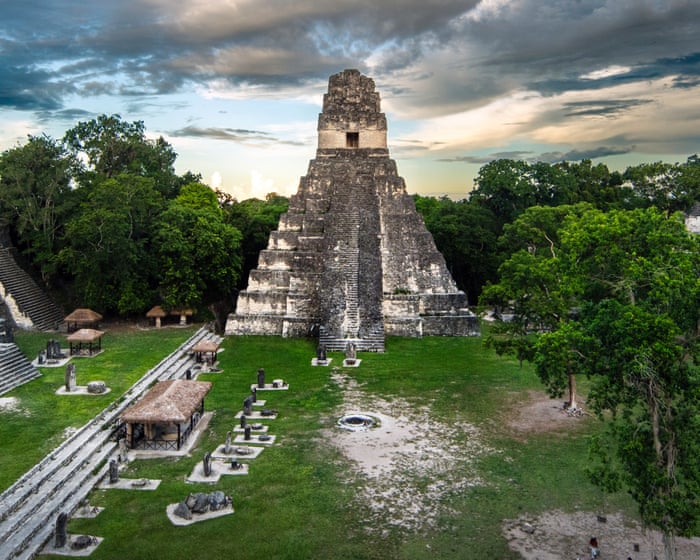
Tikal is Guatemala’s most visited Maya site, attracting hundreds of thousands of tourists each year. The surrounding woodlands are part of the Maya Biosphere Reserve, which lies within the largest tropical forest in the Americas outside the Amazon. The sense of mysticism here is captivating. At dawn, visitors sit atop a 70-meter-tall temple in darkness, listening to howler monkeys roar alongside thousands of crickets. As the sun rises, it reveals a seemingly endless tropical canopy, dotted only by the peaks of other ancient pyramids. Only a small part of Tikal has been cleared of vegetation and restored to something vaguely resembling its former glory. The rest remains buried under thick layers of soil and trees.
The most recently discovered inscribed stela at Tikal dates to AD 869. Over the past few decades, researchers’ understanding of what happened after that date has shifted from a “sudden and disastrous” collapse to a historical era known as the Terminal Classic. This term covers a 200-year period when city centers were abandoned, and farmers gradually moved to lands in the north and south. As Tikal and dozens of other cities were left behind, places like Chichén Itzá, Uxmal, and Mayapán further north on the Yucatan Peninsula grew rapidly, as did settlements in the southern highlands. It seems that many people during the Classic Maya period chose to migrate rather than simply waiting for things to fall apart around them.
“We don’t really talk about collapse anymore, but about decline, transformation, and reorganization of society, along with the continuation of the culture,” said Kenneth E. Seligson, an associate professor of archaeology at California State University. “Several similar shifts have happened in other places, such as Rome,” Seligson noted. “But we rarely talk about the great Roman collapse anymore because they came back in various forms, just like the Maya.”
Seligson is among many researchers seeking to shift focus from the Maya collapse to their long-term survival. By the time its last stela was engraved, Tikal had already seen over 1,500 years of development. At its peak in the 700s, the city was home to between 40,000 and 80,000 inhabitants, or even more, depending on how its boundaries are defined. This made it one of the world’s largest urban areas of its time. Yet the city looked nothing like the sprawling metropolises we know today. There were no street grids, and agricultural fields extended far into the city center.
Life here required ingenuity. Much of Seligson’s research has focused on limestone, the bedrock of the Maya lowlands, which is covered only by a thin layer of soil. Limestone provides poor nutrition for most forms of farming, and rainfall quickly drains through cracks deep underground. Adding to these challenges, half the year sees little rain. Despite this, Tikal and many other cities thrived. Inhabitants cultivated chocolate, vanilla, avocados, tomatoes, yuca, sweet potatoes, and hundreds of other crops. Limestone was used to preserve food, purify water, make soap, and for medicinal purposes. Houses were built from lime cement reinforced with sand and grass. Lime was even burned and mixed with maize to help the Maya absorb nutrients. “The Maya should really be known as a people of immense resilience. They worked with available resources to develop long-term, highly flexible solutions,” said Seligson.
The eventual decline of Maya lowland cities remains a hotly debated topic. Estrada-Belli believes it could have been due to shifting trade routes. Others—including geographer Jared Diamond in his influential work—The controversial book Collapse attributes the Maya’s supposed downfall to greed among their elites, which led to an ecological disaster caused by human activity. Another widely discussed theory, based on sediment analysis from lakes and caves, points to climate change. Some argue that a centuries-long “megadrought” was the ultimate cause of the classic Maya’s decline. Seligson, who recently wrote a book about the Maya and climate change, is not entirely convinced. “Climate was undoubtedly an important factor,” he said, “but it was one among many.”
Liwy Grazioso, true to her role as a government minister, believes a key explanation was declining trust in leadership. In a recent scientific article about the rise and fall of Tikal, she and her co-authors listed factors including economic competition, increased warfare, lack of arable land, failing revenue streams, soil depletion, and droughts. All these pressures made it difficult to maintain essential infrastructure like reservoirs. When I met Grazioso in the National Palace, she compared the flamboyant government building to the great pyramids of Tikal. “This is a public building and it’s very beautiful. But to maintain it, you need government funds. When a crisis or war approaches, who will care? If the palace crumbles, who will pay attention? You will focus on providing for your family.”
Sitting in the current seat of power, Grazioso turned the argument to the present. “It is the same that happens now, if we are not careful,” she said. “Governments need to earn the trust of their taxpayers.”
Sonia Gutiérrez, a lawyer from the Poqomam Maya people in the highlands southwest of the capital, is the only Indigenous woman among the 160 seats in the Guatemalan parliament, making her arguably the highest-ranking Maya in the country. “Our political system has never represented the reality of our nation,” she told me in her office a few blocks south of the National Palace.
Gutiérrez leads the Winaq party, founded by Rigoberta Menchú, who received the Nobel Peace Prize in 1992 for her efforts to end Guatemala’s civil war and achieve post-conflict reconciliation. “Our telling of history needs to change, and our society needs to change,” said Gutiérrez. “Our vision goes back to the time before colonialism. We must be seen not as alien people, but as living in our country where our ancestors used to live.”
“I have three struggles,” she said. “I am a woman, I am Indigenous, and I am on the democratic left. I am working against all of history for the vindication of our historic cause.” She spoke of the need for a “plurinational” state that recognizes the rights of self-governance among diverse groups—a concept implemented, with complications and backlash, in the constitutions of Bolivia and Ecuador.
She also discussed tzilaj k’aslemal, or “the good life”—a Maya concept she wants incorporated into the nation’s constitution. This would involve a healthcare approach where modern medicine is “complemented with ancestral knowledge,” an education system that teaches Indigenous languages, and a different relationship with the natural world. “We question the foundational capitalist model,” said Gutiérrez. “For us, natural resources are not only to be exploited but are part of our existence. We must take care of our rivers, mountains, and forests. It is a vision of a plural society built on culture.”
When asked how this could be achieved, she admitted, “It will take a long time.” Still, she emphasized the urgency of her work. “The president and his administration give us a window of possibility. But I’m afraid that the old power structures have penetrated the state so deeply that the government is having a very hard time. And there…””That’s a lot of risk.”
“Risk?”
“Yes. If we don’t take this chance, there won’t be another opportunity. And the backlash could be as severe as last time. We’re facing well-organized resistance to the ideas I’m talking about.” Her conclusion was matter-of-fact: “We could see another civil war.”
A few kilometers north of the government offices, the remains from the civil war are still being processed at the laboratories of the Guatemalan Forensic Anthropology Foundation (FAFG). Several staff members were educated at the same institutions as Liwy Grazioso, and the technical advances that have transformed ancient archaeology are used here to uncover modern Maya history: the FAFG excavates and identifies victims of massacres.
First, witness interviews and documents help pinpoint areas of interest. Sometimes, drone-mounted Lidar is deployed to detect unusually lush patches of forest, since decomposing bodies make trees grow especially fast. Finally, investigators use DNA, along with chemical analyses of soil, clothing, teeth, hair, and bones, to identify the dead.
Forensic anthropologist Alma Vásquez showed me around the laboratory. Eight human skeletons were laid out on blue tables. Under each table was a cardboard box marked with a location, date of recovery, and ID number. Three of the skeletons were tiny. These were children found with two adults in a cave outside the village of Estancia de la Virgen, a couple of hours’ drive northwest of Guatemala City. Vásquez believed the bones belonged to a family that had tried to escape a notorious massacre by the Pixcayá River in 1982.
The cranium of the smallest skeleton rested on striped red and pink padding. Vásquez estimated the child was between one and three years old, and fragments of clothing suggested she had been a girl. The front of her cranium had been blown away by a grenade. There was a bullet hole through the back of her head.
If Vásquez’s hypothesis is correct, the little girl and her family belonged to a large community that fled their villages in early 1982. In the months prior, the “Guerrilla Army of the Poor,” which dominated largely Indigenous villages in the area, had “freed” a small territory. As the government’s counterinsurgency focused on civilians, whom they assumed supported the guerrillas, the escaping families sought refuge in the wooded and hilly upper banks of the Pixcayá.
On the morning of March 18th, army units marched from three directions toward the gathering by the river. At 8 a.m., they opened fire on men, women, and children with guns and grenade launchers. The slaughter lasted for hours. Eyewitnesses reported that troops raped women and drowned children in the river. By mid-morning, the forest was burning, and army helicopters were shooting fleeing survivors.
Estimates of the dead at the Pixcayá River range between 300 and 400. Makeshift mass graves were dug on the river shore. There were reports of dogs in nearby villages gnawing on human bones. The skeletons of the little girl and her family, now in Alma Vásquez’s forensic lab, were not found until 2008. Their DNA has still not been matched with any survivors.
The massacre was one of the largest during the bloodiest phase of the war in the early 1980s. But the event was typical in its systematic targeting of civilians. The eventual Commission for Historical Clarification, one of several official truth initiatives, identified 626 massacres carried out by government forces. They were deemed responsible for more than 93% of human rights violations. The report also described 32 mass killings perpetrated by guerrilla groups.
The war claimed more than 200,000 lives, and 83% of identified victims were Maya. More than 40,000 people are still missing. This sometimes means relatives cannot claim inheritance, and spouses cannot remarry or assert parenthood in unrecognized relationships. It also…This also means that families are denied closure. The FAFG currently holds 12,611 skeletal remains. Some were recovered from mass graves, while others were found during road construction or when homeowners expanded their basements. Nearly 4,000 individuals have been identified, primarily through DNA testing.
FAFG’s work is regularly used as evidence in court. Most notably, it contributed to the genocide and crimes against humanity conviction of Guatemala’s former president, Efraín Ríos Montt. On May 10, 2013, he was sentenced to 80 years in prison for crimes against the Ixil Maya people. FAFG’s forensic evidence, along with survivor testimonies and leaked military documents, were crucial to the case, which focused on 15 massacres that killed 1,771 people under Ríos Montt’s command. “The verdict was crucial for people’s sense of belonging in the country,” Claudia Paz y Paz, the attorney general at the time of the sentencing, told me.
Ultimately, however, it was a small victory. The sentence was overturned on a technicality just 10 days later, and Ríos Montt was deemed too old for a retrial. Even so, the ruling triggered a significant backlash. Military-linked networks and economic elites reasserted control over the justice system through judicial appointments, fabricated disciplinary cases, and legislative changes.
Many lawyers involved in post-civil war accountability efforts, along with human rights activists and prominent journalists, are now imprisoned or in exile. Political murders have also increased. Luis Pacheco and Héctor Chaclán, leaders of the Indigenous movement that helped secure the democratic election of the current president, have been held for 10 months on what appear to be baseless charges of terrorism and obstruction of justice.
“With a corrupt judiciary, the democratic government has very limited powers,” said Claudia Paz y Paz, who now lives in Costa Rica and would face danger if she returned to Guatemala. In the spring of 2026, key appointments will be made to Guatemala’s Supreme Election Tribunal, constitutional court, and attorney general’s office. Impartial jurists in these roles, Paz y Paz concluded, are essential for the system to function.
Near the site of the Pixcayá River massacre lies the town of San Juan Sacatepéquez. A few blocks from the market, Blanca Subuyui and her team focus on more immediate concerns than the deep origins of their people or even the civil war’s bloody history. Subuyui’s organization, Asociación Grupo Integral de Mujeres Sanjuaneras (Agims), provides shelter and support from nurses, midwives, and lawyers to address the consequences of rape, domestic violence, and child pregnancies. Agims also offers conflict mediation, vocational training in weaving and handicrafts, and a seed bank for agriculture. Some women involved in the network must hide their participation from their husbands.
“We believe we have something to offer for the future of this country,” Subuyuj told me over a large serving of fruit. As the leader of Agims, she has helped develop a comprehensive plan for the future of Ixumulew—”the land of maize,” as Guatemala is called in the Kaqchikel language. The document’s title, Ri qab’e rech jun Utzilaj K’aslemal, translates roughly to “Our path toward the good life.” This 236-page plan was developed over seven years with input from 164 Indigenous organizations.
Its first demands are the “full recognition of Indigenous Nations as pre-existing the state of Guatemala,” that these nations should “reclaim self-determination and sovereignty over our territories,” and begin by conducting a census without the “intention of making us disappear.” The document also calls for restructuring the army away from the institutions that committed genocide and insists that large companies “pay the taxes they owe the country.”
“We do not want to take power from anybody, but we are the”Most of the population is Indigenous, so it’s only fair we have a voice in government,” said Subuyui.
“But how is that possible?” I asked. “There’s just one Indigenous woman in parliament out of 160 members.”
Subuyui spoke about how her organization has grown. She explained how Agims and other groups are creating positive change in their communities—helping people understand their rights, gain financial independence, and take pride in their history while looking toward a shared future with hope.
I mentioned Sonia Gutiérrez’s fear of retaliation, and how human rights leaders, judges, and journalists have been jailed, forced to leave, or killed.
Subuyui replied calmly, “We aren’t going anywhere. This fight will go on. The changes happening now are too deep to stop. We’ll keep working no matter what—we have to. Change may take generations, but it is coming.”
Frequently Asked Questions
Of course Here is a list of FAQs about the topic Nearly everything we thought we knew about the Maya is wrong reflecting the paradigm shift in modern archaeology
Beginner General Questions
Q Wait I thought the Maya just vanished Is that wrong
A Yes thats a major misconception The Maya never vanished While their great Classic Period cities in the southern lowlands were abandoned around 900 AD the Maya people and their culture persisted in the northern Yucatán and through the Spanish conquest Millions of Maya descendants live in Central America today
Q Were the Maya a peaceful society of stargazing priests
A Not at all Recent decipherment of their hieroglyphs and archaeological evidence reveals the Maya were frequently at war Rival citystates fought for power resources and captives Kings were military leaders and warfare including ritual sacrifice of highstatus prisoners was central to their politics and religion
Q Did the Maya predict the world would end in 2012
A No The 2012 date marked the end of a major cycle in their Long Count calendar much like our calendar resets on December 31st There is no apocalyptic prophecy in any Maya text It was a modern misinterpretation
Q Did the Maya live in the middle of the jungle isolated from others
A This is outdated They were not isolated We now know the Maya had extensive trade networks exchanging goods like jade obsidian cacao and feathers with other Mesoamerican civilizations like the Teotihuacanos and later the Aztecs
Advanced Detailed Questions
Q Whats the biggest discovery that changed our understanding
A The successful decipherment of Maya glyphs largely completed in the last 50 years We can now read their own historythe names of kings dates of battles alliances and ritualsmoving beyond just interpreting artifacts and Spanish colonial accounts
Q How did the environment play a role in their civilizations transformation
A New evidence shows that severe prolonged droughts coincided with the collapse of the Classic Maya centers This environmental stress combined with warfare and overpopulation likely caused a political and societal fragmentation not a total disappearance