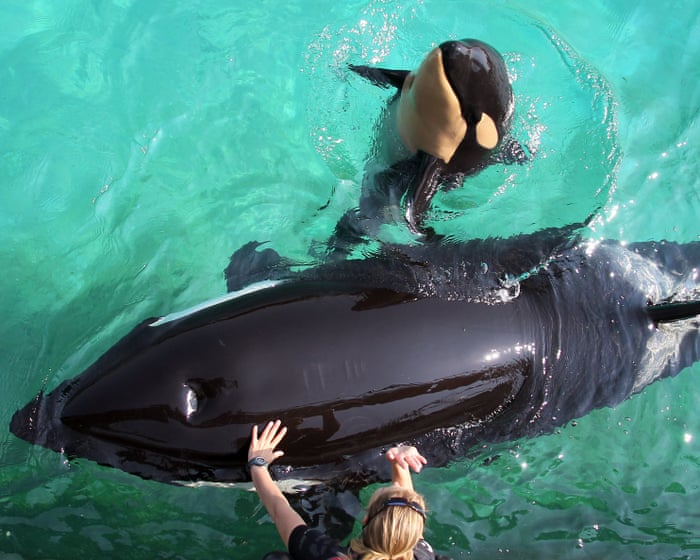
In a vast aquarium complex in southeastern France, which once attracted half a million visitors annually, only a few dozen people now wander among the pools holding the last marine mammals at Marineland Antibes. Weeds cover the walkways, the stands stand empty, and algae grows in the pools, tinting the water green.
Here, the orcas Wikie and Keijo, a mother and son, float listlessly. Born in these pools, they performed for crowds for decades. But since the park closed in January 2025, they have had no audience. When alone, they often “log”—float motionless at the surface—according to a court-ordered report released last April.
Since a 2021 French law banned keeping cetaceans in captivity, the fate of Wikie and Keijo has been hotly debated. The issue is set to reach a critical point at a decisive meeting on Monday, where the French government, animal welfare organizations, and Marineland Antibes will gather to determine their future.
Twelve bottlenose dolphins also remain at Marineland, but it has been decided they will stay in pools deemed suitable for a transitional period until a new facility is ready at Beauval Zoo in northern France.
Marineland has long stressed the urgent need to move the orcas. In a statement to the Guardian, the park reiterated: “The park cannot wait any longer. The pools are in very poor condition, at the end of their useful life, and this directly threatens the well-being and lives of the orcas.”
The ongoing debate centers on where to relocate two large marine mammals that require very specific conditions to thrive.
In December 2025, French minister delegate for ecological transition Mathieu Lefèvre announced that Wikie and Keijo would be sent to the Whale Sanctuary Project in Nova Scotia, Canada, calling it the “only ethical, credible, and legally compliant solution.” The 40-hectare outdoor site aims to recreate a seaside environment as close as possible to the natural habitat of whales and dolphins.
Lori Marino, a neuroscientist and founder of the Whale Sanctuary Project, says, “They will have depth to dive, an interesting and vibrant underwater environment to explore, and conditioning and exercise routines with trainers.”
On Monday, Marino will present her plan at the meeting, but gaining approval will not be straightforward. The French government’s decision to choose the Whale Sanctuary Project has faced strong opposition from other animal welfare groups and Marineland’s owner.
“Nobody is actually working together; that is the problem,” says Marino.
Opponents’ main concern is that, with only months until Wikie and Keijo are scheduled to arrive, the sanctuary is not yet built and still lacks $15 million in funding.
Marineland’s representatives, who oppose the plan, call the sanctuary “a hypothetical solution that does not exist.” Instead, they want the orcas moved immediately to an existing facility, such as another aquarium.
With the park closed, the orcas generate no income but cost about €500,000 each per year to maintain. Marineland’s owners could recover some costs by selling them to another aquarium.
Last year, Célia de Lavergne, former minister for ecological transition, approved a temporary move to Tenerife’s Loro Parque, but this decision was later overturned.The Spanish government rejected a transfer to Loro Parque, leaving Wikie and Keijo in limbo again. There have been reports that Marineland has arranged a deal with SeaWorld in Orlando, though Marineland denies this.
Even the staunchly anti-captivity group C’est Assez! now says it would not oppose a move to SeaWorld as a solution, despite having previously blocked transfers through legal action. The organization states, “Given the urgency of the situation and the absence of a viable sanctuary solution, this appears to be the lesser of two evils.”
A transfer to SeaWorld would be the simplest option logistically. It is common for large marine mammals like orcas to be moved between parks. Another captive orca, Katina, was captured in Iceland and moved between several SeaWorld locations before dying in Orlando in December 2025 at around 50 years old.
The process involves placing the animals in a sling, lifting them by crane into a water-filled container, and transporting them by truck or plane. A move to a sanctuary would follow similar steps, but preparation would be far more complex. Wikie and Keijo, having lived their entire lives in pools, would need to build muscle and blubber to adapt to ocean waters. The Whale Sanctuary Project plans to rebuild a nearby wharf and construct an inshore bay pen to house the orcas while the larger sanctuary is built.
Sea Shepherd France advocates for a Mediterranean sanctuary, but no such facility exists. Its initial proposal for a site in Brest was deemed unfeasible, partly due to pollution. The group also strongly opposes the Nova Scotia sanctuary, questioning water safety and claiming the waters would be too cold for Wikie and Keijo, who are accustomed to Mediterranean temperatures.
Lori Marino of the Whale Sanctuary Project counters these concerns, pointing to published data from independent analysts confirming water quality. Regarding temperature, she notes that Icelandic orcas thrive in cold water and that expert veterinarians have raised no concerns about their adaptation to Nova Scotia’s climate. She adds that the Mediterranean is warming rapidly, making Nova Scotia’s more stable temperatures a better long-term environment.
All parties hope for a resolution at Monday’s meeting, but for now, Wikie and Keijo remain in uncertainty.Keiko remains where he is as the disagreements continue. However, Naomi Rose, a cetacean expert on the Whale Sanctuary Project’s board, is quick to clarify that while this internal “warfare” has slowed progress in helping the animals, activists and animal welfare organizations are not to blame for the pair’s situation.
“We have never harmed an orca’s—or any other captive cetacean’s—welfare in captivity,” she says. “That responsibility lies entirely with the industry that has exploited them for nearly a century.”
Frequently Asked Questions
Frequently Asked Questions The Race to Save Wikie and Keijo
The Basics
Who are Wikie and Keijo
Wikie is a female orca and Keijo is her young son They are a motherandcalf pair currently living in a closed aquarium facility
Where are they trapped and why is it a problem
They are in a marine park in France The problem is that the facility has been closed to the public leaving them in tanks that are too small and lack the social and environmental complexity of the ocean They are isolated from other orcas and cannot engage in natural behaviors
What does closed aquarium mean
It means the aquarium park is no longer operating as a public attraction This often leads to reduced funding staffing and resources for animal care putting the wellbeing of the animals at serious risk
Why cant they just be released into the ocean immediately
Orcas born or held longterm in captivity lack the essential skills to survive in the wild They dont know how to hunt for live prey navigate ocean currents or interact with wild pods A sudden release would be a death sentence
The Rescue Effort
What is the goal of the rescue campaign
The primary goal is to relocate Wikie and Keijo to a more natural spacious seaside sanctuary where they can experience a more oceanlike environment with greater freedom while still receiving human care
Who is trying to save them
A coalition of animal welfare organizations marine biologists veterinarians and public advocates are leading the effort often in negotiation with the facilitys owners and government authorities
What is a seaside sanctuary and how is it better
A seaside sanctuary is a large nettedoff coastal bay or cove It provides vastly more space natural seawater tides marine life and stimuli than a concrete tank Its a middleground between a tank and full release offering a much higher quality of life
What are the biggest obstacles to moving them
Key obstacles include securing full legal and financial agreements the immense cost and complex logistics of the move and sometimes resistance from the current owners or bureaucratic delays
Deeper Questions Concerns