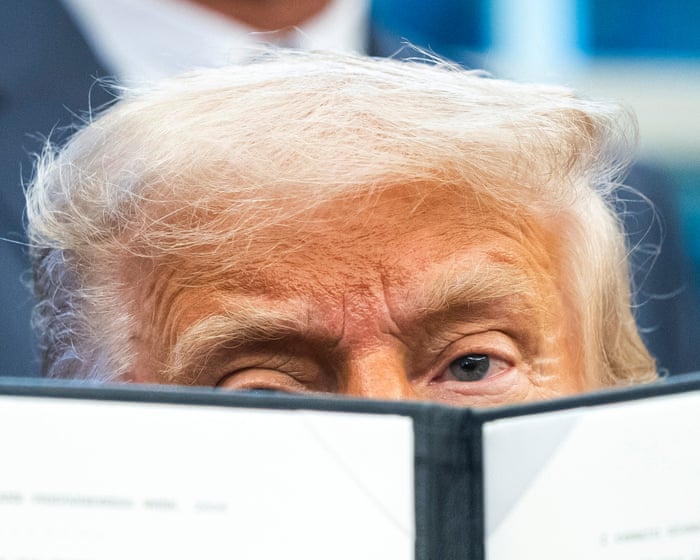
Is Donald Trump okay? Lately, he has appeared tired. His signature fake tan looks more sallow than usual and seems applied more thickly and unevenly than before. He has been caught nodding off on camera with increasing frequency, including during cabinet meetings and Oval Office events. His public schedule is lighter: he often spends time at his golf clubs, travels around the country less than he did at this point in his first term, and now rarely holds the large rallies that once defined his political style. He tends to sit when others are standing, has shortened his daily schedule, and often doesn’t begin official duties until after noon. A New York Times report noted that his public appearances have dropped by nearly 40% compared to his first year in office. He sometimes disappears from public view for days, as he did in late summer, and his administration has provided unclear or conflicting information about his health. His right hand often appears bandaged or smeared with makeup; the White House unconvincingly claimed it was bruised from shaking too many hands. In some photos, his ankles look swollen.
At 79, Trump is the oldest person ever elected president. He reached the office after harshly criticizing Joe Biden, whose age became a scandal following stiff, stumbling, and incoherent public appearances that fueled speculation his staff was hiding his decline. In 2024, Trump turned Biden’s age and frailty into a symbol of Democratic inadequacy and Washington elites’ failure to address America’s decline. Upon taking office in early 2025, Trump placed a picture of an autopen—a device that came to symbolize Biden’s incapacity in conservative circles—where Biden’s official portrait would have been on the “presidential walk of fame” Trump installed. The message was that Biden, too old for the job, was absent, running the administration on autopilot—a placeholder rather than a true leader.
Now, questions about Trump’s own health and fitness are growing. He revealed he had an MRI in October but wouldn’t say what doctors were checking or what they found. “I have no idea what they analyzed,” he told reporters on Air Force One. “But whatever they analyzed, they analyzed it well, and they said that I had as good a result as they’ve ever seen.” His physician stated in a letter that the scan was “preventative” and focused on his heart and abdomen. However, experts noted that MRIs aren’t typically used for routine prevention and are usually ordered to monitor existing heart conditions or other underlying diseases.
Trump also mentioned, “I took a cognitive test and I aced it.”
There’s no clear evidence of a specific health issue, and it would be irresponsible to diagnose him here. But the speculation about his age and physical decline reflects a reality: Trump is mortal and elderly. His reign—as president, head of the Republican Party, and the center of gravity in American politics—will eventually end.
Trump’s health might not be under such scrutiny if his polling were stronger. His public approval has plummeted; recent polls show him underwater in most states and with nearly every demographic. The dramatic, aggressive start to his second term, marked by sweeping changes to the federal bureaucracy—The era when Trump wielded executive power to force sweeping cultural changes at universities, corporations, and other institutions dependent on government funding has faded. We’ve entered a more subdued period, where Trump’s influence has waned as it becomes clear how shallow much of his support truly is. With his approval ratings low, people are more willing to push back against him—and that resistance, in turn, makes him appear less powerful and less effective.
If Trump now seems physically diminished, it may partly be because he is at his weakest politically. Shifting public sentiment appears to have cooled his ambitions to seek an unconstitutional third term, at least for now. Republicans are less willing to risk supporting such an obviously illegal move when Trump’s chances of pulling it off look so slim. This shift has brought a widespread recognition that Trump is a lame duck.
American democracy—or what’s left of it—is not secure. It wouldn’t be safe if Trump were still at his peak, nor would it be safe if he left office tomorrow. But his growing visible frailty is starting to alter everyone’s calculations—even, it seems, his own. In his later years, Trump has become more ponderous and reflective, lately speaking more often about death. “I think I’m not maybe heaven-bound,” he said in October. “I’m not sure if I’m going to be able to make heaven.”
Moira Donegan is a Guardian US columnist.
Frequently Asked Questions
Of course Here is a list of FAQs about the current status of Donald Trumps health based on the topic and the perspective of columnist Moira Donegan
BeginnerLevel Questions
Q What is the basic current status of Donald Trumps health
A Based on his most recent public medical reports and observations Donald Trump is a 78yearold man who is generally reported to be in good health for his age though he does not release detailed ongoing medical records His health is a frequent topic of political and media discussion
Q Why is there so much discussion about his health
A As a former president and current candidate for the presidency his physical and cognitive fitness for office is a matter of significant public interest and political debate similar to discussions about other older candidates
Q Has he had any major health issues
A In 2020 he was hospitalized and treated for COVID19 He has also reported taking a cholesterollowering drug and a lowdose aspirin which are common for men his age He does not have a publicly known history of major chronic illnesses like heart disease or cancer
Q What did his last official doctors report say
A In late 2023 his campaign released a letter from a doctor stating he was in excellent health with cognitive tests exceptional However such letters are brief summaries not comprehensive medical records and are typically viewed as supportive statements rather than independent evaluations
Advanced Analytical Questions
Q What is Moira Donegans perspective on this topic
A As a columnist Moira Donegan often analyzes the political and cultural dimensions of Trumps health rather than just the medical facts She might explore how his health is portrayed in the media the publics right to know versus medical privacy and how discussions of aging and fitness are weaponized in politics
Q What are the common criticisms about the transparency of his health information
A Critics argue that the information released is vague lacks specific data and comes from doctors personally affiliated with him This contrasts with the tradition of more detailed periodic medical disclosures by some past presidents
Q How does the discussion of his health compare to that of other older politicians like President Biden
A This is a