This CSS code defines the “Guardian Headline Full” font family with various weights and styles, providing multiple file formats (WOFF2, WOFF, TTF) for each variant to ensure compatibility across different browsers.This CSS code defines several font families for the Guardian website. It specifies the “Guardian Headline Full” font in various weights and styles, including bold, black, light, and regular, each with normal and italic versions where applicable. Additionally, it defines the “Guardian Titlepiece” font in bold weight. For each font, it provides multiple file formats (WOFF2, WOFF, and TrueType) hosted on the Guardian’s asset server to ensure broad browser compatibility. The font-weight and font-style properties are set accordingly for each definition.This CSS code defines several font styles for the “Guardian Headline Full” font family. It includes different weights and styles (normal and italic) by specifying source files in various formats (WOFF2, WOFF, and TrueType) from the Guardian’s asset server. Each entry sets the font weight (from 400 to 900) and style (italic or normal) for use in web typography.This text appears to be CSS code defining font styles and layout grids for a website, likely The Guardian’s. It specifies font files for different weights and styles, and sets up responsive grid layouts that change at various screen sizes. The code adjusts element positioning, padding, and column structures for optimal display across devices from mobile to desktop.For interactive grid figures with immersive captions in specific content areas, the caption padding is set to 4 pixels at the top and 0 elsewhere.
In various content sections, elements with data attributes for lines and meta are positioned in the grid from row 2 to 5 and column 1 to 2. Lines elements have a height that fits their content and a top margin of 5 pixels, while meta elements have an 18-pixel top margin.
On larger screens with a minimum width of 81.25em, the grid layout for these content areas uses specific column widths: 219px, 1px, 620px, 80px, and 300px.
For iOS and Android devices, article headers have customized typography:
– Standfirst paragraphs use the Guardian Headline font family with a medium weight.
– Section kickers are displayed as blocks with the first letter capitalized.
– Keylines have a top padding of 12 pixels.
– Author bylines use the Guardian Headline font in bold.
– Image figures have an automatic height.
– Paragraphs following atomic elements have no top margin.
Font faces for Guardian Headline Full include light and light italic variants, sourced from specific URLs in woff2, woff, and truetype formats with their respective weights and styles.This text defines a custom font family called “Guardian Headline Full” with various styles and weights. It includes regular, medium, semibold, and bold versions, each in normal and italic styles. The font files are provided in WOFF2, WOFF, and TrueType formats from the Guardian’s website.This CSS code defines font styles and layout adjustments for a website. It specifies custom fonts from the Guardian’s assets, including different weights and styles, and sets responsive design rules for various screen sizes. The layout rules control margins, widths, and positioning of elements like articles, images, and interactive components, ensuring they display properly on devices from mobile to desktop. It also includes color variables for consistent theming and handles special formatting for elements like captions and featured content.The first paragraph in various content sections, such as article bodies, interactive content, comments, and features, gets a top padding of 14 pixels. Additionally, the first letter of these paragraphs is styled with a specific font, size, and color, and is set to uppercase with a drop cap effect.
For paragraphs following a horizontal rule, the top padding is removed. Pullquotes within these sections are limited to a maximum width of 620 pixels.
In showcase elements, captions are positioned statically and also constrained to a 620-pixel width. Immersive elements span the full viewport width, minus the scrollbar, and on screens smaller than 71.24em, they are capped at 978 pixels wide with appropriate caption padding.This appears to be CSS code for responsive web design, setting up different layouts and styles for various screen sizes. It defines how elements like captions, images, and text blocks adjust their appearance, padding, margins, and grid structures on devices ranging from mobile to desktop. The code ensures that the content remains readable and visually appealing across different viewports by modifying properties such as borders, text decoration, and grid templates based on media queries.The grid layout uses five 1fr columns for the title, headline, and standfirst sections, followed by eight 1fr columns for the portrait section. Rows are defined with specific fractions for each area.
For meta and standfirst elements, a width of 620px is set, with the standfirst having a slight left adjustment. Labels in the title and article header have a small top padding.
Headlines are bold with a maximum width of 620px and a font size of 32px, increasing to 50px and a narrower width on larger screens. Some lines are hidden on medium to large screens, and their color is set by a CSS variable.
Meta elements have no right margin on medium screens, and social and comment borders use the same variable. Certain islands within meta are hidden.
Standfirst sections have negative left margins and relative positioning, with padding adjustments on medium screens. Paragraphs inside are normal weight, 20px in size, and have bottom padding.
Main media is positioned in the portrait grid area, full width with no side margins, and bottom margin changes on larger screens. On small screens, it spans the full viewport width minus scrollbar, with left margin adjustments.
Captions are absolutely positioned at the bottom with a background color and text color from variables, hiding the first span and showing the second with a max width. They become hidden with opacity, and a caption button is positioned at the bottom right with a circular background, scaling its icon slightly.
On extra-large screens, the main column has a pseudo-element that adjusts its top position and height.The main column’s interactive headings have a maximum width of 620 pixels. For iOS and Android devices, the color scheme includes a dark background, a standard feature color, and a dark mode variant. In dark mode, the pillar color adjusts to the dark mode version if available.
On iOS and Android, the first letter of the first paragraph in various article types uses a secondary pillar color. Article headers are hidden with zero height, while furniture wrappers have minimal padding. Labels within these wrappers are bold, use specific fonts, adopt the pillar color, and are capitalized. Headlines are large, bold, dark-colored, and have padding at the bottom.For iOS and Android devices, the following styles apply to article containers (feature, standard, and comment):
– Image elements within the furniture wrapper are positioned relatively, with a top margin of 14px, left margin of -10px, and width set to the full viewport width minus the scrollbar width. Their height adjusts automatically.
– Inner figure elements, images, and links inside these image containers have a transparent background, matching the full viewport width minus the scrollbar width, and an automatically adjusted height.
– Standfirst sections have top padding of 4px, bottom padding of 24px, and a right margin of -10px.
– Paragraphs within the standfirst inner container use the font family: Guardian Headline, Guardian Egyptian Web, Guardian Headline Full, Georgia, serif.
– Links and list item links inside the standfirst inner container maintain these styling rules.For comment articles, links in the standfirst are styled with a specific color, an underline, and no background image. On iOS and Android devices, hovering over these links in feature, standard, or comment articles changes the underline color to match the article’s theme. The meta section in these articles has no margin, and elements like the byline and author links use the theme color. Additionally, the meta misc section has no padding.For iOS and Android devices, the following CSS rules apply to feature, standard, and comment article containers:
– SVG elements within the meta misc section of the furniture wrapper will have a stroke color set to the new pillar color.
– The caption button in showcase elements is displayed as a flex container, centered with 5px padding, 28px width and height, and positioned 14px from the right.
– The article body has 12px padding on the left and right sides.
– Non-thumbnail, non-immersive image figures in the article body have no margin, a width calculated as the viewport width minus 24px and the scrollbar width, and an automatic height. Their captions have no padding.
– Immersive image figures span the full viewport width minus the scrollbar width.
– Quoted blockquotes in the prose section of the article body have a before pseudo-element styled accordingly.For iOS and Android devices, the styling of quoted text and links within article bodies is adjusted. Quoted text is marked with a color that matches the new pillar theme. Links are displayed in the primary pillar color, underlined with a specific offset and color, which changes to the new pillar color on hover.
In dark mode, the background of article headers becomes dark gray. Labels and headlines adopt colors from the theme for better contrast and readability. Standfirst text and author bylines are also styled to ensure they are visible and consistent with the overall design.This CSS code defines styles for different article containers on Android and iOS devices. It sets the color of author bylines and quoted text to a new pillar color, applies the same color to SVG strokes, and uses a specific color for image captions. Additionally, it ensures that various body elements have a dark background. The code also includes styling for the first letter following certain elements in feature articles.This appears to be a CSS selector targeting the first letter of paragraphs in various article containers on iOS and Android devices, specifically when they follow certain elements like sign-in gates or atom components.For Android and iOS devices, the first letter of paragraphs following specific elements in article containers will be styled with a custom color variable, defaulting to white.For comment articles on both iOS and Android, the standfirst element has a top padding of 24 pixels and no top margin. Headings at level 2 in prose are set to 24 pixels in size.
Caption buttons in feature, standard, and comment articles have different padding on iOS (6px top, 5px sides, 0 bottom) and Android (4px top and sides, 0 bottom).
In dark mode, various text and link colors are adjusted to lighter shades and specific dark mode palette colors for better readability and visual consistency.
When the furniture wrapper includes a Guardian organization logo, the branding element is always displayed.
Content labels and headlines in article containers are set to a medium font weight (500) for emphasis.
The page background uses a custom color (#fff4f2) for weekend essays, which also applies to article sections and sub-meta backgrounds.
Lines are hidden in the layout.
The furniture wrapper is positioned relatively and uses a grid layout on larger screens (over 81.25em wide) with specific row templates for title, headline, standfirst, and meta sections.
Article headers or title sections have a fixed height of 70 pixels and contain content labels that inherit this height. A decorative book GIF (70×70 pixels) appears in the bottom-right corner, scaling up to 110×110 pixels on wider screens.
A horizontal line spans the width of the viewport (minus scrollbar width) at the bottom of content labels, starting from the left edge with small offsets on mobile and adjusting on medium and larger screens for proper alignment.For screens wider than 71.25em, the furniture wrapper’s article header and title element have a height of 80px, increasing to 125px for screens over 81.25em. On these larger screens, the headline, its data attribute, and class also shift up by 2px.
Within the furniture wrapper, the headline and its variants have no bottom padding, and their portrait main media headline wrapper is set to full height with relative positioning, hidden overflow, and 24px bottom padding. Headlines and links inside this wrapper have no maximum width and feature a thicker underline on hover with a 6px offset.
Text elements like h1, links, and byline spans in the headline wrapper use a 115% line height, medium font weight, and 36px font size, which increases to 50px on screens wider than 71.25em.
The standfirst section and its equivalents are positioned relatively with 4px top padding, removed on screens over 61.25em and reduced to 2px on those over 71.25em.
In the meta section, branding elements are displayed as blocks, and main media styling is applied within the furniture wrapper.The furniture-wrapper positions media elements relatively. On larger screens (over 61.25em), it places the main media and elements with the data-gu-name attribute “media” in the portrait grid area.
Within these media containers, divs are positioned relatively, and any span following a div is displayed as a block. Figures inside take up full height with a left margin of 10px. Images and captions within figures adjust their width based on the viewport minus scrollbar width, with specific margins and padding.
A decorative frame is added as a background image before each figure, sized and positioned to cover the area without repeating.
For medium screens (over 46.25em), figures lose their left margin, and images and captions have fixed widths and adjusted padding. The frame width increases, and captions are styled with specific dimensions and spacing.
On larger breakpoints (61.25em, 71.25em, 81.25em), the frame, images, and captions adapt their widths, margins, and padding to fit different screen sizes, ensuring a responsive layout.
The caption button is positioned at the bottom right, with its placement shifting at various breakpoints for optimal visibility.For the main media caption button and furniture wrapper media caption button, position them 30px from the bottom.
In the furniture wrapper, center the no-media division both horizontally and vertically, making it full width. Style its paragraph with a 24px font size, bold weight, 115% line height, colored by the byline anchor variable, underlined, and displayed as a block.
On screens wider than 71.25em, remove the left margin from the interactive main column and hide its before pseudo-element.
For interactive content, set the background of supporting asides containing blockquotes to the weekend essay background color. Make the first letter of the first paragraph light in weight, and for specific paragraphs following an hr, progress bar, or with a drop-cap class, style the first letter with a large, uppercase, floated appearance using Guardian or serif fonts, in the drop-cap color.
Style h2 headings in a burnt orange color, 28px font size (32px on larger screens), light weight, normal line height, and 8px bottom margin. If an h2 contains strong text, increase its weight.
Set the background of figures with iframes to the weekend essay background.
On apps and iOS/Android, display the FollowWrapper island in the byline with a 10px top margin and set its span font size to 14px. Adjust media elements to fit their content width.
In dark mode for apps and mobile OS, change the article section and weekend essay backgrounds to dark gray, and add an after element to article headers and content labels in the furniture wrapper.For Android devices, specific elements in the furniture-wrapper will display a white book icon as their background image.
On apps, iOS, and Android, figures within the furniture-wrapper will use a white frame image as their background.
Both iOS and Android devices have a white background and apply a medium font weight to labels and headlines in article containers.
In light mode, the background color for iOS and Android is set to a light pink shade, while dark mode uses a dark gray background with an orange primary color for opinions.
Article containers on iOS and Android use the light pink background, and on larger screens, the furniture-wrapper adjusts its grid layout with specific columns and rows for better organization.
Title and GIF wrappers in article containers on both platforms maintain consistent styling.For iOS and Android devices, the title and GIF wrapper in article containers is set to display as a flexible row layout, positioned relatively, with space distributed between elements.
Labels within this wrapper use a bold 17px font with 115% line height. Links in these labels appear in a specific orange color and do not transform text.
GIF containers and their images are sized at 70×70 pixels. However, any container or image with the class “book-gif-white” remains hidden.
These styles adjust based on the user’s color scheme preference.For iOS and Android devices, when the theme is set to dark, hide the regular book GIFs in feature, standard, and comment article containers, and show the white version instead. Additionally, add a horizontal line at the bottom of the title and GIF wrapper in these containers. On larger screens, position the title and GIF wrapper in the grid area designated for the title.For screens with a minimum width of 980 pixels, the title and GIF wrapper’s pseudo-element in feature, standard, and comment articles on iOS and Android devices will have a width of 50 viewport width units.
In dark mode, the same element will display a background color of #606060.
On larger screens (at least 61.25em wide), the portrait main media headline wrapper in these article types and on both operating systems will be assigned to the grid area named “headline.”
Headlines and bylines (including links) in feature, standard, and comment articles on iOS and Android will use a 36px font with normal style, medium weight, and 115% line height.
Additionally, bylines and their components in these contexts will maintain the same font styling.This CSS code sets specific styles for article bylines and headlines on iOS and Android devices.
For Android, it makes the byline text red using a custom color variable. In dark mode, both iOS and Android bylines use a darker orange color.
It hides author avatars on both platforms and adjusts headline spacing by removing bottom margins and padding.
Bylines are styled in italic, but the author names within them remain in normal font style.
These rules apply to feature articles, standard articles, and comment sections across both mobile operating systems.For feature, standard, and comment articles on Android devices, the main media container adjusts its height automatically with a 4:5 aspect ratio and a transparent background.
On both iOS and Android devices, figures within these containers are set to full height with no left margin. Their inner components are positioned at the top-left corner without any offset.
The content area of these elements remains transparent, with no padding and visible overflow. Images inside are styled to span almost the full viewport width, subtracting 40 pixels, and are centered with 20-pixel left and 13-pixel top margins.For iOS and Android devices, the figure captions in feature, standard, and comment articles have their height set to auto. Within these captions, paragraphs, paragraph spans, and spans are displayed as blocks with no maximum height, positioned relatively, and colored using a custom property for caption text (defaulting to #999).
On screens wider than 46.25em, figures in these articles have their maximum width unrestricted. A pseudo-element before each figure spans almost the full viewport width with 10px margins. Additionally, images inside these figures are set to occupy nearly the entire viewport width.This CSS code adjusts the layout and styling for images within article containers on iOS and Android devices. It sets specific widths, margins, and positioning for images and their decorative frames across different screen sizes. For wider screens, it modifies the image width and alignment, and in dark mode, it changes the frame’s background image to a white version.For iOS and Android devices, the first image in articles (feature, standard, or comment types) has specific styling:
On all screen sizes:
– The image’s pseudo-element has a width of the viewport minus 20px and scrollbar width, aligned to the left.
– The image itself spans the viewport width minus 20px and scrollbar width, with no left margin and 10px padding.
For wider screens (min-width: 61.25em):
– Images adjust to half the viewport width minus 30px and scrollbar width, with a 5px left margin, auto height, and 21px top padding.
– The image container takes full height and has a maximum width of 620px.
On even larger screens (min-width: 81.25em):
– Images use half the viewport width minus 70px and scrollbar width, with a 5px left margin, auto height, -10px top margin, and 21px top padding.This CSS code defines styles for article containers on iOS and Android devices. It adjusts the layout and appearance of images and caption buttons across different screen sizes. For larger screens, it sets specific widths, positions, and grid areas for images, ensuring they fit properly and maintain aspect ratios. On medium and large screens, it modifies the position of caption buttons and image elements for better alignment and responsiveness. The styles ensure that images cover their containers without distortion and that elements are positioned consistently across various device types and article formats.For screens with a minimum width of 46.25em, the inner figure elements in feature, standard, and comment articles on iOS and Android devices will have a width of 680px, auto height, and be positioned 10px from the top and left. The caption button in these articles will be placed 25px from the bottom.
On larger screens with a minimum width of 61.25em, the figure elements themselves in feature, standard, and comment articles on iOS and Android will adjust their width to half the viewport width minus 20px and the scrollbar width.
Additionally, the standfirst sections in these articles on iOS and Android will have no top margin, 8px top padding, and 10px right padding, with any preceding content hidden. The text within the standfirst, including paragraphs, links, and list items, will use a 20px font size, normal style, medium weight, and 115% line height.This CSS code defines styles for article layouts on iOS and Android devices. It adjusts the positioning and appearance of elements like the article summary and metadata section. For larger screens, it changes the layout using grid areas and modifies the width of decorative lines. It also includes a dark mode option that changes the line color to a darker shade.For iOS and Android devices, hide certain elements in feature, standard, and comment articles:
– Remove the meta and keyline indicators before furniture wrappers.
– Conceal rich link asides.
– Eliminate the cutout container in comment headers.
Set the article and feature body backgrounds to a weekend essay color (defaulting to #fff4f2) with a 6px top margin.
Style horizontal rules as 1px high, borderless lines with a light gray background (#dcdcdc), 150px wide, positioned with 48px top and 3px bottom margins, aligned to the left.
Apply drop cap styling to the first letter of the initial paragraph (excluding those with spans) or the paragraph following a horizontal rule:
– Use specific serif fonts with light weight.
– Set size to 111px with 92px line height.
– Float left, uppercase, with 8px right margin and top alignment.
– Color using drop cap or secondary pillar variables.
Make H2 headings with strong or bold text semi-bold (weight 500).
In dark mode:
– Change horizontal rule background to dark gray (#606060).
– Use a new pillar color (#ff5943) for drop caps after horizontal rules.
– Remove underlines from paragraph links.
Also, apply drop cap styling to the first paragraph following an initial atom element in article and feature bodies.For iOS and Android devices, the first letter of the first paragraph after specific elements in article, feature, and comment sections is set to a medium font weight. In comment sections, the first letter after certain elements is given a lighter font weight and no top padding.
Headings (h2) on both iOS and Android are styled with a dark orange color, a 28px font size, normal style, light weight, standard line height, and margins of 28px on top and 8px at the bottom. On Android, the cutout container is hidden.
In dark mode, the headline wrapper has a gradient background, and the first letter of non-initial paragraphs in comments appears white. Comment section headings change to a custom orange color.
When scripting is enabled, interactive content and headers start invisible and fade in smoothly after loading.
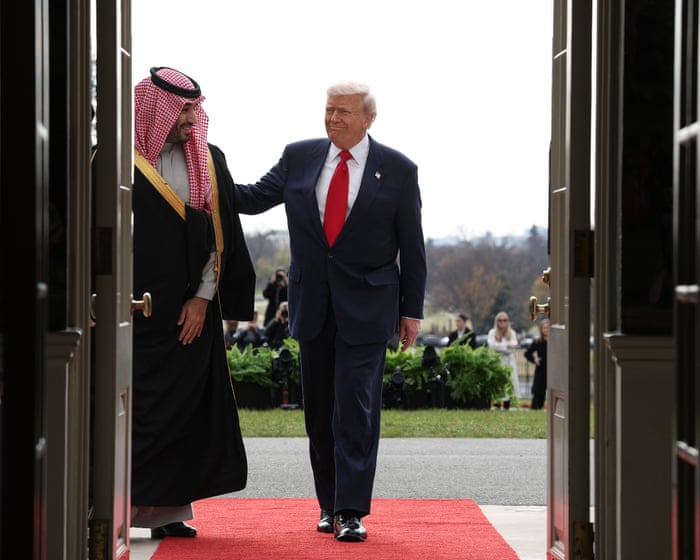
The White House reception for Saudi Crown Prince Mohammed bin Salman was the most opulent of Trump’s presidency, clearly signaling its foreign policy focus. Though labeled a working visit, it surpassed all prior state visits in extravagance. Trump welcomed the prince on the grand south lawn with flag-bearing cavalry and a fighter jet flyover.
Inside the refurbished Oval Office, Trump appeared infatuated, repeatedly clasping the prince’s hand and praising their friendship. When a journalist mentioned the 2018 murder of Jamal Khashoggi—the reason for the prince’s seven-year absence—Trump angrily defended the prince, dismissing US intelligence findings and calling Khashoggi “controversial” as if justifying the killing.
Trump’s dismissal of human rights and US intelligence agencies…The president’s policies and his open admiration for autocrats are not surprising. U.S. foreign policy had already taken a clear turn in that direction when he began his second term in January. If there was any notable change during Prince Mohammed’s visit on Tuesday, it was visible in the skies above Washington.
President Trump confirmed that the F-35 stealth fighters featured in the flyover for the visiting royal are being offered for sale to Saudi Arabia. He stated that the sale would come with no conditions and that the Saudi F-35s would be identical to those provided to Israel.
If this deal proceeds, it would challenge a long-standing principle of U.S.-Israeli relations: that Israel always receives the most advanced military equipment, ensuring it maintains a “qualitative edge” over other U.S. allies in the region. By appearing to abandon this principle, Trump emphasized that both nations are equally important allies and deserve the best technology.
“Saudi Arabia is a great ally and Israel is a great ally,” the president said. “As far as I’m concerned, I think they are both at a level where they should get top-of-the-line equipment.”
This is not the kind of message Israel wants to hear from Washington, and it represents the latest in a series of recent strains in the bilateral relationship.
In another significant move, the administration has announced it will lift the ban on selling advanced AI chips to Saudi Arabia and the United Arab Emirates. This decision supports Riyadh’s goal of becoming a global technology hub, with energy-intensive data centers that could form the foundation of a global AI economy, potentially led by both Saudi Arabia and the U.S.
Gregory Gause, a visiting scholar at the Middle East Institute in Washington, compared the potential U.S.-Saudi partnership in AI to the U.S.-led development of Saudi oilfields in the 1930s. He noted, “It could be a real solid link between the countries—a better guarantee of an American commitment to Saudi security than anything that could be written on a piece of paper.”
During Prince Mohammed’s state visit, Trump appeared deeply impressed by the Saudi leader.
Other recent events also suggest at least a temporary shift away from prioritizing Israel in U.S. Middle East policy. On Monday, a U.S.-drafted UN Security Council resolution included language about a potential path to an independent Palestine, despite Israel’s strong objections to the clause.
Earlier, in late June, Trump eased some sanctions on Syria, again going against Israeli preferences. In May, he toured the Middle East to highlight his foreign policy, visiting Saudi Arabia, Qatar, and the UAE—but not Israel.
These developments indicate a shift from what was arguably the peak of U.S.-Israeli relations, when Trump joined Israel in airstrikes on Iran’s nuclear facilities in June, fulfilling a long-standing goal of Benjamin Netanyahu and causing concern across the Gulf.
“Saudi leaders were alarmed at how quickly the conflict threatened to spill across the region,” said Sanam Vakil, director of the Middle East and North Africa programme at Chatham House. “Although a fragile ceasefire holds for now, Riyadh remains wary that another confrontation could erupt with little warning.”
Following the strikes on Iran, Netanyahu seemed to take Washington’s support for granted and overstepped by bombing a target in Doha, Qatar, in an attempt to kill Hamas officials. Reportedly, Trump had very little advance notice of the plan to strike a key regional ally.
In response, Trump humiliated Netanyahu during his late September visit to the White House, forcing him to call the Qatari leader from the Oval Office to apologize.
In contrast, Prince Mohammed is receiving lavish praise from Trump.In the transactional environment of the White House, Israel struggles to compete with the Gulf states. Crown Prince Mohammed pledged $1 trillion in Saudi investment in the U.S. economy, while Qatar provided Trump with a $400 million luxury plane to serve as the new Air Force One.
Massive financial flows occur in both public and private sectors. Saudi Arabia, Qatar, and the UAE have collectively invested nearly $5 billion in a fund managed by Trump’s son-in-law, Jared Kushner.
Trump has consistently shown a preference for absolute rulers over elected leaders. Unlike Netanyahu, who must navigate coalition politics, Prince Mohammed operates without such constraints.
The prince has also made it clear that if the U.S. fails to meet his expectations, Saudi Arabia will turn to China for military hardware and security guarantees.
Concerns about Saudi Arabia shifting toward China date back to the previous administration. This fear led to a reversal in Joe Biden’s stance on Prince Mohammed—from labeling him a “pariah” over the Khashoggi killing to a humiliating climbdown, including a visit to Jeddah in July 2022 and a notorious fist bump.
Some observers argue that recent developments do not amount to a U.S. “reset” in Middle East policy. They note that beneath the spectacle of the Saudi visit, many discussions were more superficial than they appeared.
Trump once humiliated Netanyahu by forcing him to call his Qatari counterpart from the Oval Office to apologize for bombing Doha.
When announcing the $1 trillion investment pledge, Prince Mohammed provided no timeline. It is also unclear how many F-35 jets the U.S. will sell to Riyadh. Key items from the summit, such as a bilateral defense pact and a civil nuclear agreement, face potential congressional blocks and are unlikely to materialize soon.
The possibility of Saudi-Israeli normalization under the Abraham Accords was discussed but politely deferred by the crown prince. He emphasized that normalization would require a firm commitment to a Palestinian state, going beyond the vague, conditional language in Monday’s UN Security Council resolution.
Regarding Gaza and the broader Palestinian issue, Daniel Levy, president of the U.S./Middle East Project, sees little hope for change.
“On the Palestinian file, there’s no joy at all,” Levy said. “Israel has a very free hand. They’ve secured the hostages’ release and are still bombing Gaza.”
In the bigger picture, he argued that U.S. policy in the Middle East remains fundamentally unchanged despite surface shifts.
“If you set aside the particular missteps of the Biden administration, add the self-interest of the Trump family, and factor in reactions to events and Israeli overreach, it’s not a fundamental reset,” Levy added.
He contended that U.S. policy has stayed consistent over the years, driven by individuals with a shallow understanding of the region who take cues from Israel and a handful of regional rulers.
Frequently Asked Questions
Of course Here is a list of FAQs about why Trumps efforts to win favor with Saudi Arabia are perceived as putting Israel at a disadvantage with clear and concise answers
BeginnerLevel Questions
1 Whats the basic conflict between Saudi Arabia and Israel
For decades they havent had formal diplomatic relations A major sticking point is Saudi Arabias longstanding support for the Palestinian cause which often puts it at odds with Israeli government policies
2 Why would the US being friends with Saudi Arabia be bad for Israel Isnt that good for stability
While stability is a goal the concern is that to win Saudi favor the US might pressure Israel to make concessions in peace talks with the Palestinians that it wouldnt otherwise make essentially using Israeli compromises as a bargaining chip
3 Can you give a simple example of how this might work
Imagine the US wants to sell advanced weapons to Saudi Arabia To get Israel to agree not to oppose the sale the US might ask Israel to accept a peace plan that requires it to give up land or security control which Israel sees as vital to its safety
4 What did Trump do specifically to win favor with Saudi Arabia
Key actions included his first foreign visit to Riyadh approving massive arms sales siding with Saudi Arabia in its dispute with Qatar and notably downplaying the Saudi governments involvement in the killing of journalist Jamal Khashoggi
Advanced Questions
5 How does the USSaudi relationship under Trump affect the balance of power in the Middle East
By strengthening Saudi Arabia militarily and politically without firm guarantees for Israels security it risks eroding Israels qualitative military edgea longstanding US policy to ensure Israel can defend itself against any threat A more powerful Saudi Arabia could one day pose a direct challenge to Israel
6 Didnt the Abraham Accords improve relations between Israel and some Arab nations How does Saudi Arabia fit in
The Abraham Accords were a major breakthrough normalizing relations between Israel and several Arab nations However Saudi Arabia is the biggest prize The concern is that a US administration overly eager to secure a deal with the Saudis might pressure Israel into a peace agreement with the Palestinians that is not in its longterm security interests just to get the Saudi signature