Spain’s rail network is facing increased scrutiny following a commuter train crash near Barcelona, which came just days after a collision between two high-speed trains left at least 43 dead and 152 injured.
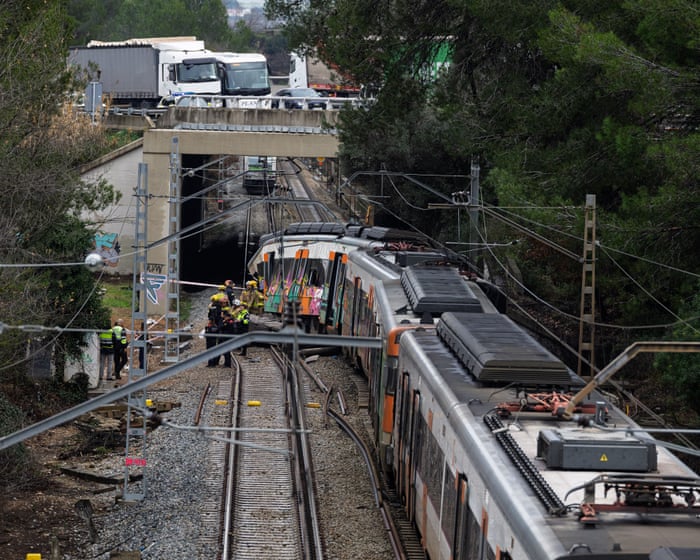
The second incident in two days happened around 9 p.m. on Tuesday when a retaining wall collapsed onto the tracks near Gelida in Catalonia, derailing a local train. The crash killed a 27-year-old trainee driver, Fernando Huerta from Seville, and injured 41 people, five of them critically.
Authorities believe the wall collapsed due to unusually heavy rainfall in the region. As a precaution, Catalonia’s rail network was shut down for inspections, stranding hundreds of thousands of commuters and causing major road disruptions.
Earlier on Tuesday, several people sustained minor injuries when a train north of Barcelona hit a rock on the track, though it was able to continue after a delay.
These incidents have led Spain’s largest train drivers’ union to call for an indefinite strike, demanding stronger safety assurances. In a statement on Wednesday, the Semaf union said it “cannot accept the constant deterioration of the rail network” and is calling for “urgent new measures,” while also seeking to hold infrastructure safety officials criminally liable.
While the cause of Monday night’s high-speed train collision near Córdoba remains under investigation, the train’s black box recorded the driver warning the control center of a problem moments before the crash. The driver reported a “snag” near Adamuz, which the operator Adif said related to the connection between the train and the overhead power line. After being instructed to disconnect from power—which he said he had already done—he asked for oncoming trains to be stopped. The controller replied there were none, but seconds later the train collided with a regional service traveling in the opposite direction.
The back-to-back accidents have drawn attention to the state of Spain’s railways—both the extensive, high-speed AVE network and the often underfunded regional services.
Transport Minister Óscar Puente emphasized in a television interview that the two accidents were “completely unrelated.” However, opposition parties have criticized the government, with the Popular Party leader demanding an “immediate clarification” of the rail network’s condition, and a Vox party spokesperson claiming Spaniards are now “afraid to get on a train.”
Despite these recent incidents, EU statistics indicate that Spain’s rail network remains one of the safest in Europe. In 2024, one rail passenger died in Spain out of 16 such fatalities across Europe—compared to 20,000 road deaths on the continent during the same period.
Frequently Asked Questions
FAQs Spains Rail Network Recent Fatal Crashes
BeginnerLevel Questions
1 What happened with Spains trains recently
In the span of just two days Spain experienced two separate fatal train crashes raising serious concerns about rail safety across the country
2 Where and when did these crashes occur
The first crash happened on and the second occurred the following day at
3 Were these crashes on the same train line or connected
While both occurred within Spains national rail network initial reports suggest they were on different lines and were separate unrelated incidents The scrutiny comes from their alarming proximity in time
4 Who operates Spains rail network
The primary operator of Spains main rail infrastructure is ADIF Passenger services are mainly run by Renfe the stateowned company
5 Is it still safe to travel by train in Spain
Authorities have launched urgent investigations and safety reviews While the network remains operational travelers should stay updated on official advisories from Renfe and ADIF regarding specific lines
Advanced InDepth Questions
6 What are the immediate causes being investigated
Investigators typically look at multiple factors including human error technical failure track maintenance issues and operational procedures The close timing of these crashes will also prompt a review of systemic pressures
7 Has Spains rail network had safety issues before
Spains rail system especially its highspeed AVE network has historically had a strong safety record However any fatal accident prompts a reevaluation These two crashes in quick succession are highly unusual and unprecedented in recent decades
8 What is ERMTS and could it be a factor
ERTMS is a modern continentwide signaling and speed control system designed to prevent accidents Investigators will check if it was installed and fully operational on the affected lines as its absence or malfunction could be a critical factor
9 What practical steps is the government taking
Standard responses include grounding similar rolling stock for