Lorsque la NFL a annoncé en septembre que Bad Bunny se produirait au spectacle de la mi-temps du Super Bowl, beaucoup ont immédiatement anticipé que Benito Antonio Martínez Ocasio allait faire une déclaration.
Des réactions négatives sont venues de ceux qui estiment qu'une performance en espagnol n'est pas américaine — malgré le statut de Porto Rico en tant que territoire américain. D'autres ont critiqué l'idée qu'une performance sur la scène de la NFL puisse remettre en cause de manière significative le pouvoir de la ligue, surtout après les protestations de Colin Kaepernick, arguant que les artistes qui acceptent l'invitation entrent dans un espace bâti sur le capital et le nationalisme. Et alors que la popularité de Bad Bunny atteignait son apogée cette semaine, certains Portoricains ont noté que pour de nombreux fans, leur engagement avec l'île commence et se termine souvent avec l'artiste.
Pourtant, son album de 2025 Debí Tirar Más Fotos constitue un chapitre récent et puissant dans la chronique de Bad Bunny sur la résilience portoricaine. Il met en garde sobrement contre l'érosion culturelle de Porto Rico face aux incitations fiscales étrangères et au déplacement économique ; il honore les traditions musicales afro-portoricaines comme la bomba et la plena en tant que formes de narration et de résistance ; et sa résidence de 31 spectacles au Coliseo de Porto Rico — au lieu d'une tournée mondiale — a injecté des millions dans l'économie de l'île. Tout cela reflétait son engagement indéfectible envers sa patrie, son identité et son histoire.
Le spectacle de la mi-temps du Super Bowl est intrinsèquement une question de compromis. Mais alors qu'il lançait le « Benito Bowl », sa plus grande concession semblait être le nombre de mots censurés dans son couplet.
Un jeune homme portant un drapeau portoricain devant un champ de canne à sucre a ouvert par une bénédiction pour tous : « Qué rico es ser latino. Hoy se bebe » (« Qu'il est doux d'être Latino. Aujourd'hui, on boit »), faisant écho à l'une des chansons de Benito les moins adaptées à la diffusion.
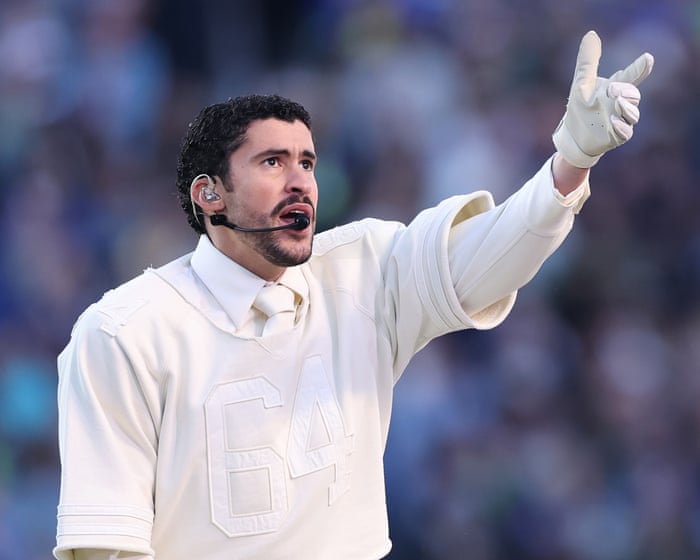
Vêtu de blanc comme le reste des artistes — et portant un superbe blazer-jersey personnalisé Ocasio brodé avec l'année de naissance de sa mère, 1964 — Benito a donné raison à de nombreux parieurs en interprétant « Titi Me Preguntó », l'hymne derrière son personnage aux nombreuses petites amies.
Autour de lui, il a construit tout un écosystème communautaire : des anciens jouant aux dominos, des vendeurs de rue vendant du coco frío, des piraguas et des tacos (ceux de Villa's Tacos de Los Angeles), les boxeurs Xander Zayas et Emiliano Vargas sur le ring, et un homme demandant sa petite amie en mariage juste au moment où commençait « Yo Perreo Sola », centré sur les femmes. « Las mujeres en el mundo entero », a-t-il déclaré, « perreando sin miedo » (« Les femmes du monde entier, perreando sans peur »). Derrière lui, à la casita inspirée d'une maison typique de l'île, se tenait un annuaire de stars incluant Karol G, Pedro Pascal, Cardi B, Jessica Alba, Young Miko et Alix Earle.
Ceux manquant d'imagination auraient pu penser que « Safaera » — le morceau de perreo le plus dur et le plus cru de YHLQMDLG — serait impossible à exécuter. Au lieu de cela, Benito a joué avec les nombreux bips de censure et une ligne notoirement incompatible avec la FCC.
Alors que l'ambiance ne pouvait être plus agitée, Benito a fait irruption à travers le toit dans la casita, désorienté alors qu'un medley des plus grands hits du reggaetón se déployait — incluant « Pa' Que Retozen » de Tego Calderón, « Dale Don » de Don Omar et, bien sûr, « Gasolina » de Daddy Yankee, avant de fusionner avec son propre titre percutant « EoO ». Le spectacle a servi d'éblouissant hommage aux nombreuses légendes musicales portoricaines — en reggaetón, salsa et musique jíbaro — que Benito perpétue, assurant qu'elles ne soient jamais oubliées.
Lady Gaga ne figurait pas parmi les invités les plus attendus, mais même « Die With a Smile » s'est transformé en célébration lorsque Gaga et Los Sobrinos lui ont donné une touche salsa lors d'un mariage sur scène. Benito l'a ensuite rejointe pour un magnifique « Baile Inolvidable », style mariage latino, avant... [texte coupé] Je me suis assis sur une chaise et tout. Plus tard dans le spectacle, Ricky Martin mettrait tout son cœur dans chaque « le lo lai » de « Lo que le pasó a Hawaii ». Mais ma célébrité préférée aperçue l'a été pendant « Nuevayol », au milieu d'une reconstitution d'un magnifique pâté de maisons avec coiffeurs et bodegas : la sainte mère de Williamsburg elle-même, Toñita, parée de tous ses anneaux, à l'intérieur d'une réplique de son Caribbean Social Club. Depuis 1974, son club résiste au déplacement par les promoteurs et reste l'endroit où la communauté peut obtenir des assiettes pleines de nourriture et des Medallas à 3 dollars.
Benito a tenu la promesse de sa musique de montrer la réalité de la vie portoricaine. Dans une performance saisissante d'« El Apagón », il a déployé le drapeau bleu clair de l'indépendance portoricaine à travers le terrain, tandis que des artistes sur des lignes électriques évoquaient les fréquentes pannes de courant causées par la détérioration des infrastructures énergétiques de l'île. Ce moment sombre a rapidement cédé la place à l'appel et réponse jubilatoire de « Café Con Ron » alors que Benito était rejoint par Los Pleneros de la Cresta.
« God bless America », a proclamé Benito alors qu'il approchait de la fin, nommant promptement le Chili, l'Argentine, et toute l'Amérique du Sud et centrale et les Caraïbes avant de terminer par les États-Unis, le Canada et Porto Rico. « Seguimos aquí » (« Nous sommes toujours là »), a-t-il conclu, en lançant violemment un ballon de football sur lequel était écrit : « Ensemble, nous sommes l'Amérique ».
Ailleurs dans le spectacle, Benito a remis à un jeune garçon regardant son discours aux Grammys à la télévision un prix à lui — la semaine dernière, « Debí Tirar Más Fotos » a remporté l'Album de l'Année, le premier album principalement en espagnol à le faire. Mais plus tôt dans la diffusion, il a ouvert son premier discours de remerciement avec la déclaration la plus simple qu'il pouvait faire face à la présence continue des agents de l'Immigration and Customs Enforcement (ICE) à Minneapolis. « Avant de remercier Dieu, je vais dire... ICE out », a-t-il dit, le premier à le faire pendant la diffusion, sous un tonnerre d'applaudissements. « Nous ne sommes pas des sauvages, nous ne sommes pas des animaux, nous ne sommes pas des étrangers. Nous sommes des humains, et nous sommes des Américains. » En septembre, il a reconnu que le risque de contrôle de l'immigration à ses concerts avait influencé sa décision de ne pas faire de tournée dans le continent américain.
Inscrite dans la politique de « Debí Tirar Más Fotos » se trouve la vérité inébranlable que Porto Rico ne peut être absorbé par les États-Unis ou par une « américanité » générique. Tout au long de son travail, il a mis en lumière la perte d'identité, de travail et d'argot caribéens qui se produit lorsque l'imagination américaine tente d'assimiler ou d'estomper ses cultures.
Ce n'était pas la première fois que Benito se produisait au spectacle de la mi-temps. En 2020, il était l'invité de Jennifer Lopez et Shakira au Super Bowl LIV à Miami. Cette performance était, au mieux, une célébration défiant deux géantes latinas du 21e siècle, et au pire, avec son élément de protestation symbolisé par des cages éparpillées sur le terrain, elle mettait en lumière l'oppression latino. Où cette conversation a-t-elle mené ? Et qui en a vraiment bénéficié ?
De nombreuses réalités violentes pour nos communautés persistent à l'extérieur. Le Super Bowl ne diffusera jamais la révolution à la télévision. Mais cette année, Benito a rappelé à tant d'entre nous l'amour, la communauté et la pure joie que nous créons ensemble chaque jour, malgré tout le reste.
Foire Aux Questions
Bien sûr. Voici une liste de FAQ sur le spectacle de la mi-temps du Super Bowl LVII de Bad Bunny, formulées comme des questions qu'une vraie personne pourrait poser.
**Général - Questions pour débutants**
**Q : Qu'est-ce qui était si spécial dans le spectacle de la mi-temps du Super Bowl de Bad Bunny ?**
**R :** C'était historique. C'était la première fois qu'un artiste latino en solo, et spécifiquement une superstar portoricaine du reggaetón, était la tête d'affiche du spectacle. C'était une célébration massive et fière de la musique et de la culture latines sur l'une des plus grandes scènes du monde.
**Q : Quand son spectacle de la mi-temps a-t-il eu lieu ?**
**R :** C'était pendant le Super Bowl LVII, le 12 février 2023, au State Farm Stadium de Glendale, en Arizona.
**Q : Quelles chansons Bad Bunny a-t-il interprétées ?**
**R :** Il a ouvert avec "El Apagón" et "Moscow Mule", puis a interprété des extraits de "Tití Me Preguntó", "Después de la Playa" et "I Like It" avec Cardi B et J Balvin. Il a conclu avec son tube mondial "Dakiti".
**Q : Pourquoi a-t-il commencé le spectacle en parlant espagnol ?**
**R :** Sa première phrase, "Esto es pal que lo tenían olvidado", était une déclaration puissante de représentation, s'adressant directement et célébrant sa base de fans latinos dans leur langue.
**Q : C'était quoi le drapeau portoricain géant et les masques de vejigante ?**
**R :** C'étaient des symboles directs de la fierté portoricaine. Le drapeau se passe d'explication et les masques de vejigante sont une partie traditionnelle des célébrations du Carnaval portoricain, représentant le riche héritage afro-caribéen de l'île.
**Avancé - Questions détaillées**
**Q : Comment son spectacle s'inscrivait-il dans le thème plus large de la mi-temps de cette année ?**
**R :** Son segment faisait partie d'un spectacle à trois têtes d'affiche qui comprenait également Mary J. Blige et Dr. Dre. Le set de Bad Bunny a établi l'énergie et la pertinence mondiale moderne, faisant la transition vers les actes de hip-hop et de R&B légendaires qui ont suivi.
**Q : Quelle était la signification des cabañuelas et du décor ?**
**R :** Le spectacle a commencé avec une tempête de pluie mise en scène et un décor de quartier, évoquant l'atmosphère communautaire vibrante d'un quartier portoricain.