Walking along Italian beaches feels like walking through a rainbow. For about 50 meters at a time, the perfectly spaced umbrellas and deck chairs are all red, then they turn orange, then yellow, green, and so on. These are the country’s famous bagni (lidos), officially called concessioni balneari (bathing concessions). They’re simple but stylish. The sand is raked at dawn. The bar plays soft background music and serves negronis or fried squid. There’s usually a ping-pong table or a beach volleyball area. Some even have swimming pools.
Everything about these lidos is well-organized. Deck chairs are priced as carefully as theater tickets, with spots near the water often costing twice as much as those by the bar (in Milano Marittima this summer, on the less glamorous Adriatic coast, an umbrella and two deck chairs cost €30 by the bar, but up to €60 by the water). Many families rent the same spot all summer, year after year.
Sometimes you have to walk a mile or two before finding a spiaggia libera—a beach free of private lidos where you can put your towel on the sand and set up your own umbrella. These “free beaches” are always in remote, less attractive areas, near a river mouth or an eyesore, or where the sand turns into rocks. They often have litter problems, with ice cream wrappers left in the sand. There are no lifeguards or bathrooms.
“This setup is crazy,” says a Dutch tourist I meet on a free beach near Naples. “I tried to sit down on the beach over there,” he points toward the private lidos, “and they shooed me away. And here,” he shrugs, “there’s no toilet, no shower, no trash can…”
You come to a shell of a building, chained shut but covered in graffiti. This is the “free beach.” It seems almost deliberately dirty, with wet wipes and straws in the sand.
The conflict between privatized and free beaches, and how to manage Italy’s nearly 8,000 kilometers (4,971 miles) of coastline, has become a hot topic in recent years. The country has about 30,000 lidos, and a 2022 report from Legambiente (an Italian environmental organization) estimated that about 43% of Italy’s sandy coasts are now occupied by private businesses.
Danilo Ruggiero, director of the Mare Libero (Free Sea) campaign, says: “Beaches have been turned into small resorts—these complexes can include swimming pools, parking lots, gyms, restaurants, and clothing stores.” Ruggiero lives in Ostia, just west of Rome, where 80% of the town’s beach is what he calls “the united states of lidos.” “Defenses have been built around the area—walls, gates, fences, and hedges—to block access and hide the view. Often, for several kilometers, you can’t even see the sea.”
Tuscany and Romagna are the regions with the most heavily privatized beaches. In Forte dei Marmi, on the west-facing sand of the Tuscan coast, 94% of the town’s beachfront is rented to resorts. Nearby, in Pietrasanta and Camaiore, it’s 98.8% and 98.4%, respectively. Until recently, Gatteo a Mare, on the Adriatic coast, didn’t have a single free beach; after public outrage, it now has 1.4% of free beach—10 meters out of a total of about 700 meters.
Because running a lido is very profitable and often involves cash transactions, they attract organized crime, and the push for more free beaches has often gone hand in hand with a broader anti-mafia movement. But the beach issue also ties into a question that overwhelmed Italians often ask themselves: how to fight the excesses of overtourism without turning beautiful places into theme parks? How can everyone enjoy the seaside if there just isn’t enough space on the sand?
Bacoli is a town at the very northwestern tip of the Gulf of Naples. It’s a stunning but unstable place: active and extinct volcanoes have created concentric circles of crater lakes and ruins.Rocky peninsulas jut out into the sea. The entire town sits on the bubbling magma of the Phlegraean Fields, where roads and buildings are constantly lifted or dropped by ground movement—known as bradyseism—causing cracks and potholes.
“Here,” Fabio Ciciliano, the national head of Italy’s civil protection department, tells me, “they’re not living on a volcano but inside one.”
“It’s like the game of the goose,” laughs the town’s mayor, the long-haired, 39-year-old Josi Gerardo Della Ragione, bouncing his hand up and down to show that, like snakes and ladders, his town is battling the whims of fortune.
Della Ragione—or Josi, as everyone calls him—has become nationally famous for his fight to free his town’s beaches from private profiteers. “Until recently,” he tells me, “our beaches were cluttered with illegal sheds, barbed wire, gates, and intercoms.” Access to various beaches required going through one compound or another. “You had to ring the intercom,” he explains, “and they’d say, ‘I’ll open the gate if I know you.’” The mayor says it’s a “clientelistic, friends-of-my-friends” arrangement that sums up the local mindset.
The issue of beach access hits especially hard in Naples because the sea is part of the city’s soul. No self-respecting Neapolitan singer is without a tribute to “O Mare” in their repertoire. Naples’ port authority manages the allocation of concessions, and many feel the balance between public and private is very skewed: in Campania (the region around Naples), 70% of concessions are private, and in Naples itself, that number is 95%.
Della Ragione says many lidos got their licenses by paying fines. “They occupied a stretch of water and a stretch of beach,” he says. “At the end of the summer, the port authority fined them for unauthorized occupation.” Through what the mayor calls “legalized squatting,” the fines became a way to legitimize the occupation. “Abusivi storici” (historical unauthorized occupants) is the legal term for many of the lidos he’s now taking on.
“It’s obvious that public property seized by force and bullying will be defended by force and bullying,” says Della Ragione. On one beach, Casevecchie, he used heavy machinery to tear down illegal buildings on public land. “We had to bring in bulldozers to demolish warehouses,” he says. “In one, we found the person running it with a chainsaw, heading toward the council workers. That’s the kind of crime we’re dealing with.”
Della Ragione has been fighting this battle for a long time. Seventeen years ago, he co-created a social media campaign called FreeBacoli. He also worked as a sports journalist and is a skilled listener. He constantly spoke out against wrongdoing in local government, which led to an arson attack on his family’s deli. But in 2015, at just 28, he was elected mayor with nearly 65% of the vote. Although his administration fell after only a year in power, he came back in 2019. He has now been Bacoli’s mayor for seven years.
What makes Bacoli unusual is that the town council owns more than a quarter of the 13 square kilometers of land, 60% of which is coastal. Many attractive sites ended up in the hands of the local mafia, the Camorra. Villa Ferretti is a 19th-century villa built next to Roman ruins that are still visible beneath the clear water of Pozzuoli Bay. There’s a public beach—maybe lessless than 100 metres long – just to the right of the villa’s balconies. The Ferretti family were wealthy Genoans, but the villa eventually ended up in the hands of the Pariante family, a notorious Camorra clan, who closed public access to the beach.
The property was seized by the Italian Anti-Mafia Investigation Division in 1995 and transferred to the municipality of Bacoli in 2003. In 2016, the town council turned the beach and garden into a public park and built an outdoor theatre, restoring public access to the beach and leasing the villa to the University of Naples Federico II.
In many ways, Della Ragione’s stance on beaches is no different from his broader political vision. “What we’ve tried to do,” he says, “is to give the city back to its citizens, based on the idea that the public administration doesn’t hand out favors or engage in patronage.” It’s a vision of politics that sometimes struggles to take root in southern Italy, where, according to Della Ragione, the “public good” is seen “as a cake to be divided among friends, voters, and relatives.”
Miseno beach is another flashpoint in Bacoli. It’s a curved strip of sand just over half a mile long. But you can’t reach it from the modern road named after Pliny the Elder. There are triumphal arches leading to private resorts and free parking for members, but unless you know where the narrow corridors are between those resorts, you’ll struggle to even see the sand, let alone stand on it.
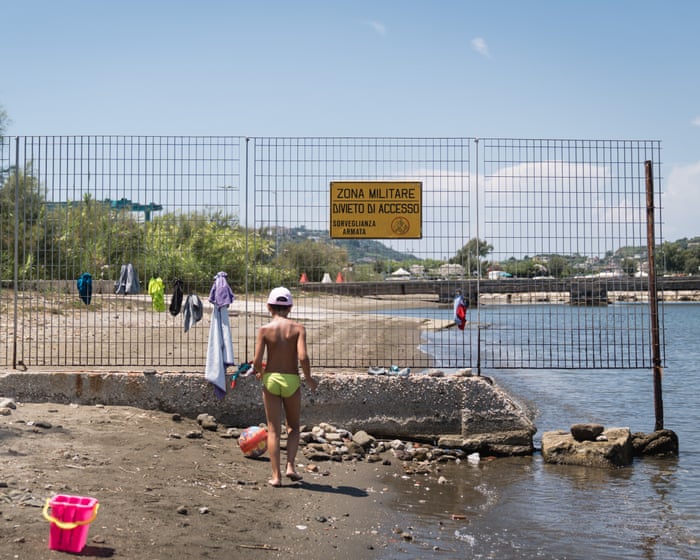
“They’re all military beaches,” says Della Ragione. “The navy has one resort, the air force another, the Italian army has two, and the coastguard has one.” If you include the nearby Guardia di Finanza resort, that adds up to about 100,000 square meters of Miseno sand reserved for exclusive use.
But when you finally find an alleyway between the military installations, it’s worth it. The water is cool and clear, and the famous islands – Procida, Ischia, and Capri – feel so close you could swim to them. To the left, there are a dozen caves, once used as storage by the Roman navy.
Two thousand years ago, these saltwater lakes and sheltered bays turned Bacoli into the chosen port for Rome’s elite fleet, the Classis Misenensis. Underground aqueducts brought fresh water directly to the sailors from a reservoir – the Piscina Mirabilis – whose ceiling had circular skylights casting angled beams onto the water.
So this has always been a militarized zone. But on Miseno’s beach, the military presence has nothing to do with training or drills – only deck chairs and economics. In the military lidos, un pezzo (“a piece,” either a deck chair or a parasol) costs only €3 (plus free parking). In the non-military lidos, each “piece” costs €7 in the low season and €10 in the high season (with no parking). “We’re being undercut,” says a barman at a non-military lido, who complains about the unfair competition.
The managers of the military resorts aren’t in uniform. They’re local guys with no connection to the military: they serve coffee for 60 cents – half the price elsewhere – and say anyone is welcome to eat in their subsidized restaurants. They’re so used to the unfair advantage that they don’t even seem to notice it.
On Miseno’s beach, the military presence has nothing to do with training or drills – only deck chairs and economics.
Eventually, you come to a shell of a building, chained shut but covered in graffiti. This is the “free beach.” It seems…The beach is almost deliberately grubby, with wet wipes and straws scattered in the sand. Litter is a common argument private operators bring up—they say it’s inevitable that public beaches will get dirty. But the atmosphere here feels different. Instead of rows of loungers set at right angles, there are small groups of people sitting around a Bluetooth speaker.
I talk to a man named Marco and ask him about the mess. “We have to fight a cultural battle,” he says. “Because when I go to certain free beaches, there are no bins, and people leave cigarette butts and bottle caps in the sand. It takes some education, some culture…”
For years, activists from Mare Libero have organized flash mobs and beach takeovers in hotspots where access is constantly being restricted. Donn’Anna Beach, just west of Naples, had been fenced off since 1999. Citizens could only enter if the keyholder—the manager of a beach club called Bagno Elena—allowed it. Even if you got in, finding a free spot in the middle of summer was nearly impossible: out of the beach’s 4,490 square meters, only 290 were considered public.
The Naples chapter of Mare Libero ran a campaign to “liberate” the beach, organizing sit-ins and arguing in court that a locked gate violated public access rights. The Naples port authority appealed against removing the gate but lost. In February 2026, the Campania regional administrative court ruled in favor of Mare Libero, and Donn’Anna Beach is now freely accessible—a victory the group hopes to repeat along the coast.
In these tense situations, Della Ragione offers a kind of socialist optimism: his fight for beach access is part of a larger plan to turn all the land owned by the town council back into public commons. “The sum of every individual interest is less than the common good,” he says.
Della Ragione has an unusual mix of skills. He combines the communication savvy of an influencer—constantly quoted and photographed in his tricolor sash, and sharing his personal phone number online during emergencies—with the bureaucratic know-how of an older lawyer. His messages come across as both natural and deliberate. “In this age of communication, if you don’t say you’ve done something, it’s as if you haven’t done it. You have to do it, and you have to say you’ve done it.” But his high profile also serves as protection: what he’s doing is dangerous (he’s received death threats), and his national fame gives him some safety.
Many resorts host weddings, birthdays, baptisms, and graduations, and some have been found to earn more in a single evening than they pay in annual rent.
Although the mayor seems revolutionary, he’s also strict about formality. He refuses to meet people in shorts, and locals tell stories—possibly made up—of groups of visitors sharing one pair of trousers outside the mayor’s office. When I go to a local boutique and explain why I need to buy a pair, the shop owner laughs: “This happens all the time.”
Walking around town with Della Ragione, people constantly come up to shake his hand. Others wave and call out, “Sindaco!” (mayor). The admiration is nonstop. And if you talk to anyone in town—shopkeepers, beachgoers, friends—they express genuine affection for “Josi.” “Fa bene,” everyone says (roughly, “He’s doing good”).You can feel what Bacoli is trying to create here. At sunset, teenagers play canoe-polo on Miseno’s saltwater lake. There’s a new beach volleyball court on the reclaimed sand at Casevecchie, with floodlights powered by solar panels. At midnight, toddlers move waist-high chess pieces for their parents, who are playing with ice cream in their hands. “It’s a positive micro-story of a slow and widespread regeneration,” wrote Klarissa Pica, a research fellow at Venice’s IUAV university, in her doctoral thesis, Territorio Mare (Territorial Waters).
“We don’t want any war with ‘the forces of order,’” says Della Ragione, laughing at how absurd that idea sounds, “but we do want to face reality: these are private clubs that take away from the idea that the beach is for everyone. In 2026, that’s absolutely unacceptable.”
This shift from small beach huts to massive resorts has taken nearly a century. In the early 1900s, the Italian state started renting out rectangles of sand (part of the demanio, or state property) to businesses that sold coffee and liqueurs and rented chairs. It wasn’t a place for the wealthy—they drank in the grand cafes of the main square or on their own boats.
Even after 1945, Italy’s long beaches weren’t glamorous. They were linked to war—littered with shrapnel and abandoned military gear—or to wilderness. They were windswept spaces for driftwood, loners, lovers, and criminals.
But what started as small kiosks grew as tourism boomed from the 1960s onward. Bagni (beach clubs) began building seating areas, putting up outbuildings, installing showers and toilets, digging pools, and fencing off sports areas and restaurants. In the pine forests behind the sand, many created parking lots and campsites. Some of it was legal, some wasn’t.
The rental agreements for these spaces were almost always “rollover” ones, renewing automatically. Until 2020, the minimum annual rent for a beach resort was just €364, and according to Italy’s court of auditors’ report for 2016-20, the state received only €101.7 million a year from these lidos—a tiny amount for an industry estimated to generate €7-8 billion.
The image problem for lidos is that they’re seen as profiting from old privileges that make running a bagno incredibly profitable. Many resorts host weddings, birthdays, baptisms, and graduations, and some have been found to earn more in one evening than they pay in annual rent. It’s been calculated that the average annual profit of a beach resort is still a tidy €260,000.
This was all supposed to end in 2006, when the EU’s Bolkestein directive required member countries to offer coastal concessions for a “limited duration, and through an open public selection procedure, based on non-discriminatory, transparent and objective criteria.” The directive was meant to break up protectionist practices and open the beaches to competition.
But successive Italian governments have avoided implementing the law by issuing proroghe (extensions) to delay any bidding process. First, there was an extension until 2012, then until 2015, then it was moved to 2020. In 2018, the “yellow-green” government (the League-Five Star Movement coalition) passed a law extending the status quo (of lidos renting the sand long-term) until 2033.
Recently, the Italian state has tried to make things fairer. It raised the minimum annual rent for a beach concession to €2,500 and then to €3,225.50. Beach resorts pay VAT at 22%, rather than the discounted rate of 10% that other tourist operators pay. The lidos also pay IMU, the Italian property tax, which is usually only required of actual owners—though that has caused its own problems. According to Ruggiero, “those who manage beachConcession holders often feel like they’re the owners in some way. So if the actual owner sees you going into their space, you’re seen as an intruder in their own home.
The debate over beaches usually falls along clear left-right lines. For the left, it’s an obvious example of public ownership and access. Italy’s large group of former socialists and communists argue that capitalism’s absurdity is shown by even shade being turned into a business. For the activists of Mare Libero, freeing beaches isn’t a trivial campaign—it’s a civil rights issue rooted in ecology and inclusion. Pica believes beaches are a matter of spatial justice as well as social justice. She sees in these struggles an echo of Roman law’s idea that “res communis omnium” (a thing common to all) should be considered “res extra commercium” (a thing outside commerce).
For the right, though, these concessions are a vital and patriotic pillar of one of Italy’s most important industries: tourism. According to a 2023 study by Italy’s National Institute of Statistics, tourism accounts for 9.6% of the country’s GDP. Of the nearly 477 million tourists (both domestic and international), 39.2% spend time at the sea, and no patriotic politician wants to disrupt such a thriving industry.
Klarissa Pica, an urban-planning researcher focused on public access to the coast, says access is about spatial justice as well as social justice. Photograph: Gianni Cipriano/The Guardian
Neither Giorgia Meloni (the prime minister), Matteo Salvini (the League leader in coalition with Meloni), nor Roberto Vannacci (a retired army general who is a rising star of the far right and outside the government) ever criticize the current state of beach resorts. Some have even invested in them: Daniela Santanchè, the scandal-hit former tourism minister, was a shareholder in Flavio Briatore’s Twiga (a luxury lido in Forte dei Marmi); and Massimo Casanova – a former MEP for the League – owns Papeete (another luxury resort) in Milano Marittima, where Salvini is a regular.
The bagni (beach resorts) claim they play an important role in keeping beaches safe. “In Italy, we’re lucky to have half the drownings they do in France,” says Antonio Capacchione, president of SIB, the Italian union of balneari (beach operators). According to Capacchione, that’s largely because lidos have a humanitarian duty to provide lifeguard services and could face manslaughter charges if they neglect safety rules.
Defenders of the lido system also argue that in an era of overtourism, they help protect the coastline. Some Italian cities and towns have become almost unrecognizable due to post-COVID travel mania. In Venice, the number of beds for tourists recently surpassed the number for locals. Rome’s Trevi Fountain is now requiring bookings and €2 tickets.
The same is happening on the beaches. Punta is one of Sardinia’s prized beaches: its small size—just a sprinkle of sand between rocky outcrops and clear sea—is what makes it so appealing. And it clearly needs protection from thousands of visitors who come with drones, tents, picnics, and charcoal (a fire last year burned dozens of cars). So in June, the Villasimius town council announced it would charge visitors €10 and limit numbers to 150 people and 70 cars. Controversially, personal umbrellas couldn’t be brought onto the beach unless the group included someone over 65 or under 10.
After national outrage—and many jokes about this being the only valid reason to bring children or grandparents on holiday—the Villasimius council increased the numbers to 190 people and 90 cars. But the outrage got to the heart of the debate about how to protect a fragile coastline from being overwhelmed by vehicles and people. It’s also, clearly, an ecological question. With risingRising sea levels, increasingly violent weather, and scorching temperatures have left Italy’s coastline highly vulnerable to erosion, pollution, drought, and wildfires.
Despite the intensity of the debate, everyone agrees on one thing: the simple, sandy beach holds a special place in the memories and identity of Italians. For millions, including my own family, spending long school holidays lounging in deck chairs under umbrellas has been a way of life. “From June to September,” Pica says, “pensioners set up their beach umbrella on the same beach, with the same beach operator, surrounded by all their beach friends. For them, that’s what enjoying the seaside is all about.”
“I’ve been coming here for 30 years,” says a retired woman I talk to at a lido in Cuma, just north of Bacoli. She’s looking after her two grandchildren. “I’ve known all my neighbors,” she says, pointing to the deck chairs around her, “for decades.” It’s clear that Italians, on the whole, expect their beach experience to be curated, predictable, and orderly.
View image in fullscreen: A lido beach at Miseno. Photograph: Gianni Cipriano/The Guardian
It’s unclear what will happen next in the standoff between the EU and Italy. According to Capacchione, any tender process should include clauses for compensation (“indennizzo”) for investments in infrastructure, and a requirement that bidders with long-standing experience in the sector get preferential treatment.
Italian mayor vows to stop sale of Neapolitan islet to wealthy speculator
Read more
To Ruggiero, that sounds like a fix. “As for compensation: the concession has a fixed term, so once it expires—and you’ve used it fully until the very end—why should I compensate you? It’s like someone saying, ‘I rent a house and then claim compensation’—compensation for what?”
The “experience clause” is even more problematic for Ruggiero. “Given that the market has been frozen, who else can claim to have experience running beachside businesses, other than those who have been running them up to now?” He sums up the current government’s position as: “I can’t give you an extension, but I’ll make sure you win the tenders.” It is, he says, a very Italian solution to the problem.
Tobias Jones lives in Parma. He is the author of Ultra: The Underworld of Italian Football. To support the Guardian, buy a copy at guardianbookshop.com. Delivery charges may apply. Per Elisa, the TV adaptation of his book Blood on the Altar, is streaming on ITVX. Additional research by Bruno Abate.
Frequently Asked Questions
Here is a list of FAQs about the Free the Lidos movement and the battle over Italys private beaches with clear concise answers
BeginnerLevel Questions
1 What is Free the Lidos all about
Its a public campaign and legal battle to open up Italys beaches Right now most of the coastline is controlled by private beach clubs The movement wants to make more beach areas free for everyone to use without paying
2 Why are most Italian beaches private
For decades the Italian government gave longterm licenses to private businesses to run beach clubs These licenses often last for years or even decades and they cover huge stretches of sand This started as a way to organize tourism but it ended up blocking public access
3 Is it illegal to walk on a private beach in Italy
Technically the first few meters of the beach are public But in practice many private clubs block access with umbrellas loungers and fences making it hard to get to the water without paying for a spot
4 Who is fighting for Free the Lidos
Environmental groups consumer rights associations some local politicians and ordinary citizens who want fair access to the coast They argue that beaches are a public good not a private business
5 Whats the main argument against private beaches
Critics say its unfair a few businesses profit from public land while everyone else has to pay to enjoy the shore They also argue it hurts the local economy and environment by turning natural beaches into crowded commercial zones
AdvancedLevel Questions
6 What is the EUs role in this battle
The European Unions Bolkenstein Directive says that longterm licenses for public services must be put up for competitive bidding not automatically renewed Italys current system violates this rule The EU has threatened legal action if Italy doesnt reform its beach concession laws
7 Who will come out on top the public or the private clubs
Its a tough fight Private clubs have deep pockets and strong political connections But public pressure and EU pressure are growing A likely outcome is a compromise some beaches will be freed