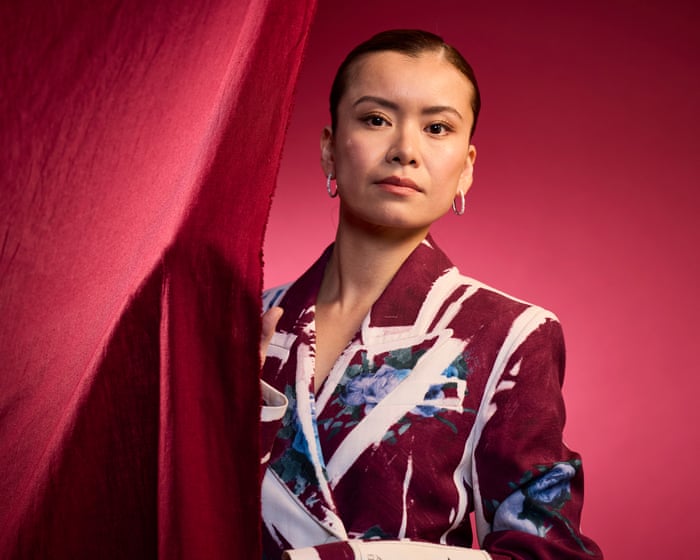
Some actors might have been a bit disappointed to audition for the part of a beautiful young romantic lead only to be cast as her mother, but not Katie Leung. “Absolutely not,” she says with a laugh. “I look young for my age—as many people in the West think Asians do—but I felt truly seen to finally play a mother.” She is a mother herself, she notes, and besides, the role of Lady Araminta Gun—the steely aristocrat set to shake up the new season of Netflix’s Regency hit Bridgerton—is so juicy, who could feel insulted?
Widowed Araminta has outlived two husbands and is now focused on marrying off her two teenage daughters, ideally to a Bridgerton, while keeping her stepdaughter Sophie in her place—as a Cinderella-like servant for the family. “The showrunners reassured me it wasn’t going to be the archetypal evil stepmother part,” says Leung. “They wanted to find Araminta’s humanity. They made sure I understood her background, her struggles, why she makes these choices, and why she’s so formidable.”
Still, from the four episodes I’ve seen, she is pretty cruel to Sophie. Leung agrees. “What defines her, and so many Bridgerton characters, is that they do terrible things, they make mistakes—they’re human. By the final episode, you might see her differently, and that’s wonderful, because usually you don’t get that with so-called ‘evil’ characters. Her drive comes from love and protection for her daughters. I understand that, having become a mum myself,” she says—her son recently turned three. “You’ll do anything for your kids. I don’t think I would have felt that way before.”
What’s it like joining a show as massive as Bridgerton? “I feel genuinely blessed,” she says. She’s no stranger to huge productions—her first role was Cho Chang in the Harry Potter films. “In a way, it feels quite familiar. I’m also older now and at a point in my life where I’m not too intimidated by something that seems so enormous.” The Harry Potter era coincided with the rise of social media and extreme online fandom—something the Bridgerton cast has also faced, much of it intense, shocking, and racist.
If Leung is worried, she doesn’t show it. She went through it with Harry Potter, and to some extent with Arcane, the Netflix animated series based on the League of Legends universe, where she voices a character. Leung says she’s learned to keep a healthy distance from the noise around her work. “I still care about the craft of acting, I still want to do well, but I can leave it behind at the end of the day, go home, and live my other life. It feels more like a job to me now, rather than the be-all and end-all, which is how I saw acting in my twenties.”
Leung comes across as grounded and thoughtful. She has campaigned to raise awareness about sexual violence against women, and on Instagram she posts as often about the horrors in Gaza as about her own projects. We discuss the rise of the far right and the spread of anti-immigrant rhetoric in the UK. It’s frightening, she says: “I feel like I’ve experienced it—in the supermarket, in daily life. I’m very aware I live in a London bubble, because if anywhere is diverse, it’s London.” Even in her area, she adds, “where there’s a real sense of community and inclusion, I’m still experiencing it. It concerns me. And it’s not just Britain—it’s happening all over the world.”
Leung grew up moving between various towns in Scotland due to her father’s job running a wholesale business.She became an actor by accident. She didn’t even do plays at school, except for one production of the musical Bugsy Malone, where she only appeared as a dancer. Her father spotted an open audition for Harry Potter and suggested it to her. Leung was less interested in landing the role than in getting her divorced parents in the same room for the first time in years—since her mother would accompany them to the audition.
“My mum and dad hadn’t seen each other for a long time, but I was really excited because, I guess in my 16-year-old mind, there was still a possibility that they might get back together,” she says with a smile. When she attended the audition in London, the first three Harry Potter films had already been huge successes, and she recalls feeling like there were thousands of people queuing outside. She thought she had no chance of getting the part.
Leung’s parents split up when she was three. Her mother, who worked in finance, moved to Hong Kong, while she and her brother were raised by their father—who later remarried, giving her younger siblings as well. “To be honest, it was my grandmother who really raised me. My dad was working full-time,” she admits. Growing up without her mother must have been difficult and unusual. “Yeah,” Leung says carefully. “It’s such a huge part of my identity; it’s not something I can ignore or say didn’t have a huge impact on my life. But because I’m really happy with where I am and who I am—though there’s obviously still lots of work to be done—I wouldn’t have it any other way.” She adds that she and her mother stayed in touch throughout her childhood and have a good relationship now.
How did she deal with the extreme and sudden fame that came with Harry Potter? “I don’t think I did,” she says. “It was overwhelming from the get-go. Being in the spotlight from that age, when you’re already insecure, was difficult, to say the least.” Looking back, she feels more aware of it now. “At the time, I was having a lot of fun. I thought: this is different from school, and I really did not enjoy school. So it was a way to escape. I’m still trying to figure it out, really, how it affected me.”
The young actors were looked after, she notes, even though conversations about mental health—especially the impact on young stars—weren’t as advanced as they are today. “I don’t know if anything could have been done back then to make things better or easier,” she reflects. “At that age, you’re curious. I remember being very curious about what people were saying about me, and I was Googling myself. Nobody could have stopped me because I was old enough to make up my own mind.”
What she found online was horrendous racism and hurtful personal comments. How did she cope with that? “I didn’t. I think it just sat with me, and it affected me in ways like, ‘Oh yeah, I made that decision because people were saying this about me.’ It probably made me less outgoing. I was very self-aware of what was coming out of my mouth.” She adds that being catapulted into a successful career made her feel she hadn’t earned it. “It happened by pure chance,” she says, underplaying her talent as if it were a lottery win. “And for the longest time, I may have tried to make up for it and overcompensate.”
Leung appeared in the last five films of the series. “I remember coming out of it and thinking, ‘Nothing’s going to beat it,’ because it was so successful. I remember feeling lost, thinking, ‘What’s next? People will have these high expectations of me topping it, and it’s never going to happen.’ I think I was so afraid of meeting these expectations that I was really hard on myself. I was trying to constantly prove I was more than just the actor from Harry Potter.””I gave up, or didn’t give myself the chance after that to try and continue acting.” She began a degree in photography, but near the end of her studies, she landed a part in a play. On stage, she remembers thinking, “No, actually, this is what I want to do.”
She went on to study drama at the Royal Conservatoire of Scotland. Did she feel self-conscious about being the actor from Harry Potter? “Oh my God, yes, absolutely. I tried really hard not to mention it, even during introductions at the start of the year, even though everyone knew. I didn’t want people to think that was why I got in. Not that it was, but I was really hard on myself. I was constantly trying to prove I was more than just the actor from Harry Potter.” (She stresses that the films are “such a huge part of where I came from, and I’m grateful for it, and they still resonate with a lot of people.”)
For a long time after drama school, Leung was mainly considered for roles that were “these kind of epic tales of the East, whether that be North Korea or China. Deep, dark subject matters.” In the BBC drama One Child, she played the child of a Chinese mother adopted by a British-American couple; and in Channel 4’s Run, she played an unauthorized migrant. She enjoyed these roles, she says, “and they gave me the chance to become more knowledgeable about the world and the injustices that happen around us all the time.” But it also felt limiting. “It’s one of those things where, just because there weren’t many roles out there, I was incredibly grateful to be considered. A large part of that was me, again, giving myself a hard time, thinking I wasn’t deserving of anything.”
She remembers the end of school and the yearbook where people wrote predictions about their classmates; Leung was described as the next Lucy Liu, the Hollywood actor. “Obviously I’m a huge fan of Lucy Liu—she’s had great longevity in her career—but that irked me. I remember thinking, why not Meryl Streep? I was kind of restricted by my race, and I guess Lucy Liu was the only other Asian actor who was, at the time, on the big screen.”
What would it have meant to Leung to see a lead who looked like her—in Bridgerton, Yerin Ha plays her stepdaughter, Sophie, whose storyline and potential romance with Benedict Bridgerton drives the fourth season—in one of the biggest shows in the world when she was growing up? “I’m envious of the younger generation who are getting to see people that represent them on screens now,” she says. “I know it would have done me good.”
When she works with younger actors like Ha, does she get a sense that their experience has been different from hers? “We’re still a long way away from where we need to be. It’s better, but it’s not as good as it needs to be. I really admire the younger generation because they are more self-aware and express themselves in a way that I, once upon a time, did not. Even now, I’m working on myself to say what I need, whether it’s in a relationship, at the workplace, with my mum, or with my partner. It’s really fundamental to having any good relationship with anybody.”
Leung thinks the quirky BBC crime drama Annika might have been the first time she was cast in a role where her ethnicity wasn’t relevant (though her Scottishness was, playing a detective with Glasgow’s Marine Homicide Unit). Progress has been slow, but it is happening, she says. “We’re getting there, and especially with a role like Araminta in Bridgerton, being able to…””To play a mother with daughters—that kind of family dynamic is something I feel is always missing. That’s where we need to try to get to now.” In contrast, she points to smaller, incidental roles—like a journalist or a social worker—”who has no ties to the rest of the cast. Because it’s all about relationships.”
Bridgerton’s famously diverse cast has reshaped the period drama landscape. “Their inclusion and diversity behind and in front of the camera is just…” Leung smiles. “You can see it and feel it, and that made me feel really safe to explore as an actor.” Still, disappointingly if not surprisingly, Bridgerton’s “colour-conscious” casting has faced criticism. Will we ever reach a point where a show can do this without backlash? “The more we see it, the less of an issue it becomes. But for now, we’re still in the middle of it,” says Leung. Yet it proves that the approach works. “The reason it’s successful is because the writing is great, the directing is great, the acting, the relationships between the characters.”
Next, Leung is set to film another role in Scotland, which she can’t discuss in detail, only that it’s an interesting part with “a kind of flexibility for me to play with it, so I’m really excited.” She has reached a point, she says, where she no longer questions whether she deserves her career. “I know who I am. I know what I can do.”
Frequently Asked Questions
FAQs Katie Leung on It was overwhelming From Harry Potter to Bridgerton
Beginner General Questions
Q Who is Katie Leung
A Katie Leung is a Scottish actress best known for playing Cho Chang in the Harry Potter film series She recently gained wider attention for her role as Miss Taylor in the hit Netflix show Bridgerton
Q What does she mean by It was overwhelming
A Shes referring to the intense sudden fame she experienced as a teenager after being cast in Harry Potter It describes the pressure scrutiny and personal doubts that came with being thrust into a global spotlight overnight
Q What role did she play in Harry Potter
A She played Cho Chang a Hogwarts student who was Harry Potters first crush and love interest in The Goblet of Fire and The Order of the Phoenix
Q What role did she play in Bridgerton
A In Season 2 of Bridgerton she played Miss Taylor a sharpwitted and observant modiste who becomes a confidante to the Sharma sisters
Q Why is her story getting attention now
A Her return to a major highprofile project like Bridgerton has sparked interest in her journey away from the Potter franchise how she navigated her early career and how shes reentering the spotlight on her own terms
Advanced InDepth Questions
Q What specific challenges did she face after Harry Potter
A She faced typecasting racist abuse online and from some fans and a lack of substantial roles being offered to her She also struggled with the pressure to represent an entire community and the difficulty of finding her own identity outside of the franchise
Q How did she navigate the sudden stardom and personal doubts
A She took a step back from acting for a period studied textile design at university and focused on personal growth This break allowed her to separate herself from the character of Cho Chang and rebuild her confidence away from the public eye
Q What was the significance of her role in Bridgerton for her career
A It marked a powerful and mature