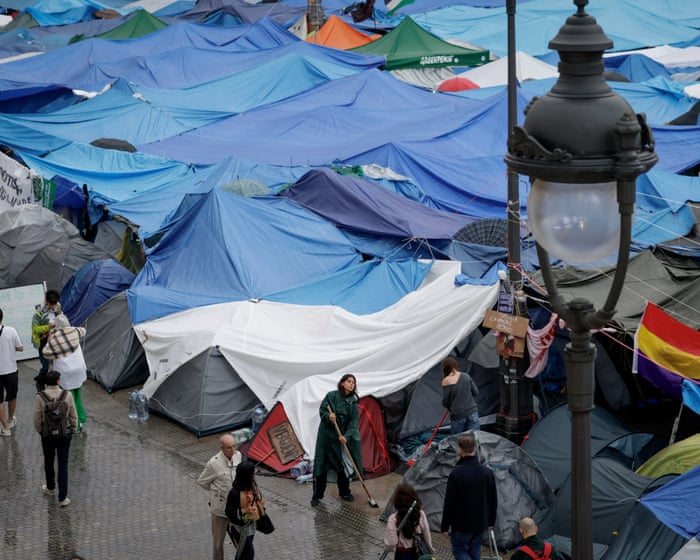
At a makeshift lunch counter tucked inside a maze of tents at a housing protest camp in Madrid, Sélpide San Luis pointed to the dizzying pace of change. “We built a city in a week,” said the 26-year-old, whose videos documenting daily life at the encampment have drawn tens of thousands of views on social media. She gestured toward the more than 1,200 tents set up in the central Puerta del Sol square. “We have urban planning, the streets have names, and we’ve set up surveillance systems. And thanks to what we’re doing here, the media haven’t stopped talking about housing—something we’ve been trying to get on the agenda for so long.”
This week marked another significant moment for the impromptu movement. After days of protests and encampments that have sprung up across the country following the eviction of 87-year-old Maricarmen Abascal from her home, Socialist prime minister Pedro Sánchez announced a snap general election in response to rightwing parties blocking emergency legislation to tackle the housing crisis.
Housing campaigners vowed to keep up the pressure. “The power of the people has ushered in a new era,” said Alicia del Río of the Madrid Tenants’ Union, as she floated plans for a general strike in November. “An election campaign is now beginning that will be deeply shaped by the housing issue. So we ask the members of parliament: are you going to introduce the measures that people are demanding—ones demanded by the majority of voters across all parties—or are you going to continue to be the lackeys of the rentier economy?”
The election, which did not have to be held until August 2027, is a high-stakes gamble for Sánchez. Polls suggest the most likely outcome will be a rightwing coalition between the People’s party and the far-right, anti-immigration Vox party.
But as anger seethes over rents that have surged 80% in a decade and housing costs that have risen by 63%, the protests also present Sánchez with an opportunity to keep his leftwing coalition in power. “Bringing forward the elections is risky. But there’s also a feeling of ‘now is the moment,'” said Antonio Prieto, 36, as he and other volunteers turned a steady stream of food donations into lunch for those at the Madrid camp. “If we had waited until 2027, the right and far right would have crushed us. And now, at least with this momentum, putting the focus on housing, we can have a tiny bit of hope.”
Prieto is among the many closely watching the parties to the left of the Socialists, hoping they will unite to form a broad front before the election. “I’m hopeful that what we’re doing has really got through, so that parties on the left realise that this is a big issue and they start working on real solutions,” he said.
The eviction of Abascal, a wheelchair user who was carried from the home she had lived in for more than seven decades on a stretcher, catapulted the long-simmering frustration over the deepening housing crisis into public view. It cast a spotlight on the intense competition for housing across Spain, one that pits local people against tourist lets, investment funds and short-term rentals.
As a wave of outrage swept the country, the investment firm that bought Abascal’s home said she could return home without paying the 230% rent hike it had reportedlyThey demanded change, and the protests and encampments have only grown stronger.
Skip past newsletter promotion
Sign up to This is Europe
Free weekly newsletter
The most pressing stories and debates for Europeans – from identity to economics to the environment
Enter your email
Sign up
After newsletter promotion
Prieto called the protests a “moral duty,” since the Spanish constitution guarantees everyone the right to “decent and adequate housing.” “What we’re seeing is a systematic violation of the constitution … So we have to be here,” he said.
The growing tent city has attracted visitors too – some to take photos, others to ask questions, and some to provoke. But the vast majority express support, said Juan Vázquez of the Housing Union of Carabanchel, a district in southern Madrid.
“People of all ages have stopped by to wish us strength, bring us water and food, and tell us to keep going,” he said.
View image in fullscreen
People hold a banner reading ‘end profiteering from housing’ at a protest in Barcelona. Photograph: Nacho Doce/Reuters
The challenge now is to turn this groundswell of support into concrete change. “On the one hand we have a right wing that pursues policies of misery and directly attacks the working class,” Vázquez said. “But on the other hand, Sánchez and his government have not gone after the profits that speculative landlords make from our misery.”
He described the coming weeks, as people across Spain prepare to vote, as crucial. “Basically, what we want is to channel all this energy so that it doesn’t just remain a footnote in a week-long encampment – to organise, apply pressure and secure our rights. We know that the organisation of the working class is the only means of looking after our interests.”
Jorge Rubio, 27, said the scale of the protests had hopefully made clear to everyone just what was at stake. “If you don’t vote, the impact could be huge. You could end up without a place to live,” he said, citing rooms for rent that had surged from €180 to €700 (£150 to £600) a month in six years. “It’s crazy. It’s not viable. We’re all affected by this,” he said.
He was among the many hoping the movement would go further. “Housing is not just a problem here, it’s a European problem. The revolution needs to reach them too.”
Frequently Asked Questions
Here is a list of FAQs about the housing activists in Madrid and Spains snap election
What is this Madrid encampment
It is a protest where housing activists set up tents in a central Madrid square to demand lower rents and better housing laws
Why are they protesting
They say housing has become too expensive Rents and home prices have risen much faster than wages pushing many people out of their neighborhoods
What is a snap election
It is an election called earlier than scheduled Spains prime minister called one for July 2023 after his party did poorly in local elections
Why do the activists care about the election
A new government could change housing laws The activists hope the election will force politicians to take housing seriously
What do the activists want
They want rent caps more public housing and protections for tenants facing eviction Some also want limits on tourist apartments
Why are their hopes cautious
They have seen promises before that were not kept They also know that no single election fixes everything quickly
Who are the main political parties involved
Spains main parties include the centerleft PSOE the conservative PP and the leftwing coalition Sumar The farright Vox also plays a role
What is a rent cap
It is a legal limit on how much a landlord can charge for rent Supporters say it keeps housing affordable Critics say it can reduce the number of rentals available
What is public housing
Homes built or bought by the government and rented or sold at belowmarket prices Spain has less public housing than many other European countries
Why is housing so expensive in Spain
Demand is high in cities like Madrid and Barcelona Tourism foreign buyers and low construction of new homes all play a part
What is gentrification
It is when wealthier people move into a poorer neighborhood raising prices and pushing out longtime residents Activists say this is happening in Madrid
What is a tourist apartment
A home rented shortterm to visitors often through apps like Airbnb Activists say these reduce the number of homes available for locals
How long has the encampment lasted
It began in May 2023 and continued for weeks It drew media attention and visits from some politicians
Did the encampment change anything
It