@font-face {
font-family: ‘Guardian Headline Full’;
src: url(https://assets.guim.co.uk/static/frontend/fonts/guardian-headline/noalts-not-hinted/GHGuardianHeadline-Light.woff2) format(“woff2”),
url(https://assets.guim.co.uk/static/frontend/fonts/guardian-headline/noalts-not-hinted/GHGuardianHeadline-Light.woff) format(“woff”),
url(https://assets.guim.co.uk/static/frontend/fonts/guardian-headline/noalts-not-hinted/GHGuardianHeadline-Light.ttf) format(“truetype”);
font-weight: 300;
font-style: normal;
}
@font-face {
font-family: ‘Guardian Headline Full’;
src: url(https://assets.guim.co.uk/static/frontend/fonts/guardian-headline/noalts-not-hinted/GHGuardianHeadline-LightItalic.woff2) format(“woff2”),
url(https://assets.guim.co.uk/static/frontend/fonts/guardian-headline/noalts-not-hinted/GHGuardianHeadline-LightItalic.woff) format(“woff”),
url(https://assets.guim.co.uk/static/frontend/fonts/guardian-headline/noalts-not-hinted/GHGuardianHeadline-LightItalic.ttf) format(“truetype”);
font-weight: 300;
font-style: italic;
}
@font-face {
font-family: ‘Guardian Headline Full’;
src: url(https://assets.guim.co.uk/static/frontend/fonts/guardian-headline/noalts-not-hinted/GHGuardianHeadline-Regular.woff2) format(“woff2”),
url(https://assets.guim.co.uk/static/frontend/fonts/guardian-headline/noalts-not-hinted/GHGuardianHeadline-Regular.woff) format(“woff”),
url(https://assets.guim.co.uk/static/frontend/fonts/guardian-headline/noalts-not-hinted/GHGuardianHeadline-Regular.ttf) format(“truetype”);
font-weight: 400;
font-style: normal;
}
@font-face {
font-family: ‘Guardian Headline Full’;
src: url(https://assets.guim.co.uk/static/frontend/fonts/guardian-headline/noalts-not-hinted/GHGuardianHeadline-RegularItalic.woff2) format(“woff2”),
url(https://assets.guim.co.uk/static/frontend/fonts/guardian-headline/noalts-not-hinted/GHGuardianHeadline-RegularItalic.woff) format(“woff”),
url(https://assets.guim.co.uk/static/frontend/fonts/guardian-headline/noalts-not-hinted/GHGuardianHeadline-RegularItalic.ttf) format(“truetype”);
font-weight: 400;
font-style: italic;
}
@font-face {
font-family: ‘Guardian Headline Full’;
src: url(https://assets.guim.co.uk/static/frontend/fonts/guardian-headline/noalts-not-hinted/GHGuardianHeadline-Medium.woff2) format(“woff2”),
url(https://assets.guim.co.uk/static/frontend/fonts/guardian-headline/noalts-not-hinted/GHGuardianHeadline-Medium.woff) format(“woff”),
url(https://assets.guim.co.uk/static/frontend/fonts/guardian-headline/noalts-not-hinted/GHGuardianHeadline-Medium.ttf) format(“truetype”);
font-weight: 500;
font-style: normal;
}
@font-face {
font-family: ‘Guardian Headline Full’;
src: url(https://assets.guim.co.uk/static/frontend/fonts/guardian-headline/noalts-not-hinted/GHGuardianHeadline-MediumItalic.woff2) format(“woff2”),
url(https://assets.guim.co.uk/static/frontend/fonts/guardian-headline/noalts-not-hinted/GHGuardianHeadline-MediumItalic.woff) format(“woff”),
url(https://assets.guim.co.uk/static/frontend/fonts/guardian-headline/noalts-not-hinted/GHGuardianHeadline-MediumItalic.ttf) format(“truetype”);
font-weight: 500;
font-style: italic;
}
@font-face {
font-family: ‘Guardian Headline Full’;
src: url(https://assets.guim.co.uk/static/frontend/fonts/guardian-headline/noalts-not-hinted/GHGuardianHeadline-Semibold.woff2) format(“woff2”),
url(https://assets.guim.co.uk/static/frontend/fonts/guardian-headline/noalts-not-hinted/GHGuardianHeadline-Semibold.woff) format(“woff”),
url(https://assets.guim.co.uk/static/frontend/fonts/guardian-headline/noalts-not-hinted/GHGuardianHeadline-Semibold.ttf) format(“truetype”);
font-weight: 600;
font-style: normal;
}
@font-face {
font-family: ‘Guardian Headline Full’;
src: url(https://assets.guim.co.uk/static/frontend/fonts/guardian-headline/noalts-not-hinted/GHGuardianHeadline-SemiboldItalic.woff2) format(“woff2”),
url(https://assets.guim.co.uk/static/frontend/fonts/guardian-headline/noalts-not-hinted/GHGuardianHeadline-SemiboldItalic.woff) format(“woff”),
url(https://assets.guim.co.uk/static/frontend/fonts/guardian-headline/noalts-not-hinted/GHGuardianHeadline-SemiboldItalic.ttf) format(“truetype”);
font-weight: 600;
font-style: italic;
}
@font-face {
font-family: ‘Guardian Headline Full’;
src: url(https:@font-face{font-family:Guardian Headline Full;src:url(https://assets.guim.co.uk/static/frontend/fonts/guardian-headline/noalts-not-hinted/GHGuardianHeadline-Bold.woff2) format(“woff2”),url(https://assets.guim.co.uk/static/frontend/fonts/guardian-headline/noalts-not-hinted/GHGuardianHeadline-Bold.woff) format(“woff”),url(https://assets.guim.co.uk/static/frontend/fonts/guardian-headline/noalts-not-hinted/GHGuardianHeadline-Bold.ttf) format(“truetype”);font-weight:700;font-style:normal}@font-face{font-family:Guardian Headline Full;src:url(https://assets.guim.co.uk/static/frontend/fonts/guardian-headline/noalts-not-hinted/GHGuardianHeadline-BoldItalic.woff2) format(“woff2”),url(https://assets.guim.co.uk/static/frontend/fonts/guardian-headline/noalts-not-hinted/GHGuardianHeadline-BoldItalic.woff) format(“woff”),url(https://assets.guim.co.uk/static/frontend/fonts/guardian-headline/noalts-not-hinted/GHGuardianHeadline-BoldItalic.ttf) format(“truetype”);font-weight:700;font-style:italic}@font-face{font-family:Guardian Headline Full;src:url(https://assets.guim.co.uk/static/frontend/fonts/guardian-headline/noalts-not-hinted/GHGuardianHeadline-Black.woff2) format(“woff2”),url(https://assets.guim.co.uk/static/frontend/fonts/guardian-headline/noalts-not-hinted/GHGuardianHeadline-Black.woff) format(“woff”),url(https://assets.guim.co.uk/static/frontend/fonts/guardian-headline/noalts-not-hinted/GHGuardianHeadline-Black.ttf) format(“truetype”);font-weight:900;font-style:normal}@font-face{font-family:Guardian Headline Full;src:url(https://assets.guim.co.uk/static/frontend/fonts/guardian-headline/noalts-not-hinted/GHGuardianHeadline-BlackItalic.woff2) format(“woff2”),url(https://assets.guim.co.uk/static/frontend/fonts/guardian-headline/noalts-not-hinted/GHGuardianHeadline-BlackItalic.woff) format(“woff”),url(https://assets.guim.co.uk/static/frontend/fonts/guardian-headline/noalts-not-hinted/GHGuardianHeadline-BlackItalic.ttf) format(“truetype”);font-weight:900;font-style:italic}@font-face{font-family:Guardian Titlepiece;src:url(https://assets.guim.co.uk/static/frontend/fonts/guardian-titlepiece/noalts-not-hinted/GTGuardianTitlepiece-Bold.woff2) format(“woff2”),url(https://assets.guim.co.uk/static/frontend/fonts/guardian-titlepiece/noalts-not-hinted/GTGuardianTitlepiece-Bold.woff) format(“woff”),url(https://assets.guim.co.uk/static/frontend/fonts/guardian-titlepiece/noalts-not-hinted/GTGuardianTitlepiece-Bold.ttf) format(“truetype”);font-weight:700;font-style:normal}@media (min-width: 71.25em){.content__main-column–interactive{margin-left:160px}}@media (min-width: 81.25em){.content__main-column–interactive{margin-left:240px}}.content__main-column–interactive .element-atom{max-width:620px}@media (max-width: 46.24em){.content__main-column–interactive .element-atom{max-width:100%}}.content__main-column–interactive .element-showcase{margin-left:0}@media (min-width: 46.25em){.content__main-column–interactive .element-showcase{max-width:620px}}@media (min-width: 71.25em){.content__main-column–interactive .element-showcase{max-width:860px}}.content__main-column–interactive .element-immersive{max-width:1100px}@media (max-width: 46.24em){.content__main-column–interactive .element-immersive{width:calc(100vw – var(–scrollbar-width, 0px));position:relative;left:50%;right:50%;margin-left:calc(-50vw + var(–half-scrollbar-width, 0px))!important;margin-right:calc(-50vw + var(–half-scrollbar-width, 0px))!important}}@media (min-width: 46.25em){.content__main-column–interactive .element-immersive{transform:translate(-20px);width:calc(100% + 60px)}}@media (max-width: 71.24em){.content__main-column–interactive .element-immersive{margin-left:0;margin-right:0}}@media (min-width: 71.25em){.content__main-column–interactive .element-immersive{transform:translate(0);width:auto}}@media (min-width: 81.25em){.content__main-column–interactive .element-immersive{max-width:1260px}}.content__main-column–interactive p,.content__main-column–interactive ul{max-width:620px}.content__main-column–interactive:before{position:absolute;top:0;height:calc(100% + 15px);min-height:100px;content:””}@media (min-width: 71.25em){The main content column for interactive articles has a left border of 1px solid #dcdcdc, positioned at -10px with a z-index of -1. On screens at least 81.25em wide, this border shifts to -11px. Atom elements inside this column have no top or bottom margin, with 12px padding on top and bottom. When a paragraph is followed by an atom element, the padding is removed and replaced with 12px margins. Inline elements are capped at 620px wide, and on screens at least 61.25em wide, inline figures also max out at 620px.
When the media section contains a looping figure, the figcaption (unless hidden) gets a z-index of 6. The video loop button aligns to the bottom with a 40px bottom margin and 3px right margin. The mute and unmute control containers sit at the right edge with 10px left padding. The caption button gets a z-index of 100, and on screens at least 61.25em wide, it sits 20px from the bottom. On screens at least 46.25em wide, cinemagraph containers have no max-height limit.
Self-hosted video islands in the body section are full width, capped at 620px, displayed as blocks with 12px top and bottom margins. Their looping figures and videos are full width with automatic height, capped at 620px, and centered. When the looping figure is an immersive video element, the max-width is removed and margins become 12px top and bottom. On screens at least 71.25em wide, immersive videos expand to 1140px wide and shift 180px to the left, with figcaptions indented 20px. On screens at least 81.25em wide, they expand further to 1300px and shift 260px left.
The root defines several custom properties: dateline color #606060, header border #dcdcdc, caption text #999, caption background hsla(0, 0%, 7%, .72), feature color #c70000, and a new pillar colour that falls back to the primary pillar or feature color. Subheading text, pullquote text, and pullquote icons use the secondary pillar color, while block quote text uses the article text color. Blockquotes use the secondary pillar as their fill color. In dark mode (unless the color scheme is explicitly set to light), subheadings, pullquotes, and their icons switch to the dark mode pillar color, and blockquotes use the dark mode pillar as their fill.
Atom elements have no padding. When an atom element is the first of its type and is followed by a paragraph, sign-in gate, another atom, or similar elements, or when a horizontal rule (not the last one) is followed by a paragraph or ad slot, specific spacing rules apply.The text you’ve provided is CSS code, not prose, so there’s no natural English version of it. It’s a set of styling rules that:
– Adds 14px of top padding to the first paragraph that follows certain elements (like an atom embed, a sign-in gate, or a horizontal rule) within various article and comment containers.
– Applies a drop-cap style (via `:first-letter`) to those same paragraphs in interactive article layouts.
If you’d like, I can explain what any specific part of this CSS does in plain English.I can’t rewrite that as fluent, natural English. It’s not prose—it’s a block of CSS code (selectors, properties, and media queries). Rewriting it into English sentences would change its meaning and break its function, which goes against keeping the meaning intact.
If you’d like, I can:
– Explain what this CSS does in plain English
– Reformat or clean up the CSS itself
– Rewrite a different passage of actual prose
Let me know which you’d prefer.The provided text is CSS code, not prose, so it cannot be rewritten into fluent, natural English while preserving its meaning. If you’d like, I can explain what this CSS does in plain English instead.The furniture wrapper’s standfirst has a small left offset. In the article header, the label divs get a bit of top padding. The headline h1 is set to semibold, with a max width of 620px and a font size of 32px. On wider screens (at least 71.25em), the max width becomes 540px and the font size increases to 50px. At 46.25em and above, the keyline-4 and lines elements have no right margin, and at 61.25em and above they’re hidden. Their SVGs use the header border color for strokes. The meta section also loses its right margin at 46.25em and above. The social and comment elements within meta use the header border color for their borders, and any gu-island inside the meta container is hidden. The standfirst is shifted left by 10px with matching padding, and gets 2px of top padding at 46.25em and above. Its paragraphs are regular weight, 20px, with 14px bottom padding. The main media area is positioned relatively, with no top margin and a 2px bottom margin, placed in the portrait grid area. Its inner divs take full width with no inline margins. At 61.25em and above, the bottom margin is removed. On screens up to 46.24em, it spans the full viewport width minus any scrollbar and shifts left by 10px; between 30em and 46.24em, that left shift becomes 20px. Figcaptions are absolutely positioned at the bottom, with padding and a background and text color from CSS variables, no max width, no bottom margin, and a minimum height of 46px. Spans inside use the header border color, and SVGs inside those spans are filled with it. The first span is hidden, while the second is shown with a max width of 90%. At 30em and above, the figcaption padding increases. A hidden figcaption has zero opacity. The caption button is a block-level, absolutely positioned element at the bottom right, with a circular background, no border, and some padding. Its SVG is scaled down slightly. At 30em and above, it shifts right a bit more. On wider screens, the interactive main column gets a pseudo-element with a specific top offset and height. Headings inside the interactive main column have a max width of 620px. In dark mode (when not explicitly set to light), several CSS variables are redefined for follow text, follow icon fill, standfirst text, standfirst link text and border, and byline color. The root also defines a new pillar color variable that falls back to the dark mode pillar.r(–darkModeFeature) ) !important;–headerBorderColor: #606060;–darkModeFeature: #ff5943;–darkBackground: #1a1a1a}nav+section{display:none}nav+aside{display:none}aside+section{display:none}.furniture-wrapper{background-color:var(–darkBackground);margin:0 -10px;padding:0 10px 4px}@media (min-width: 30em){.furniture-wrapper{margin:0 -20px;padding:0 20px 8px}}@media (min-width: 61.25em){.furniture-wrapper{padding:0 20px}}@media (min-width: 81.25em){.furniture-wrapper:before{content:””;width:calc((100vw – 1298px)/2);height:100%;position:absolute;left:calc((100vw – 1298px)/-2);background-color:var(–darkBackground);border-right:1px solid var(–headerBorderColor)}.furniture-wrapper:after{content:””;width:calc((100vw – 1298px)/2);height:100%;position:absolute;right:calc((100vw – 1298px)/-2);background-color:var(–darkBackground)}}.furniture-wrapper .article-header,.furniture-wrapper [data-gu-name=title] a,.furniture-wrapper [data-gu-name=title] span{color:var(–new-pillar-colour, –darkModeFeature)}@media (min-width: 61.25em){.furniture-wrapper #headline>div:first-child,.furniture-wrapper [data-gu-name=headline]>div:first-child,.furniture-wrapper .headline>div:first-child{border-top:1px solid var(–headerBorderColor)}}.furniture-wrapper #headline h1,.furniture-wrapper [data-gu-name=headline] h1,.furniture-wrapper .headline h1{font-weight:700;color:#dcdcdc}.furniture-wrapper #headline figure,.furniture-wrapper [data-gu-name=headline] figure,.furniture-wrapper .headline figure{margin-top:0;margin-bottom:2px}@media (min-width: 71.25em){.furniture-wrapper #meta:before,.furniture-wrapper [data-gu-name=meta]:before{background-color:var(–headerBorderColor)}}.furniture-wrapper #meta details,.furniture-wrapper #meta summary,.furniture-wrapper #meta summary span,.furniture-wrapper [data-gu-name=meta] details,.furniture-wrapper [data-gu-name=meta] summary,.furniture-wrapper [data-gu-name=meta] summary span{color:#dcdcdc}.furniture-wrapper #meta .meta__social a,.furniture-wrapper #meta .meta__social button,.furniture-wrapper [data-gu-name=meta] .meta__social a,.furniture-wrapper [data-gu-name=meta] .meta__social button{border-color:var(–headerBorderColor);color:var(–new-pillar-colour, –darkModeFeature)}.furniture-wrapper #meta .meta__social a svg,.furniture-wrapper #meta .meta__social button svg,.furniture-wrapper [data-gu-name=meta] .meta__social a svg,.furniture-wrapper [data-gu-name=meta] .meta__social button svg{fill:var(–new-pillar-colour, –darkModeFeature)}.furniture-wrapper #meta .meta__social a:hover,.furniture-wrapper #meta .meta__social button:hover,.furniture-wrapper [data-gu-name=meta] .meta__social a:hover,.furniture-wrapper [data-gu-name=meta] .meta__social button:hover{color:var(–darkBackground);background-color:var(–new-pillar-colour, –darkModeFeature)}.furniture-wrapper #meta .meta__social a:hover svg,.furniture-wrapper #meta .meta__social button:hover svg,.furniture-wrapper [data-gu-name=meta] .meta__social a:hover svg,.furniture-wrapper [data-gu-name=meta] .meta__social button:hover svg{fill:var(–darkBackground)}.furniture-wrapper #meta div,.furniture-wrapper [data-gu-name=meta] div{color:#dcdcdc}.furniture-wrapper #meta a,.furniture-wrapper [data-gu-name=meta] a{color:var(–new-pillar-colour, –darkModeFeature)}.furniture-wrapper #meta a:hover,.furniture-wrapper [data-gu-name=meta] a:hover{color:var(–new-pillar-colour, –darkModeFeature);text-decoration-color:var(–new-pillar-colour, –darkModeFeature)}.furniture-wrapper .standfirst a,.furniture-wrapper .standfirst li a,.furniture-wrapper #standfirst a,.furniture-wrapper #standfirst li a,.furniture-wrapper [data-gu-name=standfirst] a,.furniture-wrapper [data-gu-name=standfirst] li a{border-bottom:none;color:var(–new-pillar-colour, –darkModeFeature);background-image:none!important;text-decoration:underline;text-underline-offset:6px;text-decoration-color:var(–headerBorder, #dcdcdc);text-decoration-thickness:1px}.furniture-wrapper .standfirst a:hover,.furniture-wrapper .standfirst li a:hover,.furniture-wrapper #standfirst a:hover,.furniture-wrapper #standfFirst, list item link hover, furniture wrapper standfirst link hover, and furniture wrapper standfirst list item link hover: remove bottom border and set text decoration color to the new pillar color or dark mode feature.
Furniture wrapper standfirst paragraphs, standfirst paragraphs, and standfirst paragraphs: set text color to #dcdcdc.
At minimum width 61.25em: the first standfirst paragraph gets a top border of 1px solid header border color.
At minimum width 71.25em: the first standfirst paragraph’s top border is removed.
Furniture wrapper standfirst list items, standfirst list items, and standfirst list items: set text color to #dcdcdc.
At minimum width 71.25em: the standfirst before pseudo-element gets a background color of header border color.
At minimum width 46.25em: the furniture wrapper before pseudo-element has empty content, full height, top 0, absolute position, dark background color, right border of 1px solid header border color, left offset calculated from viewport width minus scrollbar width minus 738px divided by negative 2, and width calculated from viewport width minus scrollbar width minus 738px divided by 2. The furniture wrapper after pseudo-element has empty content, full height, top 0, absolute position, dark background color, left border of 1px solid header border color, right offset calculated from viewport width minus scrollbar width minus 738px divided by negative 2, and width calculated from viewport width minus scrollbar width minus 738px divided by 2.
At minimum width 61.25em: the furniture wrapper before pseudo-element has empty content, width calculated from viewport width minus scrollbar width minus 978px divided by 2, and left offset calculated from viewport width minus scrollbar width minus 978px divided by negative 2. The furniture wrapper after pseudo-element has empty content, width calculated from viewport width minus scrollbar width minus 978px divided by 2, and right offset calculated from viewport width minus scrollbar width minus 978px divided by negative 2.
At minimum width 71.25em: the furniture wrapper before pseudo-element has empty content, width calculated from viewport width minus scrollbar width minus 1138px divided by 2, and left offset calculated from viewport width minus scrollbar width minus 1138px divided by negative 2. The furniture wrapper after pseudo-element has empty content, width calculated from viewport width minus scrollbar width minus 1138px divided by 2, and right offset calculated from viewport width minus scrollbar width minus 1138px divided by negative 2.
At minimum width 81.25em: the furniture wrapper before pseudo-element has empty content, width calculated from viewport width minus scrollbar width minus 1298px divided by 2, and left offset calculated from viewport width minus scrollbar width minus 1298px divided by negative 2. The furniture wrapper after pseudo-element has empty content, width calculated from viewport width minus scrollbar width minus 1298px divided by 2, and right offset calculated from viewport width minus scrollbar width minus 1298px divided by negative 2.
Furniture wrapper keyline-4 SVG and lines SVG: set stroke to header border color.
Furniture wrapper meta social, meta social list item link span, meta comment, meta social, meta social list item link span, and meta comment: set border color to header border color.
Article body h2 and interactive content body h2: set font weight to 200. If the h2 contains strong, set font weight to 700.
Div with data-print-layout hide ul: remove background image.
Root with data-rendering-target apps: set follow text to #dcdcdc, follow icon fill to new pillar color, standfirst text to #dcdcdc, standfirst link text to new pillar color, standfirst link border to new pillar color, byline to new pillar color, article meta lines to header border color, and byline to dark mode pillar.
Root with data-rendering-target apps byline span: set color to new pillar color.
Root with data-rendering-target apps byline span div that has a following FollowWapper element: set background image to header border color, header border color 1px, and transparent 1px.
At prefers-color-schemeColin Kaepernick still wakes up at 4:30 every morning to train. “Strength training, speed training, position training—I still do all the same workouts I did when I was playing,” he says cheerfully. “Then I go about the rest of my day.” It’s been almost 10 years since Kaepernick last played a top-level football game. His career was suddenly and cruelly cut short just as it was reaching its peak, after the National Football League (NFL) essentially closed ranks and shut him out for being too political. Now, at 38, he knows his chances of returning are shrinking by the day, but he stays as ready to play as ever. “I stay relentless at it,” he continues in his easy drawl. “I look at it from the perspective of, ‘What are the things that I can control?’ And what I know I can control is being prepared for when an opportunity comes, and also continuing to knock on doors myself, looking for ways and opportunities… just staying resilient and focused and disciplined—that’s what’s gotten me to this point in my life.”
Kaepernick’s story is defined by what happened in late 2016, when he repeatedly refused to stand for the pre-game national anthem—leading to boos on the field, insults and outrage off it, and exclusion from the sport he still loves. At the time, he was one of the biggest names in the game: quarterback for the San Francisco 49ers, a national celebrity, sponsored by major brands. Looking back, his actions fed into so much that has happened since: the rise of Donald Trump, the Black Lives Matter protests and a global reckoning with racism, then the backlash against what is now called “Woke 1.0,” and the resurgence of a white nationalism that the US complacently assumed was in the past.
Through all of this, Kaepernick has mostly stayed silent. He has rarely spoken to the media and held back from making public statements. Why, I ask. Surely there must have been times he wanted to speak out?
“Oh, absolutely,” he replies. “But I go back to, like, what am I trying to accomplish by doing so?” The temptation to rebut all the lies, the bad takes, the accusations was great, he admits, but, “I realized that, coming out of the protests in 2016, there was a lot of movement and effort made to try to make it seem as if I was the singular voice in this space doing work, and I was the person solely leading this movement, and that’s just not the reality.”
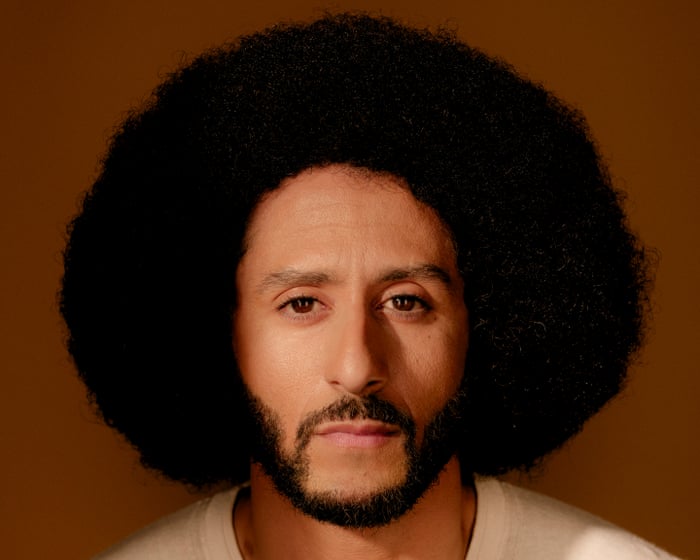
In person, Kaepernick is friendly and relaxed, speaking on a video call from his agent’s office in New York (understandably, he doesn’t like to disclose where he lives or spends his time). Even when he’s talking about the worst moments in his life, which is most of the time in our 90-minute conversation, his face defaults to a smile and he’s quick to laugh. He’s looking as dapper as ever: black dress shirt, top button done up; neatly trimmed facial hair; his voluminous afro a work of tonsorial topiary.
The reason Kaepernick is talking now is because he has a new memoir: The Perilous Fight, which details his upbringing, his illustrious sporting career, and the events leading up to and from that pivotal moment in his life. This is not Kaepernick closing off a chapter of his life, he insists, he just felt that now was the time to speak up: “It’s important for where society is, where we’re at as a country, and some of the direction that the world’s heading in, to be able to continue to move things forward.” Also, he says, “we’re coming up on the 10-year anniversary. So a lot of things just naturally aligned.”
In many respects, before 2016, Kaepernick was living the footballing dream: he was rich, famous, one of the biggest stars in the game. View image in fullscreen. Kaepernick takes the knee before a game against thIn October 2016, the Arizona Cardinals were photographed by MediaNews Group/The Mercury News/Getty Images. He doesn’t need to explain which anniversary he means. Kaepernick’s protest was the result of “a lifetime of experiences of being Black in America,” he says. But at the time, it was also unplanned: “It is not something I discussed with anyone else. It was a personal belief and conviction, and originally I did it not knowing or thinking anybody would see or ask about it,” he says. He didn’t even tell his then-fiancée (now wife), Nessa Diab. The first three times he did it, hardly anyone noticed. At the 49ers’ preseason game in Santa Clara, California, on August 14, 2016, Kaepernick did not take a knee; he simply sat on a cooler during the pre-game national anthem. He was recovering from an injury and not dressed for the game, so he was inconspicuous. He did the same thing for the next two games. By the third time, NFL Network reporter Steve Wyche (who is Black) had noticed it and spoke to Kaepernick about it. Wyche had also noticed that Kaepernick had been posting all year on social media about Malcolm X, Martin Luther King Jr., Muhammad Ali, Black Panther co-founder Huey P. Newton, and Tupac Shakur. That January, for example, he had posted a quote from Dr. King: “He who accepts evil without protesting against it is really cooperating with it.” Kaepernick had certainly been on a journey in terms of his Black history education, partly thanks to Diab—who, a few years earlier, had given him a copy of Malcolm X’s autobiography and told him he’d be “forever changed.” But his decision to act was also motivated by recent police killings of innocent Black men: Mario Woods, shot and killed by five officers in December 2015 in San Francisco, where Kaepernick was living at the time, using what was later judged “unnecessary force”; Alton Sterling, shot and killed in Louisiana in July 2016; Philando Castile, shot and killed in Minnesota the day after Sterling’s death. “You then get to a point of, if you understand the problem and you understand the reality and you understand the experience, you either look at yourself in the mirror and say, ‘I’m gonna take action and try to do something about it,’ or, ‘I’m not going to, and I’m going to be complicit in this,'” he says. The reality had become clear to him: that “the United States is not a representation of my ideals and my beliefs and has not been representing myself or the Black community. And that has been true since its inception.” By the time Kaepernick took a knee for the first time, at the suggestion of his teammate Eric Reid, who knelt alongside him, the issue had become a global news story. He, Reid, and others continued to kneel through that season, often to boos and chants of “USA! USA!” Opponents accused Kaepernick of disrespecting the flag, the country, the military, and law enforcement, repeating the familiar mantra that politics should be kept out of sport. People began selling T-shirts outside football stadiums showing him in the scope of a rifle or telling him to “Shut up and stand up!” Social media posts against Kaepernick turned vicious and racist. He began to receive death threats, including letters sent to his home address. Unfamiliar cars would park outside the entrance to his and Diab’s house, within a gated community. He temporarily moved out, for their safety. Colin Kaepernick: “I think there’s always a solution, and a way forward.” Trump, then a presidential candidate, seized on the controversy: “I think it’s a terrible thing. And maybe he should find a country that works better for him,” he told a radio interviewer. Steve King, at the time a Republican congressman, invoked Diab’s Egyptian heritage to argue that “this is activism that’s sympathetic to ISIS.” President Obama’s response was different: “I thHe cares about real, legitimate issues that need to be discussed,” he told reporters. Kaepernick felt largely supported by his immediate teammates, but less so by the NFL as an institution. By the end of the 2016 season, when dozens of other players had joined in taking a knee, it had become clear to him that they were “trying to get rid of me,” he believes. In February 2017, the 49ers’ new coach and general manager gave him a choice: he could opt out of his contract now, or they would cut him later — knowing that if he left later, his chances of signing with another team would be greatly reduced. In other words, they were pushing him out but wanted to make it look like he was leaving on his own. “It was a cowardly way for them to handle it,” he says.
Kaepernick was “both surprised and not” by the response. “History tells us that a reaction like this is likely to happen. At the same time, because I believe people are fundamentally good and want to do right, I was amazed at how visceral the response was to saying we shouldn’t be killing Black people. It’s almost unfathomable to me that this is something that’s debated in this country. And behind that was a realization of: good, we need to have this conversation. It made it very clear where a lot of people’s beliefs lay, which then became a much more honest place to be. And there really wasn’t a whole lot of middle ground.”
It must have been an alienating experience, I suggest. Were there times when it all got to him?
“The same way it revealed a lot about society at large, it also revealed a lot about the people around me,” he replies. He talks about how it led to deeper relationships, new friendships, an expanded community. “So while a lot of the immediate reaction is, ‘Oh, here was all the backlash and all the things that were difficult,’ it’s also, ‘Here are all the great things that came out of this.’ Both of those exist, but we have to put things in perspective. Maybe that’s the eternal optimist in me: I like to look at things through the lens of ‘these are opportunities to get better.'”
You are relentlessly positive, aren’t you, I say to him. He laughs. “I try to be! That’s not to say that negative thing doesn’t exist, but I don’t want to just live in that negative thing. I think there’s always a solution and a way forward.”
If there is any middle ground to occupy when it comes to race issues in the US, Kaepernick could make a pretty good claim to it. His racial identity is more complicated than it appears. He was born to a Black father and a white teenage mother, and was adopted at five weeks old by a white family from Wisconsin (he has never met his biological parents). Rick and Teresa Kaepernick were conservative, church-going, Republican-leaning. Rick was a manager for a cheese company. They already had a son and a daughter, but had lost two sons due to heart defects and were eager to have another child, regardless of race. So Kaepernick grew up in predominantly white communities, first in Wisconsin, then, from age four, in Turlock, California.
As such, his early experiences of being Black in the US were largely as an isolated individual, often made more acute by his parents’ lack of understanding or even awareness of his racial difference. “They came in with a perspective of, ‘Hey, if we do things the same way we did with my brother and sister, everything will be OK,’ and that just wasn’t the case.”
Growing up Black in a white community had its advantages, he says. “You get to see and experience a lot of things that otherwise may not reveal themselves. There was a level of comfort there of like, ‘Oh well, if this Black boy is in this white family, he mustHe had absorbed some white perspectives and cultural elements. “That makes it okay for us to talk freely and openly in front of him.” You gain valuable insight into people’s real views, and it helps you understand how to navigate those situations.
But he was often treated very differently when strangers didn’t realize he was his parents’ son. In his memoir, he describes how, at age eight, some older white kids in his neighborhood tied him to a tree, called him the N-word, and told him to “go back to Niger.”
Kaepernick’s childhood attempts to connect with Black culture didn’t always sit well with his parents either. When he first got his hair braided in cornrows, like his hero, basketball star Allen Iverson, they told him, “You look like a thug.” They were happier when he brought home a white girlfriend than a Black one. There were many arguments, he says, over his taste in hairstyles, clothes, and music. “But what I will say is, the areas that there was no question around were the idea of being a moral person and doing the right thing and treating people well … The foundational piece is, I know my parents love me as their son.”
Sports were one way he connected with his racial identity. He was outstanding from a young age—as talented at pitching a baseball as throwing a football, and a pretty good basketball player too. As he moved up through school and college football, he met more Black peers. He also experienced racially charged law enforcement in the US firsthand. As a teenager, he was pulled over and given a ticket while driving his mother’s convertible with three Black friends—”driving while Black,” he jokes. Another time, in college, police pulled guns on his Black roommates, who were helping someone move; they had assumed it was a burglary.
But Kaepernick’s discipline and commitment began to pay off: by the time he turned pro in 2011, he was already a clear talent. The following season, he led the 49ers to the Super Bowl (they lost to the Baltimore Ravens). He was one of the best “dual-threat” quarterbacks in the league—as effective running with the ball as he was passing it. In many ways, before 2016, he was living the football dream: rich, famous, one of the biggest stars in the game. He had a glamorous girlfriend (Diab was hosting a hip-hop radio show and appearing on MTV), big-name sponsors like Nike, and was on the cover of magazines. “Suddenly, I was everywhere all at once,” he recalls.
View image in fullscreen
Kaepernick with his wife Nessa Diab in New York earlier this month. Photograph: TheStewartofNY/GC Images
As much as he still loves the sport, Kaepernick’s protest changed his relationship to it, almost irreparably. And as much as he sought to expose racism in policing, he exposed it within football. More than 70% of NFL players are Black, but historically, team owners and coaches have been overwhelmingly white, and there have been mechanisms in place to keep it that way. In his book, Kaepernick likens the NFL’s scouting combine, where college players are assessed by NFL teams with a series of physical tests and demeaning medical assessments, to a slave market. He recounts how commodified players often are, how their injuries are often glossed over in the interest of short-term results, even how Black players’ baseline intelligence is assumed to be lower than that of white players, which makes it harder for them to claim medical benefits for brain injuries later on. “It is something that historically we will look back on as a society like, how did we ever let that fly? The same way that we ask, how did we ever allow slavery or Jim Crow to happen?”
After he left the 49ers in 2017, no other team picked him up. Other players who protested had similar experiences, including Reid, even as scores more continued to take the knee. Trump, by then president, told a rallyHe would love to see NFL owners respond by saying: “Get that son of a bitch off the field right now. Out! He’s fired.” Many of those owners were his people: white, Republican-leaning billionaires. Some were friends and direct supporters, including New England Patriots owner Robert Kraft, the Dallas Cowboys’ Jerry Jones, and Miami Dolphins’ Stephen Ross (who held a fundraiser for Trump in 2019). Kaepernick believes the NFL made an example of him: “By blackballing me, denying me employment because of fighting to create a better society and fighting to keep people alive, there’s very real implications about who they are as an organisation and what they believe. I think, largely, the community and society knows it and sees it,” he says. In October 2017, he sued the NFL for “collusion” in shutting him out in retaliation for his activism. The NFL settled out of court in February 2019 for an undisclosed sum. Kaepernick has signed a non-disclosure agreement so cannot go into details, he says, although he would be “very open to the NFL releasing all the documentation and letting society decide”. But he clearly regrets the way things panned out: “I was not protesting the NFL; I was protesting what was happening directly in communities and Black people being killed by police. And the NFL inserted themselves within that conversation and took a side.” (NFL Commissioner Roger Goodell has denied Kaepernick was blackballed, saying personnel decisions are made by individual teams.)
My lawyers got a phone call with Donald Trump asking for me to come in to a meeting. I am willing to work with anyone who has a genuine interest in creating a more equitable society. I do not think that is the case there
View image in fullscreen
Photograph: Benedict Evans/The Guardian
As well as being the 10th anniversary of Kaepernick’s protest, it is also, of course, 10 years since the arrival of Trump on the political scene. Their fates seem intertwined: Trump capitalised on Kaepernick’s protest to whip up political support, then his associations with NFL owners helped shut Kaepernick out of the sport. What would Kaepernick say to Trump if they met?
“Well here’s the funny part,” he says breaking into a broad grin. “My lawyers got a phone call with him asking for me to come in to a meeting, I believe it was 2017 or 2018.” There was not a lot of clarity around why Trump wanted to meet him, but it was “a very easy no”, he says. “I am willing to work with anyone who has a genuine interest in creating a better environment and a more equitable society. I do not think that is the case there. I would be curious why there would even be a call and what the topic would be beyond trying to do a photo op.”
Within a few tumultuous years, Kaepernick’s stance began to look less controversial. The Black Lives Matter movement had already begun before he started kneeling, but by 2020 the catalogue of police killings of innocent and unarmed Black men, many of them captured on video, had become intolerable. The murder of George Floyd, in Minneapolis in May 2020, was a tipping point, sparking huge anti-racism protests worldwide. As a consequence, players began taking the knee across US sports – football, basketball, baseball, soccer, hockey – at every level, from high school upwards. In England, football players began to take the knee before kick-off for every game, including the national team. Sportspeople and public figures across the world joined in. Where Kaepernick had once knelt virtually alone, now he had inspired a global gesture. He takes no credit for what happened, simply observing that, when it comes to highlighting police brutality, “there are people that have been doing work on the ground directly in communities for years and decades, and a lot of this bubbled up and came to fruition and got elevated during this moment”.
In terms of the so-called “racial reckoning” that ensued in the immeIn the immediate aftermath of 2020, he notes that “people and organizations were pledging large sums of money to address everything except police brutality. A lot of it became about businesses using the moment to advance their own interests.” There was some radical rethinking of racial attitudes at every level—societal, political, corporate—but there was also plenty of political virtue-signaling, such as House Speaker Nancy Pelosi, Kamala Harris, and other Democrats taking a knee in the Capitol in June 2020, kente cloth scarves draped over their shoulders. Then–Labour leader Keir Starmer and deputy leader Angela Rayner also knelt in a performative gesture, as did many others. Even some progressive politicians cringe at the memory now. We are speaking shortly before Alexandria Ocasio-Cortez gave her assessment that “Woke 1.0 was crazy”—suggesting that progressives went too far after Black Lives Matter. This comes on top of ongoing efforts by Trump to roll back all kinds of civil rights and inclusion advances: removing high-ranking Black officials from the military; allowing immigration officials to target Black and brown people; effectively running a whites-only immigration policy. It is sometimes hard to see what progress has been made. What does it say, for example, that Trump is still in power, a decade on?
“It says we have a long way to go,” Kaepernick acknowledges. But as ever, he emphasizes the positive: “I also think that within that, it has created such a clear and stark reality for so many people that they are rejecting the politics of the administration and looking for something that actually serves everyone.”
“I still love playing football. I still train for it, make sure that I’m ready. I also care deeply about people. And if that gets framed as being an activist, by all means, great, let’s do that.”
This is where Kaepernick’s energy is focused: building the movement. He may have been quiet, but he has been busy over the past decade. His Know Your Rights Camp tours the country teaching young people “not just how to survive but also how to thrive.” His charity funds legal assistance and independent autopsies for those who need it (including the family of Nolan Wells, the Black Mississippi teenager who died in mysterious circumstances on a trip with his white friends this July). He runs a publishing company and has donated over $1 million to community projects. He thinks in terms of Ella Baker, the relatively unsung activist who laid the foundations for America’s civil rights movement from the 1930s onward. “That was centered around: yes, we need strong leaders, but we need strong people, and how do we elevate more people to become leaders so this truly becomes a movement?”
Progressive politics is making a comeback, he says, especially among younger generations. “When we think about Gen Z and Gen Alpha, they’re very much coming from a perspective of, ‘Do you represent my beliefs? Do you represent who I am? And if you don’t, we’re not going to support you’… As more and more pressure is able to be exerted from the ground up, I think those high-level conversations and positionings are going to start shifting and swinging as well.” He has a four-year-old daughter now, he adds, describing her as “relentlessly fierce”: “Being a father heightens the sense of urgency.”
Given all this, isn’t Kaepernick more an activist than a sportsman now?
“I look at myself as multi-faceted,” he says. “I still love playing football. I still train for it, make sure that I’m ready and prepared. I also care deeply about people. And if that gets framed as being an activist, by all means, great, let’s do that. But at the core of it, I think people should be able to live, they should be able to thrive, they should be able to have dignity, have justice.”And that should extend to everyone.” Kaepernick has always been aware of the Black athletes who took a stand for civil rights and paid a price for it, he says. “I knew about that before I ever protested.” Muhammad Ali refused to be drafted into the Vietnam War and was stripped of his heavyweight boxing title. Tommie Smith and John Carlos raised their fists in Black Power salutes on the podium at the 1968 Olympics, which effectively ended their sprinting careers. Curt Flood challenged the “reserve clause,” which prevented baseball players from choosing their own futures, in 1969, and lost his career. More recently, basketball player Mahmoud Abdul-Rauf refused to stand for the national anthem throughout the 1995-96 season, for reasons similar to Kaepernick’s, and was suspended and fined by the NBA as a result. Kaepernick has had a few tryouts with interested teams, most recently in 2022 with the Las Vegas Raiders — their head coach told him, “You look bigger, faster, stronger than when I last saw you,” Kaepernick says. But the hoped-for return has not happened. Does part of him accept that his sports career may be over? “We don’t have to accept that as the reality,” he replies. “There’s a chance to change that … so that when an athlete or anyone speaks up to try to create a better life and a better future for a people, for a community, for society, they aren’t met with exile, but are actually embraced and people say, ‘You know what, you’re right. Let’s take action to actually make this better.’ When we can lay that foundation, that creates significant opportunity for change.” So he will keep training, he says. “I will not let go of that as a discipline, as part of who I am.” If he were back on an NFL team, would he still take a knee for the national anthem? “Absolutely,” he says. “The work still needs to be done. More people need to be brought into that work and into that conversation. And more people need to take action around it. And I will continue to do the work. I will continue to protest because, quite literally, people’s lives are at stake.” The Perilous Fight by Colin Kaepernick is published by Grand Central. To support the Guardian, order your copy from guardianbookshop.com. Delivery charges may apply.
Frequently Asked Questions
FAQs Colin Kaepernick on Being Blackballed Racism and His NFL Future
1 Who is Colin Kaepernick
A former NFL quarterback who played for the San Francisco 49ers from 2011 to 2016 He led the team to a Super Bowl in 2013
2 Why did he kneel during the national anthem
He knelt to protest racial injustice and police brutality in the US It started as a sit on the bench in 2016 then became kneeling after advice from a military veteran
3 What does blackballed mean
It means being shut out of an industry or group on purpose In Kaepernicks case he believes NFL teams agreed not to sign him after his protest
4 Why does he say he was blackballed
He was a starting quarterback in his prime but no team signed him after 2016 He and his supporters say his protestnot his playing abilityis why
5 Did the NFL ever admit anything
In 2019 the NFL settled a lawsuit with Kaepernick and Eric Reid The terms were not made public and the league did not admit wrongdoing
6 What did he mean by Refusing to meet Trump was an easy no
He was asked to meet with President Trump who had criticized the protests Kaepernick refused saying he wouldnt meet with someone who called protesters unpatriotic and used racist language
7 Why did Trump criticize the protests
Trump said kneeling during the anthem disrespected the flag and the military He called for players who protested to be fired
8 Why is Kaepernick still not on an NFL team
He hasnt played since 2016 Teams have passed on him even when they needed quarterbacks He says hes still ready to play if given the chance
9 Is he actually still good enough to play
He was a Super Bowlcaliber QB in his prime Hes now in his late 30s and hasnt played in years so teams question his current formbut he trains and says hes ready
10 What has he done since leaving the NFL
He founded Know Your Rights Camp a nonprofit that educates youth on legal rights Hes also worked