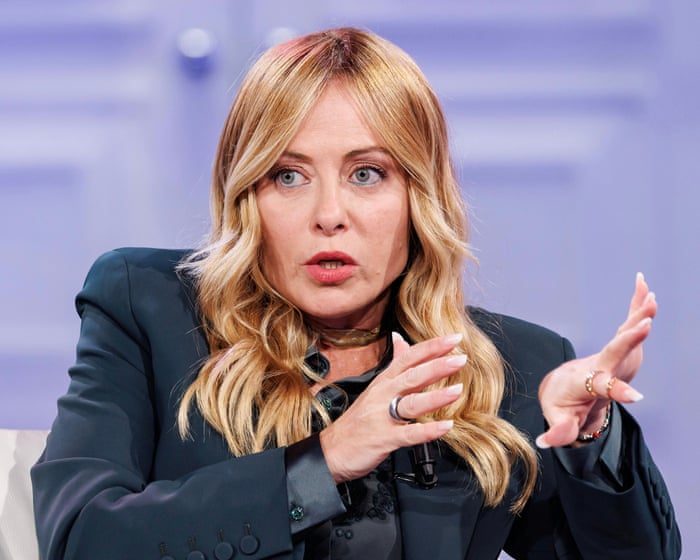
The Italian government has been accused of increasing divisive rhetoric to win over far-right voters before next year’s general election. This comes after it passed a decree to limit the number of newly arrived migrants in classrooms and ban the burqa and niqab in schools. Prime Minister Giorgia Meloni, who leads the far-right Brothers of Italy party, said her government had approved what she called “commonsense measures that do not divide but genuinely help to integrate.” On social media, she said the measures included: “A limit of 30% in classrooms for students who do not adequately know Italian, plus tools to learn our language and a halt to burqas and niqabs in school.” The announcement was a softer version of comments she made earlier in the week at an event organized by Brothers of Italy’s youth division. “It cannot be that in the classroom it is Italian children who feel left out because they’ve become the minority,” Meloni said, promising to “legally set the number of foreign students per class.” Thursday’s decree also states that if students have ongoing integration problems or struggle to learn the language, their parents will be referred to social services and must take free literacy and Italian language classes. If parents fail to comply, they could face fines of up to €1,000. Education Minister Giuseppe Valditara said the measures, set to take effect in the 2027-28 school year, would affect about 1,000 classrooms, or about 0.3% of the total nationwide. Rights campaigners quickly linked the measures to next year’s election, in which Meloni’s premiership is facing an unexpected challenger on the right. “She’s creating an emergency that is not a real emergency at all,” said Daniela Ionita of the campaign group Italians Without Citizenship, pointing out that an estimated 60% of pupils who could be described as foreign were born in Italy but face many hurdles when it comes to accessing citizenship. “Because there are now new parties pushing from the right, I think Meloni is scared,” she said. View image in fullscreenJannatur Nayeem, 33, an Italian citizen of Bangladeshi origin, chats with other mothers as they wait for a sports session to end at a school in Rome on Thursday. Photograph: Alessandra Tarantino/AP The government said students born and raised in Italy or who had attended at least two years of nursery school or completed three years of schooling in Italy would be exempt from the measures. Ionita said the increased rhetoric was an attempt by the government to hide how little it had accomplished while in power. “If you remove every decree linked to security or to migrants, the government’s political and economic program will fall apart, and very little concrete remains of one of the longest-serving governments of the last years in Italy,” she said. Marco Tarchi, a political scientist who focuses on the extreme right and teaches at the University of Florence, said the measures were “undoubtedly” driven by fears of a new political challenge on the right. Since February, a new party, Futuro Nazionale (FN), has energized the extreme right, with polls suggesting it could capture about 8% of the vote in an election expected as early as spring 2027. Led by Roberto Vannacci, a former army general best known for self-publishing a book full of racism, homophobia, Islamophobia and antisemitism, the party’s popularity in polls has surpassed that of Brothers of Italy’s two coalition partners, the League and the conservative Forza Italia. View image in fullscreenRoberto Vannacci’s party Futuro Nazionale has energized the extreme right. Photograph: Remo Casilli/Reuters Those who have shifted allegiances include some who had enthusiastically supported Meloni years ago as she spoke of “ethnic substitution” and vowed to install an all-out naval blockade to prevent migrant arrivals.Tarchi said: “Many of the FN’s potential voters are former supporters of Giorgia Meloni’s party who are disappointed that, once in power, she softened many of her previous stances regarding the European Union, which she had harshly criticised; immigration, on which she had made radical proposals that were later abandoned; and other issues.” He said Vannacci had capitalised on this, capturing voters with an extreme manifesto that promised “remigration” and limits on the number of foreigners in the country, as well as curtailing LGBTQ+ rights and negating the right to abortion. He said that in order to win back this support, Meloni may have to adopt positions closer to those she held in opposition.
A glimpse of what this could look like came this summer when Meloni seized on the sudden entry of tens of thousands of people into the tiny Spanish territory of Ceuta in north Africa, said Elisa De Pieri, a researcher at Amnesty International. “Meloni immediately exploited the situation in Ceuta, which had absolutely nothing to do with Italy and nothing to do with the Schengen space, but she made it into a supposed crisis for Italy,” she said. “And so that’s the mode that I think we’re going to see in the next months.”
De Pieri predicted that Meloni “won’t be talking too much” about Italy’s offshore detention agreement with Albania on the grounds that it had not been as successful as she would have hoped. “It’s been very costly, and it’s been struck down repeatedly by national and international courts,” she said.
A reception camp for migrants transferred from Italy in Gjader, Albania, in 2024. Photograph: Florion Goga/Reuters
Instead, she expects Meloni will adopt a more aggressive tone on migration more generally, leading to a polarising electoral campaign that would have a disproportionate impact on migrant communities.
The view was echoed by critics of the new measures who pointed out the rarity of burqas or niqabs in Italian classrooms and said the government was simply repackaging previous, unenforced policies, given that the 30% threshold was previously floated by the education ministry in 2010. Save the Children said the overall impact would be to “create ‘first-class’ and ‘second-class’ students”.
The leader of the Democratic party, Elly Schlein, described the decree as “shameful” and accused the government of “living on a different planet”. She said Italian parents were grappling with a very different set of issues, citing crumbling school buildings, the high costs of textbooks and low teacher salaries. “Faced with all this, the government’s response is to kick foreign children out of the classroom,” Schlein said. “Who do they think they’re kidding? After four years of cuts and no serious investment in school buildings, they’re inventing a witch-hunt that targets the youngest children.”
Frequently Asked Questions
FAQs Meloni Accused of Running Scared Over Limits on Foreign Children in Classrooms
Beginner Questions
What is this controversy about
Italys government led by Prime Minister Giorgia Meloni introduced rules limiting the number of foreignorigin students in classrooms Critics say shes avoiding integration instead of fixing it
What exactly did the government propose
A cap on students without Italian citizenshipreportedly around 2030 per classespecially in schools with large migrant populations
Who is Giorgia Meloni
Shes the Prime Minister of Italy and leader of the rightwing Brothers of Italy party known for hardline immigration policies
Why are people saying shes running scared
Critics argue the cap lets her avoid the harder work of integrating migrant children and that its a political move to please antiimmigration voters
Who opposes these limits
Teachers unions education experts human rights groups the political opposition and even some Catholic organizations
What do supporters say
They claim too many nonItalian speakers in one class slows everyone down and makes it harder for teachers to help migrant kids learn Italian
Intermediate Questions
Is the cap actually law yet
It has been proposed and debated but implementation has faced pushback and legal questions so its status keeps shifting
Does the cap apply to all foreign children
No Reports suggest it targets students who recently arrived and lack Italian language skills not all noncitizens
How many foreign students are in Italian schools
Roughly 1011 of students nationwide but in some schoolsespecially in cities like Milan Rome and Pratothe share is much higher
Whats the main criticism from educators
That separating or capping kids by nationality harms integration fuels segregation and doesnt address the real problem not enough language support
How does this compare to other countries
Some countries have languagebased placement but caps by nationality are rare and often criticized by EU bodies
What do opponents say Meloni should do instead
Invest in Italianlanguage programs hire more support teachers and fund integration projects rather than limiting enrollment
Advanced Questions
Whats the legal problem with the cap
It may conflict with Italys constitution EU antidiscrimination rules and the UN Convention on the Rights of