There’s probably a Swedish word for what Dirty Dancing makes me feel. A kind of turbo-nostalgia that mixes comfort, joy, and a sense of continuity with a longing so sharp I can feel it in my ribs.
I must have been about 12 when I first watched Baby (Jennifer Grey) and Johnny (Patrick Swayze) fall in love while grinding against each other as dance partners (before Strictly Come Dancing, this storyline felt more unexpected).
The movie must have seemed quite racy to me then. Light on actual sex, but heavy on petting during long scenes of hot, fully-clothed couples grinding to a soundtrack of genuinely incredible music. Catnip, then, for curious tweenage girls.
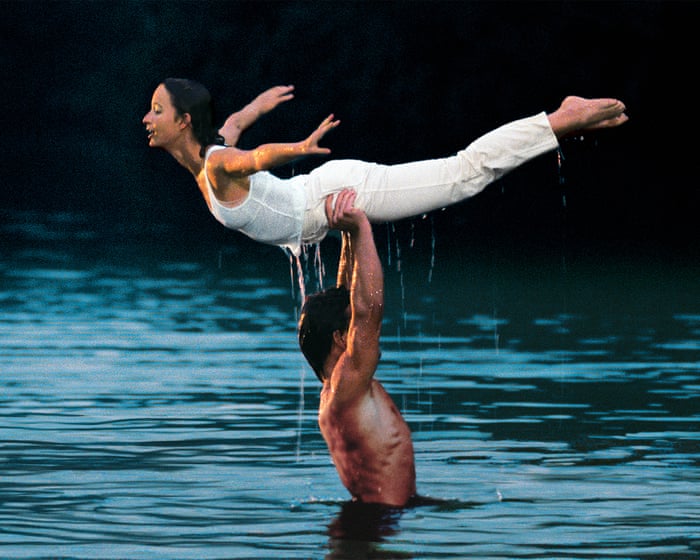
For several years, Dirty Dancing was the background to every sleepover I went to. Its catchphrases were social currency at my girls’ school. Shouting “I carried a watermelon,” or “nobody puts Baby in the corner!” across a crowded classroom signaled a sophisticated understanding of the Year 7 zeitgeist. And, of course, we all tried to do the lift. So many memories of uniformed girls landing on top of other uniformed girls at break time; so many scraped knees and elbows.
Its soundtrack was everywhere at school discos. There were so many bangers, like The Ronettes’ Be My Baby, though there was also (I’ve Had) The Time of My Life, which still triggers Pavlovian terror in my heart. Those opening lines mean: it’s slow dance time, time to hide in the loo! Because the fear of not being picked by a boy – of being publicly stranded – was just too much to bear. We were that uncool. Which was why we loved Dirty Dancing, because its protagonist, named Baby – not so subtly for a coming-of-age tale – was a dweeb at first too.
When Baby arrives at Kellerman’s, a stale Catskills resort, in the summer of 1963, she is childlike and awkward, prone to saying embarrassing things. She longs to be part of the world she discovers in the camp’s staff quarters. There, badass dance instructors gyrate to songs like Do You Love Me by The Contours behind closed doors. Her dull vacation takes a turn when Johnny – the biggest badass of all, all biceps, dark glasses, and oscillating pelvis – happens to urgently need a partner for an important performance. Montages, and romance, follow.
So much has changed since I learned this movie by heart – for me and for the world – that when I watch it I almost can’t believe it still exists, preserved exactly as it was, looking and sounding somewhat out of time, like a dream, with its 1980s-meets-1960s soundtrack, its pastel palette, and its costume design, blending 1980s perms and leotards with cat’s eye glasses and A-line frocks.
There is a mournful quality to the aesthetic as a whole, which is heavy on mist and rain, on chirping crickets and colored lanterns reflecting on the lake. Much of the soundtrack is mournful too, particularly the song She’s Like the Wind, sung by Swayze – watching it now, knowing that he died at just 57, is additionally tragic.
The dancing style, which Johnny at one point calls “soul dancing,” is clearly inspired by Black culture, but there are few Black characters, and none in starring roles. Meanwhile, the age of the characters (if not the actors, who were 26 and 34) is awkward. Baby is 17, Johnny 24, and he feels a great deal more grown up than her as the movie opens. Meanwhile, Johnny is working class, Baby is upper middle class, which plays into certain class tropes when, at the end, he says that she has “taught me about the kind of person I wanna be.”
I don’t remember noticing any of that as a child, but I do think something else struck me – even if it was subconscious. That’s how unusual it was to see a movie in which the male character, Johnny, was the object of lust, more so than the female lead. Though Johnny is Baby’s mentor on the dancefloor – andYes, that’s a metaphor – she notices him first, and she takes the lead when their relationship becomes romantic. It still feels unusual for a movie to focus on what she wants rather than what he wants. Growing up with 1980s and 1990s Disney films, my school friends and I had probably never seen that on screen before. I haven’t seen it much since either. No wonder we were so obsessed that, thirty years later, I still know all the songs, dance moves, and lines, and still feel a rush of joy when Johnny starts the exuberant final scene by saying that nobody puts Baby in the corner.
Dirty Dancing is available to rent digitally in the US, on ITVX in the UK, and on Amazon Prime in Australia.
Frequently Asked Questions
FAQs Still Gives Me a Jolt of Joy Why Dirty Dancing Is My Feelgood Movie
1 What does feelgood movie actually mean
A film you turn to when you want to feel better it lifts your mood comforts you and leaves you happier than you started
2 Why is Dirty Dancing considered a feelgood movie
It mixes romance great music dancing and a satisfying ending Its warm fun and easy to rewatch
3 What is Dirty Dancing about
A 1987 film set in 1963 A young woman Baby spends the summer at a resort and falls for Johnny the dance instructor She learns to dance and stands up for what she believes in
4 Who stars in it
Jennifer Grey as Baby and Patrick Swayze as Johnny
5 Why do people say it still gives a jolt of joy
Because certain scenes the lift the finale the music hit you with happiness no matter how many times youve seen them
6 Whats the most famous scene
The final dance to The Time of My Life ending with the iconic lift
7 Whats the famous line everyone quotes
Nobody puts Baby in a corner
8 Ive never seen it Where do I start
Just watch it once start to finish No prep needed Its only about 100 minutes
9 Which version should I watch
The standard theatrical release Its the version most people know and love
10 Does it hold up if I watch it for the first time today
Mostly yes The music dancing and chemistry still work Some 1960s details and outfits may feel dated
11 What are the main benefits of rewatching a comfort movie like this
It reduces stress boosts mood and feels safe because you already know what happens
12 Why do we enjoy rewatching movies instead of always watching new ones
Familiar stories save mental effort and give a reliable emotional payoff You get the good feelings without the uncertainty
13 Is it just nostalgia
Partly But the craft matters too the music choreography and performances are genuinely strong