Britain is under increasing pressure to remove its military bases from Cyprus, as local protests intensify against facilities viewed as endangering their security following an unprecedented drone strike on RAF Akrotiri.
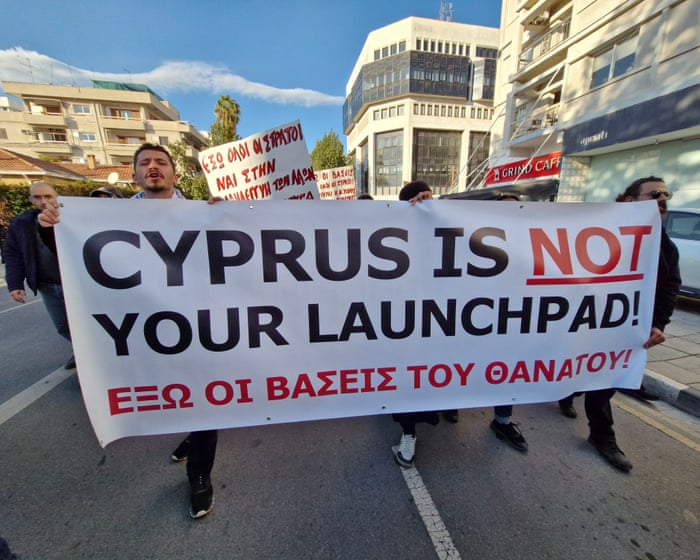
Anger over the bases spilled onto the streets of Nicosia on Saturday, where protesters chanting “out with the bases of death” marched to the colonial-era presidential palace. Many fear the Mediterranean nation could be drawn into the broader conflict with Iran.
“They are a danger to our security and should never have been here in the first place,” said Mathaios Stavrinides, criticizing bases established as part of the island’s negotiated independence deal. “We want them closed.”
This growing opposition comes as Cyprus’s Foreign Minister, Constantinos Kombos, told the Guardian that the Iranian-made drone which struck the airbase was launched from Lebanon—home to the Iranian proxy group Hezbollah and units of the Islamic Revolutionary Guard Corps. Less than 12 hours after the explosive-laden device hit the base late Sunday, two other combat drones were intercepted off the island’s coast, also deployed from Lebanon, 150 miles to the east.
“Right now it’s a fact that we have to be looking towards the Lebanese front,” said Kombos, confirming the drones’ origin for the first time. “We cannot exclude anything from the broader direction of the north-east. We have to be very careful … we have to make sure that the systems in place are covering all possibilities of threat.”
Cypriot officials, who pride themselves on the island’s neutrality and humanitarian role as the EU’s closest state to the Middle East, insist it is the British bases—not the republic itself—that have been targeted since the onset of the US-led offensive against Iran. They say Nicosia repeatedly raised concerns about threats to the facilities in talks with London starting last year, but these warnings went unheeded.
RAF Akrotiri is the UK’s primary forward-operating base for Middle Eastern missions and is widely considered the most strategically important territory Britain retained in 1960, when it kept 3% of the island’s land in exchange for granting independence.
“We’ve consistently communicated that the bases could be a target if things move in a specific direction regionally,” Kombos said. “This is a concern we shared consistently … but the outcome of those conversations is clear in terms of what transpired on Sunday night.”
He added that it was evident “not everything that could be done was done to the level of expectations that we have, that people living and working in the bases, Cypriots, also have, and I’m sure the British government has as well … but, right now, I want to focus on how the cooperation improves.”
Kombos noted that the swift deployment of warships and air assets from several European states—military support requested by Cyprus—would help strengthen the defense of the installations.The UK has also supplied air defense systems, including Royal Navy Wildcat helicopters capable of neutralizing aerial threats, in addition to the “extra fast” F-35 fighter jets deployed last month. However, many view this deployment as too little, too late.
The destroyer HMS Dragon, currently undergoing repairs and refitting in Portsmouth, is not expected to arrive off the coast of Cyprus until the week after next.
“We don’t just want to stockpile assets. We want assets that are useful,” said Kombos. He added that defense plans are being implemented with a whole-of-Cyprus approach, rather than focusing solely on military facilities in UK sovereign territory.
Although the protective cordon established around the island is unprecedented, Kombos stated that his government will continue to push for NATO membership, a move long obstructed by Turkey’s opposition.
“In the meantime, we are trying to ensure we have the capacity to link up with NATO systems and structures as much as possible for a non-member,” he said.
Amid the worst security crisis since 1974—when an attempt at union with Greece prompted Turkey to invade—President Nikos Christodoulides has insisted that Cyprus has no intention of becoming involved in any military operation. He also stated that “nothing is ruled out” when asked about the future of the British facilities.
Late on Friday, Cypriot Defense Minister Vasilis Palmas revealed that the Shahed-like drone managed to go undetected and penetrate RAF Akrotiri because it was flying “at an altitude of 1,000 meters and at a speed of 90 to 100 miles per hour”—too low and too fast to be easily picked up by radar.
Anger over the bases has been fueled not only by lingering resentment over what are seen as remnants of the colonial empire but also by shifting accounts of what exactly happened at RAF Akrotiri.
Stavrinides, holding a giant banner that read “Cyprus is not your launch pad,” said: “First we’re told it hit a runway, then there are pictures of a destroyed hangar—a hangar we later learn is used by American military assets, specifically U-2 spy planes stationed there. It’s lie after lie. Anything they tell us we have to take with an ocean of salt, and that’s why these protests will continue.”
Frequently Asked Questions
Of course Here is a list of FAQs about the pressure on the UK to withdraw its military bases from Cyprus designed to be clear and conversational
Beginner General Questions
1 Why does the UK even have military bases in Cyprus
The UK has maintained two Sovereign Base Areas on Cyprus since the island gained independence in 1960 They were kept under UK sovereignty as strategic military outposts for British and allied forces in the Eastern Mediterranean and Middle East
2 Where exactly are these UK bases located
The two areas are the Akrotiri base and the Dhekelia base They are not part of the Republic of Cyprus and are British sovereign territory
3 Why are local communities pressuring the UK to leave now
Pressure has existed for years but its increasing due to several factors environmental damage from base activities land disputes noise pollution from aircraft and a growing sense that the colonialera arrangement is outdated Recent geopolitical events have also intensified military activity affecting daily life
4 Isnt Cyprus an independent country How can the UK just have part of it
Yes the Republic of Cyprus is independent The SBAs are a unique holdover from the colonial period established by the treaties that granted Cyprus independence The UKs right to the bases is rooted in these international agreements
Intermediate Impact Questions
5 What are the main complaints from the communities living near the bases
Common complaints include
Environmental Harm Concerns about pollution damage to protected wildlife habitats and the impact of livefire exercises
Land Property Disputes over land that was historically used by Cypriots but is now within the SBA boundaries
Noise Disruption Frequent and loud lowflying aircraft and military exercises disturb residents and tourism
Sovereignty A symbolic and political objection to foreign military presence on their soil
6 What does the UK say in its defense
The UK argues the bases serve vital