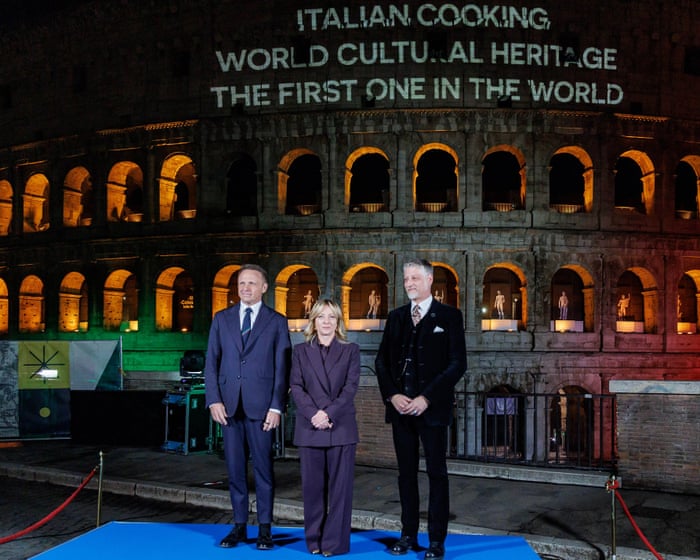
Italy’s cuisine has now been added to UNESCO’s list of intangible cultural heritage, a decision met with the kind of nationwide joy usually reserved for an unexpected World Cup victory or the resignation of a disliked prime minister. This wasn’t because the world needed approval to enjoy pizza—it clearly didn’t—but because the news eased a long-standing national annoyance: France and Japan, recognized in 2010 and 2013, had gotten there first. For Italy’s culinary patriots, this had become a constant, nagging reminder that others had been acknowledged before them.
Yet the strength of Italian cuisine has never relied on an ancient, unified culinary tradition. Much of what is considered age-old “regional tradition” was actually pieced together in the late 20th century, largely for tourism and domestic comfort. The true history of Italian food is one of upheaval: a story of hunger, improvisation, migration, industrialization, and raw survival instinct. It is not a serene lineage of grandmothers, sunlit tables, and recipes set in stone. It is more like a national dash away from starvation—not quite the image Italy chose to present to UNESCO.
To make matters worse (or better, depending on your sense of humor), the “Italian” cuisine that won over the world was not what Italians brought with them when they emigrated. They had no such cuisine to bring. Those who left Italy did so because they were hungry. If they had daily access to tortellini, lasagna, and bowls of spaghetti as later imagined, they would not have boarded ships for New York, Buenos Aires, or São Paulo to face discrimination, exploitation, and even lynching. They arrived abroad with a handful of memories and a deep desire to never eat bad polenta again.
And then something miraculous happened: they encountered abundance. Meat, cheese, wheat, and tomatoes in quantities unimaginable in the villages they had left. Faced with ingredients they had never seen together in one place, they invented new dishes. These creations—not ancient recipes—are what later returned to Italy as “tradition.” In short: Italian cuisine did not migrate. It was invented abroad by people who had finally found enough to eat—a truth that sits awkwardly with UNESCO’s appreciation for thousand-year-old continuity.
But the most decisive change happened not abroad, but at home, during Italy’s astonishing economic boom between 1955 and 1965. In that decade, the country underwent a culinary transformation akin to a religious conversion. Refrigerators appeared in kitchens, supermarkets replaced corner shops, and meat was no longer a luxury. Families who had long measured cheese by the gram discovered, with a mix of disbelief and guilt, that it could be bought whenever they wanted. What the world sees as Italy’s timeless culinary confidence is, in reality, the lingering glow of that moment. Italians did not inherit abundance. They stumbled into it, slightly bewildered, like people walking into the wrong movie theater and deciding to stay.
This context makes Italy’s current wave of culinary protectionism particularly surreal. We hear stern warnings against “globalist contamination” from politicians who grew up eating industrial panettone and Kraft singles in their school sandwiches. We are told that Italian cuisine must remain pure, fixed, and untouchable—as if purity had anything to do with our past. Italian food is a master of adaptation. It has always survived by borrowing, absorbing, and reinventing. The Darwinian logic is embarrassingly simple: the cuisines that change are the ones that endure. Yet protectionist rhetoric insists on freezing everything in place, as if the national menu were a snow globe.
Of course, the British have played a part. Britain has nurtured its own affectionate fantasy of Italy: eternal sunshine, tomatoes that taste like childhood holidays, and families who spend hours eating together as if auditioning for a commercial. Television personalitiesFigures like Stanley Tucci have refined this fantasy into a polished export—the boisterous, endearing Italian sweeping into your kitchen to save you from bland British food. It’s entertaining, it sells, and it bears as much resemblance to Italian history as Mamma Mia! does to the Greek economy.
This British fantasy aligns perfectly with Italy’s own instinct for mythmaking. For centuries, Italians were hungry—not in a poetic or metaphorical sense, but literally. Pellagra, starvation, and malnutrition formed the true foundations of Italian “tradition.” Precisely because the past was so harsh, modern Italians felt driven to construct a golden myth of themselves: one where the grandmother is an oracle, the tomato a sacred relic, and “tradition” a timeless, serene truth rather than a post-1960s reinvention.
So what did Italy actually present to UNESCO? The real story of its cuisine, forged by hunger, migration, innovation, and sudden prosperity? The glossy tourist-brochure version, lit like a Netflix travel show? Or—stranger still—what some promoters called “the relationship Italians have with food,” described in the breezy language of airport psychology? A heritage not of recipes, but of feelings; conveniently vague, pleasantly flattering, and not entirely disprovable.
The first version would have deserved recognition. The second trivializes it. The third turns heritage into national therapy.
Italy did not need UNESCO to feel important. It needed to move past the insecurity that a cuisine only has value when stamped by an outside authority. Instead, the country reached for the certificate, not the substance. And so we have preserved a living cuisine like a museum piece, framing it just as it continues—thankfully—to evolve in real homes, restaurants, and workplaces.
This is the paradox worth remembering. The world already loves Italian food, but often loves a version shaped by television, tourism, and decades of gentle mythmaking. Italians rarely resist the myth—it is flattering and profitable—but myths make fragile foundations for a UNESCO bid. Because in the end, what Italy submitted was not its history, but a postcard: beautifully composed, carefully lit, and designed to please.
And like all postcards, it risks being forgotten in a drawer, while the real story of Italian cuisine—restless, inventive, and gloriously impure—carries on elsewhere.
Alberto Grandi is the author of La Cucina Italiana Non Esiste and a professor of food history at the University of Parma.
Frequently Asked Questions
Of course Here is a list of FAQs about the myth versus reality of traditional Italian cuisine designed to sound like questions from curious readers
Beginner General Questions
Q What do you mean by the myth of Italian cuisine
A Its the idea of a single ancient unchanging Italian food tradition passed down through generations The myth often includes stereotypes like spaghetti and meatballs being eaten everywhere in Italy or that all Italian food is simple and only uses a few ingredients
Q Isnt pasta and pizza what Italians eat every day
A While pasta is a staple the daily diet is incredibly regional and seasonal Many traditional meals feature soups risottos polenta vegetables legumes and smaller portions of meat or fish Pizza is often a weekly treat not an everyday meal
Q Whats the biggest misconception about Italian food
A That its one cuisine Italy was unified as a country only in 1861 and its regions have distinct food cultures shaped by local geography history and available ingredients Food from Sicily is vastly different from food in Lombardy
Q Are dishes like Fettuccine Alfredo or Spaghetti Bolognese actually Italian
A Not as served abroad Fettuccine Alfredo was a simple Roman dish of butter and cheese now heavily adapted in the US An authentic Bolognese sauce is a slowcooked meat sauce typically served with tagliatelle not spaghetti and contains little to no tomato
Q Is olive oil used for cooking everything in Italy
A No While extra virgin olive oil is crucial for finishing dishes many northern regions historically used butter lard or other fats for cooking due to the climate and local agriculture
Advanced Detailed Questions
Q How did ItalianAmerican cuisine create this myth
A Italian immigrants adapted their regional recipes to available ingredients and American tastes creating new hearty dishes These ItalianAmerican creations were then exported back to the world as Italian overshadowing the originals
Q Whats an example of a traditional dish thats actually quite modern
A