A combination of tropical cyclones and heavy monsoon rains has devastated large areas of Asia, killing over 1,100 people—a number expected to rise—and leaving many more homeless.
A convergence of three tropical weather systems, including a rare cyclonic storm that formed in the Malacca Strait, has driven intense wind and rain over the past week. This has caused severe flooding and mudslides across parts of Indonesia, Malaysia, Thailand, and Vietnam.
Indonesia has been especially hard hit by flooding, with 604 people killed and 464 missing. Nearly 300,000 people have been displaced, and almost 3,000 homes damaged, including 827 that were destroyed or washed away.
On the island of Sumatra, videos shared on social media showed people navigating collapsed barricades, flooded roads, and broken glass to obtain food, medicine, and fuel.
Cyclones rarely form near the equator because the Earth’s rotational forces there are too weak to set them spinning. However, Cyclone Senyar developed just north of the equator in the Malacca Strait last week.
Indonesia’s meteorology agency called Senyar a “rare” event, though such occurrences have become more frequent over the past five years. “Indonesia’s location near the equator theoretically makes it less prone to the formation or passage of tropical cyclones,” said Andri Ramdhani of the agency.
Two other storms have added to the destruction: Typhoon Koto caused severe flash floods in the Philippines before approaching Vietnam, while Cyclone Ditwah ravaged Sri Lanka.
In Sri Lanka, floods and landslides have killed 355 people, with 366 missing. The country’s disaster management centre reported that over 1.3 million people have been affected by the record rainfall.
This is the worst extreme weather event to strike Sri Lanka in twenty years. Officials noted that the full extent of damage in the hardest-hit central region is only now becoming clear as relief workers clear roads blocked by fallen trees and mudslides.
Thousands of police and military personnel are distributing food, clearing roads, and evacuating trapped families. Nearly 148,000 people have been displaced and are staying in temporary shelters.
Tropical cyclones are powerful rotating storms that bring heavy wind and rain. The strongest ones in the Caribbean or North America are called hurricanes, those in East Asia are often termed typhoons, and those in the Indian Ocean (like Ditwah) are known simply as cyclones.
Monsoons are shifting seasonal wind patterns that can bring significant rainfall.
Human-caused climate change has increased the frequency of the most intense and destructive tropical cyclones, although the total number each year has not changed globally. Warmer oceans provide more energy, fueling stronger storms. Across most of the world, extreme rainfall has also become more common and intense due to human-driven climate change.
Sri Lanka’s President, Anura Kumara Dissanayake, declared a state of emergency to address the disaster and pledged to rebuild with international support. “We are facing the largest and most challenging natural disaster in our history,” he said in a national address. “Certainly, we will build a better nation than what existed before.”Heavy rainfall hit Kaduwela on the outskirts of Colombo on November 29. In nearby Wellampitiya, an elderly man was carried through a flooded street. While the rains have subsided across Sri Lanka, low-lying areas of the capital, Colombo, remained flooded on Sunday, prompting a major relief operation as residents waded through submerged neighborhoods.
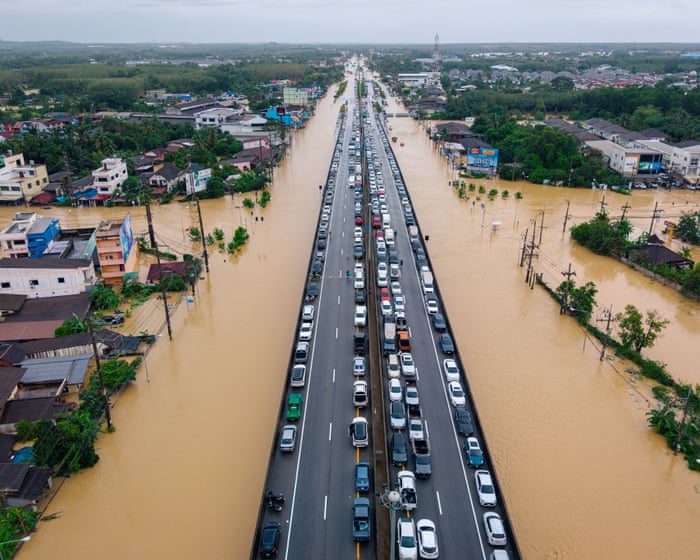
In Thailand, the ministry of public health reported 170 deaths following some of the worst flooding in a decade. In Hat Yai, two boys looked at a car surrounded by high floodwaters. Authorities are delivering aid and clearing damage, offering compensation of up to 2 million baht (£47,000) to households that lost family members. However, public criticism of Thailand’s flood response is growing, leading to the suspension of two local officials over alleged failures.
In Vietnam, rains from Typhoon Koto killed three people after two boats sank amid strong winds and high seas along the flood-hit central coast. Heavy rains have lashed central areas in recent weeks, flooding historic sites and popular holiday destinations, causing hundreds of millions of dollars in damage. The weather bureau forecasts further rains of up to 150mm (6 inches) on Tuesday and Wednesday in regions just recovering from historic floods.
In Malaysia, two people were killed after floods submerged stretches of northern Perlis state. Approximately 18,700 people remain in evacuation centers, according to the national disaster management agency.
This report includes information from The Associated Press, Agence France-Presse, and Reuters.
Frequently Asked Questions
Frequently Asked Questions Asias Cyclone Monsoon Devastation A Visual Guide
BeginnerLevel Questions
1 Whats the difference between a cyclone and the monsoon
A cyclone is a specific powerful storm system with intense winds and rain that forms over warm ocean waters The monsoon is a seasonal shift in wind patterns that brings a long period of widespread heavy rains to a region Think of a cyclone as a single violent event and the monsoon as a rainy season
2 Which parts of Asia are most affected by these disasters
South Asia Southeast Asia and parts of East Asia are frequently and severely impacted
3 What kind of damage do these events cause
The damage is often catastrophic and includes widespread flooding destructive winds that tear apart buildings deadly landslides in hilly areas contamination of drinking water destruction of crops leading to food shortages and displacement of millions of people from their homes
4 Why does flooding get so bad
Heavy rainfall from cyclones and monsoons overwhelms rivers and drainage systems In many urban areas rapid development and concrete surfaces prevent water from soaking into the ground Deforestation in upstream areas also reduces the lands natural ability to absorb water
5 How can I help people affected by these disasters
The most effective way is to donate to reputable international relief organizations that are already on the ground providing emergency shelter clean water food and medical care
Advanced Practical Questions
6 How is climate change making these events worse
A warmer atmosphere holds more moisture leading to more intense rainfall during both cyclones and monsoon seasons Warmer ocean waters can also fuel stronger and more frequent cyclones Rising sea levels worsen storm surges pushing seawater further inland during coastal cyclones
7 What are storm surges and why are they so dangerous
A storm surge is a rise in sea level caused primarily by a cyclones winds pushing water ashore Its often the deadliest part of a cyclone as it can create walls of seawater that inundate coastal communities with little warning causing massive flooding and drowning